




Rotate Rings review
 Analysis by Appsdrops
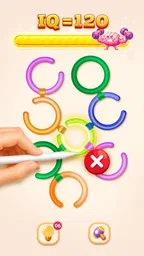
Some puzzle games ask for long stretches of concentration; Rotate Rings is better suited to the small gaps in a day. I find its central idea appealing because it turns a simple action—rotating rings—into a quiet logic exercise that can be picked up without a big commitment. It is a free puzzle game from Nebula Studio, and its promise is not spectacle but a calmer way to keep the mind occupied.
What the ring-rotation idea feels like
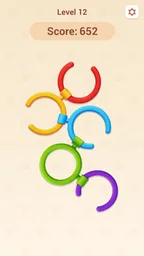
The appeal rests on looking at a puzzle, considering how its rings relate, and deciding which rotation might bring the arrangement closer to a solution. That makes the game a natural fit for players who enjoy visual reasoning more than rapid reactions. I would reach for it when I want something to think about without starting a story, managing a collection, or competing against a clock.
That simplicity is also a constraint. If you prefer puzzles with lots of distinct mechanics, a growing narrative, or elaborate levels, the ring-based concept may feel narrow after a while. Rotate Rings is most compelling when you enjoy working through one visual problem at a time and are happy for the pleasure to come from the solving itself.
How quickly it fits into a break
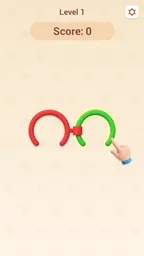
The basic interaction sounds easy to understand: rotate rings and reason about the result. That should make the game approachable for a brief pause, while still leaving room to think carefully instead of tapping at random. I especially like this kind of puzzle for a waiting room or a quiet moment between tasks, when a complicated game would be more effort than entertainment.
There is an important distinction between a quick start and a quick solution. A puzzle can be simple to enter yet still ask for patience once the pieces stop lining up as expected. I would treat Rotate Rings as a short-session option, not assume every puzzle will be solved in seconds. If you are looking for an immediate burst of action, its deliberate logic focus is a different kind of pace.
For a more useful first attempt, I recommend watching what changes after each rotation rather than making several moves in a rush. Keeping track of one ring’s position at a time can help you spot patterns and avoid losing the arrangement you were trying to understand. This is a practical way to make a small puzzle feel less like guesswork, especially if you put the game down and return later.
When a puzzle takes longer than expected
Heavier use is less about demanding controls and more about mental repetition. If I play several puzzles in a row, the same visual language could become tiring, even when each individual challenge is pleasant. I would alternate a focused stretch with a break rather than expect the game to provide the changing pace of a collection with many puzzle types.
A useful personal workflow is to pause when rotations stop producing new insight. Instead of repeating the same move sequence, I would reset my attention by looking at the whole arrangement and identifying what seems out of place. That kind of deliberate pause is a strength for a logic game: it encourages reasoning over frantic tapping. It can also be a limitation for anyone who wants the game to keep supplying variety without needing a change of activity.
The game can suit a commute or another offline moment, since it is described as supporting offline brain training. That makes it a reasonable choice when connectivity is uncertain, but I would still think of it as a self-contained activity rather than a social or competitive companion. If your ideal puzzle session depends on sharing progress or comparing results, another kind of game may serve you better.
Reliability and the feel of returning
I judge a casual puzzle partly by how little ceremony it seems to require. Rotate Rings has a focused premise, which is promising for returning to a problem after a short interruption: the central task is still to inspect and rotate, rather than remember a complex set of systems. The current version is 1.1.6, but a version number alone is not a guarantee of how smoothly it will behave on every device.
In practical terms, I would avoid making assumptions about long-term progress or recovery from an interrupted session. A sensible approach is to finish a puzzle before switching apps when possible, and to make a mental note of the arrangement if you need to step away. That advice is not a claim that the game loses progress; it is simply a useful habit for any compact logic challenge when you want to resume without frustration.
Its broad audience rating is Everyone, so the concept is suitable to consider for a shared household device, though the best fit still depends on the player’s taste. Younger players who like visual patterns may enjoy the straightforward premise, while adults looking for a low-pressure mental break can use it in much the same way. The puzzle format may be less engaging for someone who needs sound, story, or frequent novelty to stay interested.
Device fit and value before installing
The minimum operating-system requirement is 7.1, which gives prospective players a concrete compatibility point to check before downloading. I would also keep expectations modest about resource demands: a ring-rotation puzzle sounds less graphically intensive than a large action game, but the premise does not establish how much battery, storage, or memory it uses in practice. If your device is older or nearly full, checking available space and testing a short session is more sensible than assuming it will be effortless.
The game is free to download, with in-app purchases ranging from $0.99 to $9.99 per item. That is worth knowing if you prefer games with no optional spending at all. I would start with the free experience and decide whether the puzzle loop is genuinely enjoyable before considering any purchase. The existence of paid items does not by itself tell me what they provide, so I would not treat them as necessary to enjoy the central idea.
There is some reassurance in its scale: Rotate Rings has passed 10 million installs, with an average rating of 4.8 from around 262,000 ratings and roughly 2,300 written reviews. Those figures suggest that many players have found the concept appealing, but popularity cannot tell you whether its particular rhythm suits you. The more useful question is whether you like patient, spatial problem-solving enough to return to the same core interaction.
How it compares with other puzzle choices
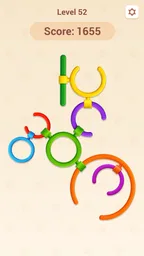
Compared with word puzzles, this game asks you to reason visually rather than search for vocabulary. Compared with match-style games, it sounds less dependent on clearing a board through quick pattern matching and more focused on how rotations affect a connected arrangement. That difference gives it a clear niche: choose it when you want a quiet spatial challenge, not when you want a broad catalogue of mechanics or a stream of changing objectives.
It may also be a better fit than a fast arcade puzzle when you want to play without feeling rushed. On the other hand, if you enjoy timed rounds, escalating action, or a strong sense of progression, the restrained premise may not hold your attention. I would choose Rotate Rings for a calm pause and pick a more varied puzzle collection for a longer session where novelty matters more than a consistent central mechanic.
Who I would recommend it to
I would suggest Rotate Rings to someone who likes visual logic, wants an easy game to revisit in short bursts, or needs an offline-friendly activity for a quiet moment. A realistic use case is waiting for an appointment: play a puzzle, stop when your name is called, and come back when there is another gap. The straightforward ring-rotation focus is its strongest reason to try it.
I would steer away from it if you are looking for multiplayer competition, a story-led campaign, or a puzzle game that continually changes its rules. It is also not my first pick for someone who gets bored when a game returns to one central idea. In that case, a varied puzzle bundle is likely a better use of your time, even if its individual challenges are less focused.
My performance verdict
Developed by Nebula Studio, Rotate Rings has the ingredients of a low-pressure puzzle companion: a clear visual task, an offline-friendly angle, and a free starting point. I would expect its pace to feel more thoughtful than demanding, though I would not promise particular loading speeds or flawless behavior across devices. The best test is a short session on your own phone, especially if compatibility or battery use matters to you.
Overall, I see it as a focused choice rather than an all-purpose puzzle game. Its appeal is strongest when you want to reason through ring positions at your own pace, and weaker when you need variety, urgency, or a deeper progression system. With the current version at 1.1.6 and an Everyone age rating, it is easy to consider for a casual trial; just remember that optional purchases are available and that the core concept may not suit every puzzle fan.
My recommendation is simple: give it a try if a calm visual challenge sounds more inviting than another fast-moving game. I would keep it as a small, convenient option for spare moments, not as the only puzzle app on a device. That expectation makes its narrow focus feel like a deliberate strength instead of a promise of endless variety.
What we like
- Simple controls make the game easy to pick up.
- Quick rounds suit short play sessions.
- Ring rotation adds a clear spatial challenge.
- The basic objective is easy to understand.
- Progress depends on timing and planning.
What could be better
- Later stages may feel repetitive.
- Precise timing can be frustrating.
- The challenge may rise sharply.
- There may be little variety between levels.
- The simple gameplay may not hold attention for long.







