



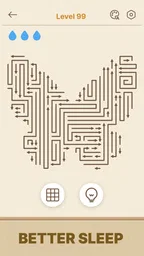
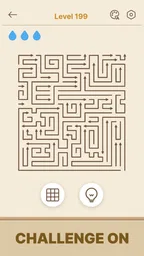


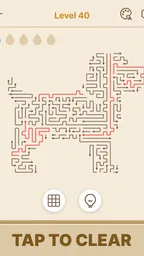
Amaze GO! review
 Analysis by Appsdrops
I’d choose Amaze GO! when I want a small puzzle to focus on, not a sprawling game that asks me to learn a world, manage a collection of tools, or keep up with a long story. Its appeal is in the simple premise of clearing a board with taps; the real question is whether that kind of compact brain teaser is what you want to spend a few spare minutes on. As a puzzle game from Oakever Games, it is easy to understand at a glance, but a clear premise does not automatically make every puzzle satisfying. I’d approach it as a casual way to exercise attention and think through a board, rather than as a deep strategy game.
Choosing the right kind of puzzle
Before downloading, I’d decide what I want from a puzzle game. If I enjoy looking at a layout, considering what a tap will change, and working toward a cleared board, Amaze GO! sounds like a natural fit. If I’m after a narrative, a large set of mechanics to master, or competition with other players, this is probably not the first kind of game I’d pick. Its store summary points to board-clearing brain puzzles, so the central draw is the act of solving, not an elaborate premise around it.
That distinction matters in everyday use. I can imagine opening it while waiting for a friend, taking a short break between tasks, or settling into a brief puzzle session before putting my phone away. A board-based challenge can make a few idle minutes feel more purposeful than scrolling, while still being easier to leave than a game built around long missions. I’d treat it as a focused pause, not assume that every session will be equally quick or that every puzzle will yield to the first idea.
The game is free, and its age rating is Everyone, which makes trying it a fairly straightforward decision for a broad audience. Free does not mean every player will enjoy the style, though. I’d install it because the basic puzzle loop appeals to me, not because I expect the absence of a purchase price to guarantee a perfect match. If you prefer games where progress comes from a story or from building a character over time, the core appeal here may feel too narrow.
What the board-clearing format asks of you
A tap-based board puzzle rewards deliberate attention more than speed. My practical advice is to pause before acting and inspect the whole arrangement, rather than tapping immediately wherever a move seems obvious. In games centered on clearing a board, the visible result of a move can matter as much as the move itself: an easy-looking tap may leave a less convenient layout, while a moment spent surveying the board can make the next choice clearer. That habit is useful even when a puzzle is designed to be approachable.
I’d also avoid treating every board like a test of raw intelligence. If I get stuck, I’d first look for a pattern I overlooked, then change my approach instead of repeating the same tap sequence. This is a concrete way to make the game more rewarding: slow down, identify what the board is asking, and use each move with a reason. It helps turn a simple interface into a small exercise in planning, without pretending the game is a complex strategy simulator.
That restrained format is one of its strengths and one of its limits. It keeps the focus on the puzzle in front of me, which is welcome when I have limited time or don’t want to memorize a collection of controls. But players who need every level to introduce a new mechanic, or who want a strong sense of progression outside the puzzle itself, may find the premise repetitive. I would judge it by whether I enjoy solving the next board, rather than by expecting a broader game structure that its central idea does not promise.
Where Amaze GO! makes the most sense
For me, the best use case is a short, self-contained break when I want to pay attention to something without committing to a long session. A commuter waiting for a connection, someone taking a breather after finishing a task, or a puzzle fan who likes to reason through a compact board could all find a good reason to try it. The format also suits people who enjoy keeping their phone games simple: open the puzzle, work out a solution, and decide whether to continue.
There is a useful difference between a game that occupies time and one that gives that time a clear focus. Amaze GO! is positioned around solving, so I would use it when I want a small mental challenge rather than background entertainment. If I’m trying to relax with minimal concentration, a soothing game that asks for little planning could be a better choice. If I’m alert enough to study a board but don’t have room for a long campaign, this kind of puzzle sits in a more comfortable middle ground.
One practical tip is to pay attention to your own stopping point. A sequence of puzzles can make it tempting to continue simply because another board is available, but the game’s short-break appeal works best when I set a modest intention: solve one puzzle, or play until the break ends. That approach keeps a casual puzzle from swallowing time I meant to spend elsewhere. It is not a special in-game feature; it is a sensible way to use a pick-up-and-play game without turning a quick pause into an accidental long session.
Another useful trade-off is how much mental effort you want at different times of day. I’d be more likely to open a board puzzle when I can give it my attention than when I’m distracted by conversation or trying to do two things at once. If I repeatedly make careless moves while multitasking, that is not necessarily a sign the game is poorly suited to me; it may simply mean I’m choosing the wrong moment. Conversely, anyone who wants a game that can remain entertaining while barely looking at the screen should consider a less concentrated alternative.
How it compares with other puzzle choices
The puzzle category covers very different moods. Word games ask me to search for language; jigsaws focus on matching visual pieces; logic games may ask me to follow rules across several steps; and physics-style puzzles often invite experimentation with movement. Amaze GO!’s board-clearing premise points toward a more direct, layout-focused kind of thinking. I’d choose it over a word puzzle when I want to reason visually, but I’d choose a word game instead if forming words is the part I find satisfying.
Compared with a long-form logic game, this appears to offer a more immediate entry point: the idea of tapping to clear a board does not require me to first learn a large rulebook. The trade-off is that players looking for layered systems, a campaign, or a puzzle that feels like a sustained project may prefer those alternatives. I wouldn’t call one style better in every situation. The right choice depends on whether you want an approachable board challenge or a deeper structure that rewards extended attention.
It is also worth separating a puzzle’s accessibility from its difficulty. A simple interaction can still require careful thought, but I would not download Amaze GO! expecting a particular difficulty curve or a specific kind of challenge on every board. The best way to decide is to ask whether the act of considering taps and clearing a layout sounds enjoyable to you. If that exact loop does not appeal, a game with a different puzzle language is more likely to hold your interest than one chosen just because it also sits in the puzzle category.
For a more social experience, I’d look elsewhere too. Some players get their strongest motivation from head-to-head play, shared goals, or comparing progress with friends. The appeal described here is centered on solving boards, so I would not pick it as a substitute for a competitive or cooperative game. On the other hand, someone who wants a quiet activity they can approach on their own may prefer not to have social pressure attached to every session.
What the audience response tells me
Amaze GO! has a 4.9 average rating from around 588,000 ratings, and it has passed 100 million installs. Those figures suggest that its straightforward puzzle approach has found a broad audience, which is reassuring if you are unsure whether a tap-to-clear concept can hold attention. They are a reason to consider trying it, not proof that it will suit every puzzle fan. Ratings cannot tell me whether I personally prefer board-clearing puzzles to word games or whether I want a more demanding strategy experience.
Its rating is also useful as context for a newcomer: this is not an obscure idea with no visible audience. Still, I’d make the decision based on the kind of thinking I enjoy and the role I want a phone game to play in my day. A widely installed casual game can be a poor match for someone who wants a rich narrative, just as a niche logic title can be perfect for the right player. Audience size helps answer “is it worth a look?” more than “will I love it?”
Switching in, updating, and setting expectations
Because it is free and rated for Everyone, the cost of trying Amaze GO! is mainly your time and attention. I’d give it a fair test by playing enough to see whether I enjoy studying the boards, rather than judging it from the premise alone. If that rhythm clicks, it can earn a place among the small games I keep for spare moments. If I find myself wanting more story, social play, or variety in the underlying puzzle rules, switching to another category is a reasonable choice, not a failure to understand this one.
The current version is 1.38.0, and the game’s minimum operating-system requirement is Android 7.1. Those details are useful when checking whether it fits an Android device before installing. If you play on a different platform, I’d check the relevant app store for compatibility there rather than assume the same requirements apply. In either case, it is sensible to make sure the device has enough room and that you are comfortable using the store account associated with your phone before you begin.
One detail that can help set expectations is the scale of the written feedback: the game has about 9,500 reviews. I’d use that alongside the much larger rating total as context, while remembering that short store reviews rarely explain whether a player wants the same things I do. When deciding, focus on comments that describe the actual puzzle experience—how people feel about the board challenges and their pace—rather than broad reactions that could apply to almost any casual game.
Oakever Games is the developer behind the title. That is worth knowing if you are comparing it with other games from the same creator, but I would still judge this particular game on its own. The decision is not about the developer name alone; it is whether this specific board-focused style gives you the kind of mental break you are after.
My recommendation
I’d recommend Amaze GO! to anyone who enjoys clear, visual puzzles and wants an easy-to-approach game for short breaks. Its strongest case is the direct connection between looking at a board and deciding what to do next. I can see it working well as a low-commitment way to engage my attention while waiting or winding down, especially if I already like solving compact puzzles on my phone.
I would skip it if I mainly want a story-led game, a competitive challenge, or a deep system that keeps adding new kinds of play. I’d also choose something less demanding if I want entertainment that can run in the background while I’m distracted. Those are not flaws so much as clear boundaries: a focused board puzzle has less to offer when the player wants a different kind of experience.
Overall, I think Amaze GO! is worth trying for the right person, particularly because it is free and its premise is easy to evaluate once you start playing. I would go in expecting a focused puzzle activity, not a sprawling adventure, and give myself time to see whether I enjoy thinking through each board. If that small act of planning feels satisfying, it has a practical place in a casual game collection; if you want more narrative or variety, another puzzle style will likely be a better fit.
Its short description calls it “Amaze GO!”, but what matters to me is simpler: whether I want to spend a few minutes making thoughtful taps and clearing a layout. If the answer is yes, this is an easy recommendation to try. If not, I’d save my time for a game whose central pleasure better matches what I want from my phone.
What we like
- Quick access to store offers can make shopping more convenient.
- A simple layout helps shoppers find key features without much effort.
- Digital promotions can help users spot potential savings.
- A mobile account keeps shopping details accessible on the go.
- The app offers a handy alternative to carrying printed coupons.
What could be better
- Some features may depend on your location or participating stores.
- An account may be required to access personalized offers.
- Promotions can change or expire with little notice.
- The app provides limited value for people who shop elsewhere.
- Offer availability may vary across devices or app versions.







