

Royal Match review
 Analysis by Appsdrops
I like puzzle games that make sense before I have time to overthink them, and Royal Match gets to the point quickly: I’m matching pieces, clearing a board, and working toward restoring parts of King Robert’s castle. That simple loop makes it easy to try for a few minutes while waiting for something else. The charm is in the quick burst of problem-solving; the catch is that a short session can turn into several levels before I notice.
Quick puzzles with a clear purpose
Made by Dream Games, Ltd., Royal Match is a free match-three puzzle game for players of all ages. Its castle theme gives the levels a light sense of progression, so the activity is not just clearing one board after another. I found that framing pleasant rather than essential: the puzzle is the main event, while the castle provides a reason to keep going.
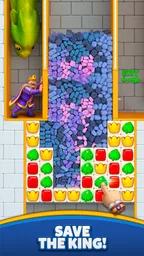
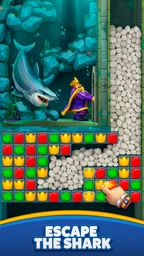
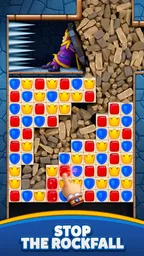
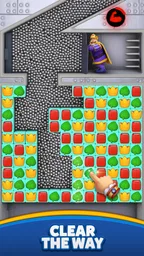
The opening is easy to understand even if you rarely play this kind of game. You scan the board, look for a useful match, and try to meet the level’s objective. There is little setup between deciding to play and making a move, which is exactly what I want when I have only a spare moment. The visual style is bright and tidy, helping the board remain readable instead of making every move feel like a search through clutter.
That clarity matters more than it may sound. In a crowded puzzle board, a colorful effect can be satisfying but also distract from the next decision. Here, I can generally return my attention to the remaining pieces and think about what the objective requires. The most rewarding move is not always the one that makes the biggest splash; it is often the match that opens a useful area or brings the board closer to its goal.
The game has a strong audience already: it has more than 100 million installs, an average rating of 4.6 from around 11 million ratings, and roughly 102,000 written reviews. Those figures do not tell me whether a particular level will suit my taste, but they do suggest that the straightforward format has broad appeal. It is available at no charge to start, with optional in-app purchases ranging from $0.99 to $99.99 per item.
How a session finds its rhythm
Royal Match works best for me when I treat each level as a small, self-contained challenge rather than a commitment to play for a set length of time. The first moves are usually about reading the board: what needs clearing, where can a match make progress, and whether a tempting move will actually help. Once I understand the objective, the pace picks up. That switch from looking to acting gives even a brief session a satisfying shape.
A useful habit is to pause before making an obvious match and check the objective again. A move that clears pieces may look productive without advancing the task that ends the level. I get more value from scanning for matches near the areas that matter than from automatically choosing the first available option. It is a small adjustment, but it makes the puzzles feel more considered and reduces the sense that I am simply tapping through animations.
There is also a practical difference between playing while fully focused and playing with half an eye on the room. When I can concentrate, I enjoy planning a couple of moves ahead. If I am distracted, I can still make progress because the rules are familiar, but I am more likely to miss a better opportunity. For a quick break, that is an acceptable trade: the game does not demand a long tutorial or a complicated strategy before it becomes enjoyable.
For example, if I have a few minutes before an appointment, I can open the game, attempt a level, and stop when I need to leave. I would not choose that moment to chase a long run of wins or spend money in response to frustration. The better approach is to play the puzzle in front of me, then leave the next one for later. That keeps the experience closer to a pleasant interlude than an obligation.
Putting it down and coming back
The simple board format makes Royal Match fairly easy to resume after an interruption. I do not need to remember a complex story or a chain of controls to understand what I am doing. When I return, I can orient myself by checking the objective and the board. That makes it a comfortable choice for stop-and-start play, especially compared with puzzle games whose enjoyment depends on following a long sequence of clues or maintaining a detailed plan.
Still, interruption tolerance is not the same as being completely interruption-proof. If I am in the middle of thinking through a level, a message or a conversation can break my concentration. When I come back, I may no longer remember which match I was saving for later. I recommend treating any pause as a fresh look at the board: reassess the objective instead of trusting a half-remembered plan. That habit is more reliable than trying to preserve every thought from before the interruption.
The castle progression helps give repeated play a destination, but it does not change the basic appeal of the moment-to-moment puzzle. If I enjoy matching and clearing boards, the surrounding theme adds a pleasant reason to continue. If I want a story-heavy adventure, the castle alone should not be mistaken for that kind of experience. The main reason to stay is still the satisfaction of solving another level.
Royal Match is rated for Everyone and was released on February 25, 2021. Its current version is 40220, and it requires Android 7.0 or later. Those details make it straightforward to assess as a casual mobile game, though the fit still depends on whether a bright, repeatable puzzle loop is what you want. I would not recommend it to someone looking for a deep tactical game or a puzzle experience built around unusual rules and constant novelty.
Replay value, repetition, and spending choices
Replay value comes from having another board to solve and from the small variation in how a familiar matching task unfolds. I enjoy returning when I want a quick mental reset: the rules are easy to recall, but the arrangement and objective give me something to work out. This is a different kind of replay appeal from a word game, where vocabulary is the focus, or a logic puzzle, where a single solution can take sustained quiet. Royal Match is more immediate and tactile.
The trade-off is that the core activity remains recognizably the same. If I need every level to introduce a radically different mechanic, the steady match-and-clear rhythm may become repetitive. The castle theme softens that repetition, but it cannot erase it. I would choose a more varied puzzle collection if I wanted to switch between several kinds of brainteasers in one sitting; I would choose this game if I wanted one familiar format that is easy to pick up again.
Because the game is free to begin and includes optional purchases, I think it is worth deciding in advance how I want to handle spending. The listed items range from $0.99 to $99.99, a wide span that makes it sensible to check the purchase details before confirming anything. I do not see a purchase as necessary to understand the basic appeal: the central draw is solving the boards. If I were tempted to buy something after a frustrating attempt, I would take a break first and decide later rather than letting one difficult moment make the choice for me.
Another useful way to keep the experience enjoyable is to set a natural stopping point. I might finish the level I am on, then close the game instead of treating every available moment as an invitation to continue. That is especially helpful when the immediate pleasure of a quick win makes “one more” feel automatic. The game is well suited to short sessions, but it is up to me to keep those sessions short when that is what my day allows.
Who I’d recommend it to
I would suggest Royal Match to a friend who likes clear goals, colorful boards, and puzzles that can fit around everyday interruptions. It is particularly suitable for someone who wants a familiar match-three game with a castle theme and a reason to keep moving through levels. It also works for players who are new to mobile puzzles and want to understand the basic activity without first learning a complicated control scheme.
I would steer a friend elsewhere if they dislike repetition, prefer games that can be completed without optional purchases being part of the surrounding experience, or want an absorbing story to follow. Someone who enjoys slower, more deliberate logic challenges may find this loop too quick and visually lively. And if you are trying to avoid spending entirely, the free starting point is useful, but it is still wise to keep purchase settings and personal limits in mind.
My verdict is that Royal Match earns its place as an easy-to-return-to puzzle game, not because every session is profound, but because the basic pleasure is immediate and the objective is easy to grasp. I like it most as a brief break: check the board, make a thoughtful match, and see whether I can clear the goal. Its best quality is that it asks little of my setup time while still giving me a real puzzle to solve; its main limitation is that the same familiar rhythm will not satisfy anyone who needs constant reinvention.
What we like
- Levels are quick to play during short breaks
- The basic match-three controls are easy to learn
- Team events add a social element to progression
- Renovating rooms gives goals beyond clearing levels
- Boosters can help with especially tricky boards
What could be better
- Lives can run out after repeated failed attempts
- Later stages may require several tries to complete
- Some rewards depend on limited-time events
- Progress can feel slow without frequent play
- Optional purchases may tempt players seeking faster progress







