





Meowdoku: Brain Puzzle Games review
 Analysis by Appsdrops
I like puzzle games that make me slow down and check my assumptions rather than race a timer. Meowdoku: Brain Puzzle Games aims for that kind of thoughtful play: it brings together ideas associated with Sudoku and Minesweeper, then asks you to reason about where cats’ territories belong. That gives its central puzzle a distinctive flavor without asking players to learn a complicated premise first. My main reservation is that this combination will suit people who enjoy careful deduction much more than anyone looking for a fast, action-heavy game.
How the cat-territory puzzle asks you to think
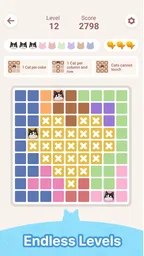
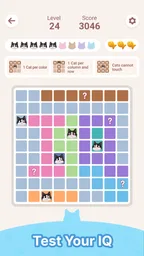
At heart, this is a logic puzzle game from Oakever Games. The Sudoku side suggests structured constraints; the Minesweeper side suggests drawing conclusions from clues and ruling out possibilities. The twist is to use that reasoning to find each cat’s territory. Rather than treating the theme as decoration alone, the game’s identity rests on applying familiar logic to a different sort of board problem.
That blend is appealing if you already enjoy pencil puzzles but have grown tired of solving the same grid in the same way. Sudoku usually has you fill in a number pattern, while Minesweeper asks you to interpret clues around hidden hazards. Meowdoku points toward a different mental task: keep track of which spaces can or cannot belong to a cat, and use the relationships between clues to narrow the answer. The pleasure is less about tapping quickly and more about spotting a deduction you had not noticed.
I would approach a puzzle by separating what I know from what I merely suspect. Start with the clearest clue, mark the spaces it rules out mentally, then look for places where the remaining possibilities become constrained. This kind of disciplined pass is more reliable than guessing based on the cat theme or filling spaces just to see what happens. It also makes mistakes easier to understand: if a later clue conflicts with your conclusion, you can revisit the assumption that led there.
A useful habit is to pause after each deduction and ask what it actually proves. In logic games, a space that seems likely is not necessarily forced. Keeping that distinction clear is especially valuable in a puzzle that draws on the satisfying chain of inference associated with Minesweeper. I find that approach rewarding, but it also means the game may feel less breezy than its cute subject suggests.
Who will enjoy the pace
This is a natural fit for someone who likes to solve a small problem during a quiet break, perhaps with a drink beside them or while waiting for an appointment. A puzzle can give that spare time a focus without requiring the player to follow a story or compete in a live match. I would also recommend it to Sudoku fans curious about a fresh logic framework, and to Minesweeper players who enjoy deduction but want a different theme and set of constraints.
It is less suited to a player who wants constant motion, reflex challenges, or a strong sense of narrative progression. The appeal depends on being willing to look at a board, consider alternatives, and change your mind when a clue points elsewhere. If you find that kind of concentration tiring after work, a simple matching game or a more relaxed word puzzle may be a better fit for that particular moment.
For an everyday example, I would use it as a short mental reset between tasks rather than open it expecting a long, uninterrupted session. If I have only a few minutes, I can work through one local deduction and leave the broader puzzle for later. That works best when I resist rushing: making an unsupported guess can turn a calm puzzle into a frustrating attempt to reconstruct my reasoning.
Free to start, with paid items in the picture
The game is free to download, and its in-app purchases range from $3.99 to $69.99 per item. That is the practical spending context I would keep in mind before installing: you can begin without paying, but purchases are part of the app’s offering. I would treat the free entry point as a chance to decide whether its style of deduction genuinely suits me before spending anything.
Those price points alone do not establish what a purchase includes, whether it changes puzzle access, or whether it affects the solving experience. I would not assume that paying makes the logic easier, that the game requires a purchase to progress, or that any particular item is necessary. If you are careful about spending, check the purchase details in the app store and on the purchase screen before confirming; the listed range is broad enough that an intentional check is sensible.
There is also a small but important distinction between “free” and “no spending considerations.” Meowdoku costs nothing to download, yet it offers optional purchases at several price levels. For a parent or anyone sharing a device, I would make sure purchase confirmation is protected through the device’s normal settings. That is a general precaution around in-app purchases, not a claim about a special payment system in this game.
Progress without turning every puzzle into a race
The available description frames the game around solving logic puzzles, not competing against other players. That is a plus for anyone who prefers to think at their own pace. I would rather take a moment to test a deduction than feel pushed to tap faster, and this concept seems strongest when treated as a reasoning exercise rather than a speed test.
At the same time, a quiet puzzle can still create its own pressure. If I get stuck, I may be tempted to guess simply to move on. My advice is to step back and re-evaluate the board instead: list the possibilities around the most informative clue, then see whether one option contradicts another constraint. That workflow is not a hidden game feature; it is a practical way to get more out of this sort of logic challenge without turning uncertainty into random taps.
One trade-off is that a deduction-focused game can feel demanding when attention is divided. I would avoid starting a tricky puzzle while switching between messages or listening for something important. The same careful reasoning that makes a solved board satisfying can make interruptions costly, because you may lose track of which spaces were proven impossible and which were only tentatively set aside.
Meowdoku is listed at version 1.22.0, and it is intended for devices running Android 7.0 or later. It is rated Everyone, so its audience is broad; that rating does not mean every puzzle will be effortless for every age or skill level. I would still judge suitability by whether the player enjoys logic and can comfortably follow the board, rather than assuming that a family-friendly rating makes the reasoning itself simple.
How it compares with familiar puzzle choices
Compared with standard Sudoku, the main draw is the change in theme and the blend of clue-based deduction with territory placement. If you enjoy Sudoku’s orderly elimination but want a different kind of conclusion to reach, this may feel refreshing. If you want the exact satisfaction of filling rows and columns with numbers, a conventional Sudoku app remains the more direct choice.
Against Minesweeper, the shared appeal is inference: use information on the board to reduce uncertainty instead of relying on luck. The cat-territory idea gives the puzzle a different goal, so it is not simply a reskinned version of finding hazards. Players who love Minesweeper chiefly for its familiar numerical clues may prefer to stay with it; those who like the process of ruling out possibilities may be more open to this variation.
It also differs from casual match-three games, which tend to reward quick recognition and repeated short actions. Meowdoku asks for more deliberate thought, so I would choose it when I want to engage my attention rather than switch it off. On the other hand, if I have only a moment and do not want to hold a chain of deductions in mind, a lightweight arcade or matching game would be the more comfortable option.
What the audience response suggests—and what it cannot settle
The game has a 4.7 average from around 546,000 ratings, with about 15,000 written reviews, and it has passed 10 million installs. Those figures suggest that the puzzle has reached a large audience and is well received overall. They are useful context, but they cannot tell me whether its exact reasoning style will click with you; puzzle preferences are personal, and a strong overall score is not a substitute for trying the game yourself.
Because it is free to download, I see little reason to decide based on popularity alone. The more useful question is whether you enjoy the central activity: studying clues, narrowing possibilities, and finding a consistent arrangement for the cats’ territories. If that sounds satisfying, the premise is specific enough to justify a try. If you mainly want a story, competitive rankings, or action, the audience numbers are unlikely to change the mismatch.
The game was released on Apr 24, 2026. That release detail may matter if you compare it with older puzzle titles, but it does not by itself say anything about how frequently the game changes or what future updates will contain. I would judge the current experience by the puzzle style and the purchase choices visible in the app, not by assumptions about a roadmap.
A sensible way to decide whether to install
My trust verdict is cautiously positive on the purchase terms I can verify: there is a free download, and optional in-app items are listed from $3.99 to $69.99 each. That is enough to understand the broad spending range, but not enough to infer what each item provides or whether any purchase is important for a particular player. I would keep spending optional and make a decision only after seeing the actual item descriptions in context.
The most concrete reason to try Meowdoku is its unusual combination of Sudoku-style structure, Minesweeper-like deduction, and cat territories. The most concrete reason to skip it is equally clear: if you do not enjoy sitting with a logic problem and testing possibilities, a charming theme will not transform that activity into a different genre. I would also pass if I needed a game built around quick reflexes or direct competition.
For puzzle fans, especially those who want a fresh alternative to number grids, I think it is worth trying as a free download and deciding from the solving itself. Give the board your attention, distinguish a forced conclusion from a hunch, and do not spend merely because an option is available. If the moment of seeing how the territories fit together feels rewarding, this is a good match for a quiet break; if it feels like homework, choose a lighter puzzle instead.
What we like
- Quick rounds make it easy to play during short breaks.
- Gradually harder puzzles help keep the challenge engaging.
- The cat theme gives the game a cheerful visual style.
- Simple controls make placing pieces easy to learn.
- Offline play suits travel and places without internet.
What could be better
- Some puzzles may feel repetitive after extended play.
- Later levels can be difficult without a clear hint system.
- Ads may interrupt the flow between puzzle sessions.
- Small pieces can be tricky to place on compact screens.
- Progress may feel slow for players seeking rapid rewards.







