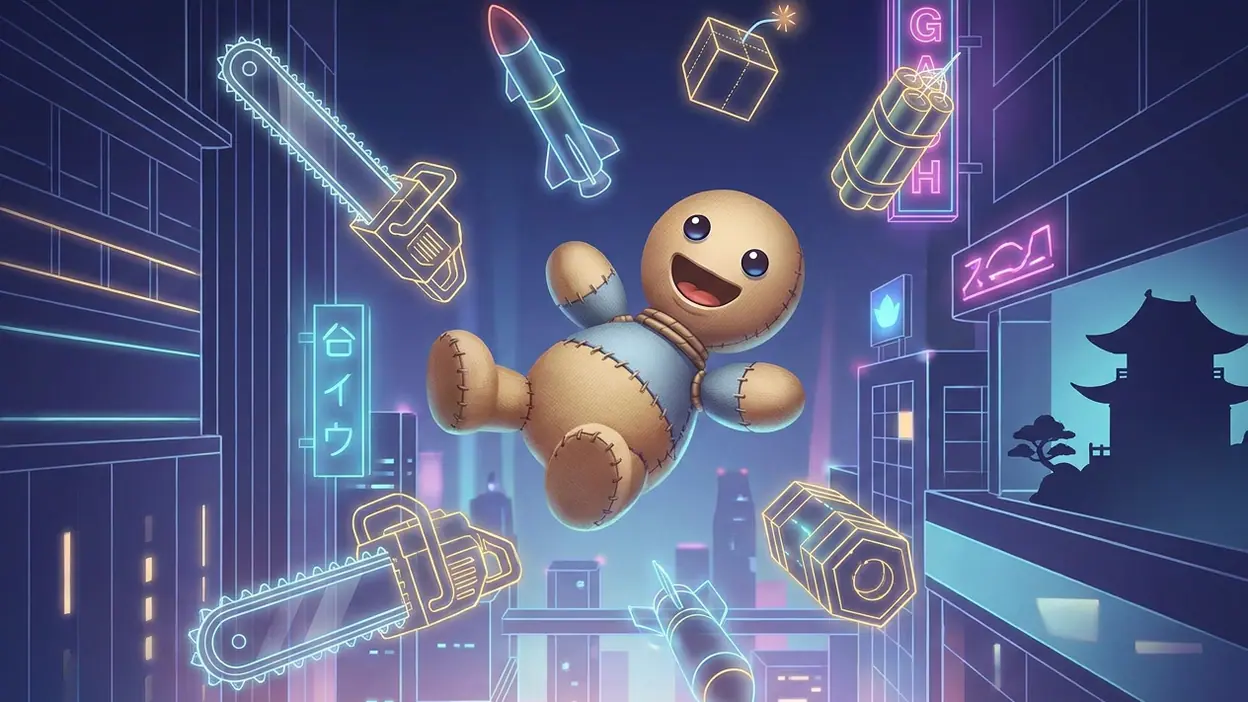
Kick the Buddy Review: Slapstick Stress Relief
 Analysis by Appsdrops
·
Some mobile games ask for your attention; Kick the Buddy-Fun Action Game asks what you would do with a floppy rag doll, a room full of toys, and a few minutes to burn. Its answer is an unruly physics sandbox built around one clear pleasure: make Buddy react, watch the scene tumble into chaos, then try something else. The premise is deliberately silly, but the best version of this game is more than a button to mash. It is a pocket-sized slapstick workshop, and its appeal depends on how much fun you find in making a familiar setup behave in surprising ways.
A simple idea with a strong comic rhythm
Buddy is the whole performance. He hangs around the play space with the loose-limbed vulnerability of a cartoon prop, and every tap, weapon, or environmental hit gives him another way to flop, bounce, and ricochet. The game does not need a plot to explain the joke. You supply the action; Buddy supplies the reaction. That clean division makes the first few seconds immediately legible, even to someone who has never played a physics toy before.
That clarity is the first reason it deserves the spotlight. Many action games begin by asking you to learn a movement scheme, follow a mission, or compete against a clock. Here, there is almost no ceremony. Choose an option, use it, and see what happens. The pleasure is tactile and visual: a hit lands, the rag-doll body swings, and the room turns a basic interaction into a little comic scene. It is not deep in the conventional campaign sense, but it understands that a small game can feel complete when its central action has personality.
The title promises kicking, but the game’s real hook is variety in the reactions. Buddy’s limp animation makes every impact feel slightly different, and the surrounding props help sell the idea that this is a toybox rather than a conventional fighting arena. The screen becomes a stage for quick experiments. A new tool is not just a stronger number; it is a fresh way to puncture the same deadpan setup.
What feels exceptional in the first session
The opening session works because it gets to the joke quickly. There is no long tutorial standing between the player and the first satisfying result. The controls are generally built around direct touch, so the distance between intention and action stays short. That matters in a game whose best moments last only a few seconds: hesitation would drain the humor, while immediate response lets the player keep improvising.
Its strongest quality is the conversion of a simple tap into a readable physical gag. You do not need a score screen to understand what happened. Buddy’s wobble, the movement of objects, and the sudden change in the room’s rhythm provide their own feedback. That makes the game easy to pick up while waiting in line or taking a short break, but it also gives the action enough texture to invite another attempt. The joke lands, then the player wonders whether a different tool or sequence might land harder.
There is a pleasing mismatch between the harmless toy-box presentation and the exaggerated force of the play. The game treats its rag doll as a cartoon performer, not a character in a serious story. That distinction keeps the tone light and makes the slapstick readable rather than grim. It is also why the game works best in small bursts: the comic premise is instantly effective, and the short loop does not pretend that every session needs a dramatic arc.
How the loop keeps asking for one more try
Replay value comes from collecting possibilities, not conquering a campaign. The basic loop is to pick a way to interact with Buddy, observe the reaction, and change one ingredient. A different weapon, a different timing, or a new combination can alter the scene enough to make the same room feel fresh for another minute. This is a modest form of mastery. You are not learning a complex combat system; you are learning what the sandbox lets you do and how its pieces respond.
That structure gives the game an appealing rhythm. A session can begin with a quick hit, become a series of increasingly elaborate experiments, and end as soon as the novelty fades. There is no need to protect a streak or remember a complicated objective. For a mobile game, that low commitment is a genuine design strength. It makes returning painless, and it lets the player decide how much attention the game deserves on any given day.
Still, the loop has a natural ceiling. Once the main interactions are familiar, novelty depends heavily on access to new items and on how much variation those items create. Unlocks can give a player a reason to keep testing, but a catalog is not the same thing as meaningful progression. If the reward path feels more prominent than the play itself, the sandbox risks turning into a waiting room for its next toy. The game is most engaging when it encourages experimentation, not when it merely asks you to accumulate.
The moments that make it click
In real use, the best moments are often unplanned. One tool produces a neat little reaction, so you try it again with a different rhythm; the second attempt sends Buddy careening into another object, and suddenly the scene has a comic timing you did not set out to create. Those accidental sequences are the game’s equivalent of a punchline. They give the player authorship without demanding skill tests or a perfect run.
It also suits the awkward gaps in a day better than a game that requires a full match. EA SPORTS FC Soccer Mobile 26 is built around the tension and structure of a football contest; Roblox can lead into sprawling player-made worlds; Magic Tiles 3™ - Piano Game asks for attention to rhythm and timing. Kick the Buddy has a much smaller promise. Open it, make something happen, and leave when you have had your fill. That modesty is part of its charm, not a failure to compete on every front.
The game’s humor is at its best when the player gets to set the pace. A rapid succession of taps can make the action feel chaotic, while a more deliberate approach lets each reaction register. That flexibility gives even a short session a tiny arc: anticipation, impact, response, and the decision to try one more variation. It is a simple rhythm, but it is a rhythm the game understands.
Its edge over louder rivals, and the polish it needs
Kick the Buddy is refreshingly uninterested in pretending that every mobile session must be a social event, a competitive ladder, or a sprawling universe. Its ambition is local and physical. Compared with the broad creative scope of Roblox or the match-day stakes of EA SPORTS FC Soccer Mobile 26, it gives up scale in exchange for immediate cause and effect. That focus keeps it easy to understand and makes it a useful counterweight to games that ask players to commit more time, learn more systems, or keep pace with other people.
But a focused premise also leaves little room to hide rough edges. Repetition becomes visible if the available interactions start to feel like variations on the same hit, and unlock pacing can affect whether curiosity turns into frustration. The game could use more consistently meaningful ways to discover its tools and more reasons to revisit familiar items beyond sheer escalation. Its physics are the main attraction, so any animation or interaction that feels repetitive carries extra weight.
There is also a tonal limit worth acknowledging. The slapstick is cartoonish, but the repeated act of attacking a dummy will not appeal to everyone, and the joke can wear thin if a player wants characters, goals, or a more developed world. This is not a story-driven action game, and it should not be judged as one. Its success depends on whether Buddy’s reactions remain funny and whether the toybox keeps offering enough surprises to make another quick session worthwhile.
Who should make room for Buddy?
This is for players who enjoy physics toys, quick comic payoffs, and games that can be understood without a tutorial or a long-term plan. It is especially well suited to short breaks, younger players who like exaggerated animation, and anyone who wants a low-pressure alternative to competitive mobile games. If you enjoy testing how objects react to each other, the sandbox can hold your attention longer than its premise first suggests.
It is less suited to players who need a clear campaign, regular narrative rewards, or a deep skill ceiling. Those looking for a demanding action system will find the controls and objectives intentionally lightweight. And if you dislike repetition, no amount of unlocks will fully change the fact that the game returns to the same central joke. It is better to approach it as an interactive toy than as a game you must finish.
That distinction is why it belongs in the current mobile mix. Phones are crowded with games that compete for sustained attention, but there is still room for a focused diversion that respects a spare minute. Kick the Buddy makes no grand claim about becoming a daily ritual or a lasting world. It offers a small, readable burst of comic release, and it is strongest when it trusts that burst instead of padding it.
My verdict is an enthusiastic but measured one: Kick the Buddy-Fun Action Game earns its place through instant access, expressive physics, and a toybox loop that can turn a few taps into an unexpectedly funny scene. It needs more durable variation to keep the joke fresh for the long haul, and its progression should support play rather than overshadow it. But as a quick action sandbox with a clear point of view, Buddy still knows how to make a mess worth watching.