





Township review
 Analysis by Appsdrops
I like how Township gives its match-3 puzzles a purpose beyond clearing a board: the rewards feed into a town that I can shape and expand. That connection is the game’s strongest idea. A puzzle feels less like a stand-alone task and more like one step in a slow, visible project, which makes it easier to return for a few minutes and know what I’m working toward.
Why the puzzle-and-town loop works
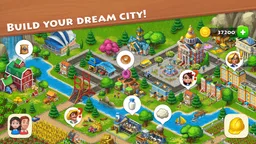
Playrix’s casual game mixes match-3 play with town-building and farm management. Instead of asking me to choose between a puzzle game and a simulation, it links the two. I play levels, collect the resources they provide, and use those resources to keep the town developing. The result is a steady loop of short challenges and longer-term progress.
That structure suits the game better than either half would on its own. A match-3 level can be satisfying in the moment, but repeated boards may begin to feel interchangeable. Township gives those wins a destination: I can see the town change as I make progress. Conversely, a town-building game can feel like a waiting exercise if there is little to do between upgrades. Here, the puzzle board supplies an active task.
The balance is not perfect, and the puzzle side can become the bottleneck. When a level takes several attempts, the town’s next step may feel frustratingly distant. Still, I find that the link between the two gives ordinary victories more weight than they have in a puzzle game without a larger project attached.
What progress feels like in practice
When I open the game for a short break, I can focus on a level rather than needing to plan an elaborate building session. If I have more time, I can look at what the town needs and decide where my recent progress should go. That shift between a quick task and a broader goal is useful: the game gives me something immediate to do without making the town feel like a backdrop.
A practical tip is to treat each session as a small decision, not an obligation to finish everything available. I first check which town task I actually want to move forward, then play with that goal in mind. This keeps the puzzle rewards connected to a purpose and helps me avoid bouncing around the game simply because several things look unfinished.
The town also gives the game a visual sense of continuity. In a pure match-3 title, progress is often measured mainly by how far I have advanced through levels. Here, I can also notice how the place is developing. That makes the experience appealing to players who enjoy seeing a setting take shape, even if they are not looking for a deep city-planning simulator.
A good fit for a small everyday break
Township works particularly well when I have a little unstructured time: waiting for a ride, taking a quiet break, or unwinding at home before moving on to something else. I can attempt a level, make some progress, and stop without needing to commit to a long story session. The town gives me a reason to come back later, while the puzzle offers a clear activity when I do.
It is also an easy game to share the room with. Its Everyone age rating and straightforward central loop make it approachable for a broad range of players. That does not mean every player will enjoy the same part of it: one person may care most about clearing boards, while another may be more interested in seeing the town grow. The combination gives both types a way into the game.
For a family setting, the useful point is not that everyone must play in the same way, but that the premise is easy to understand. A younger player can grasp the basic appeal of puzzles and a changing town, while an adult can decide whether the repeated level structure suits their taste. I would still recommend checking whether in-app purchases are appropriate for the person using the device; the game is free to download, but optional purchases are available.
The trade-off: town goals depend on puzzle progress
The main limitation follows directly from the game’s best idea. Because the town and match-3 play are connected, getting stuck on a board can interrupt the feeling of progress elsewhere. If I am in the mood to decorate or develop the town but do not want to tackle puzzles, the game’s central loop may not satisfy me. It is not a free-form building sandbox in which I can ignore the challenge side indefinitely.
That is an important distinction from a pure town simulator. Those games may be a better choice if your priority is unrestricted planning, detailed management, or a building experience that does not hinge on puzzle wins. Township is a better fit if you enjoy earning your way toward visible changes and find the match-3 challenge pleasant rather than a chore.
The other trade-off is repetition. Match-3 games rely on familiar rules, and Township does not remove that basic pattern; instead, it gives the pattern a larger context. If you tire quickly of returning to a board-based challenge, the town layer may not be enough to keep you engaged. I would not choose it expecting every session to feel radically different.
There is also a gentle but persistent pull to keep checking on progress. That can be motivating, yet it may not suit someone who prefers a game with a definite ending or a self-contained round. I get the most from it when I set my own stopping point: finish a level or make one useful step, then close the game instead of treating every available goal as something I need to clear immediately.
How it compares with other casual games
Compared with a straightforward match-3 game, Township offers a stronger sense of purpose between puzzles. I am not only trying to beat the next board; I am also contributing to a larger place that changes over time. Compared with a conventional farming or building simulator, it puts more emphasis on puzzle challenges as the engine of progress. That hybrid identity is its advantage, but also the reason it will not be everyone’s preferred version of either genre.
If you want pure puzzle variety and little else, a dedicated match-3 game may be a cleaner choice. If you want to spend most of your time arranging a town, a building-focused alternative may give you more freedom. I would pick Township for the middle ground: enough simulation to make wins feel consequential, with enough puzzle play to keep each visit active.
The game is free, with in-app purchases ranging from $0.99 to $149.99 per item. I would approach those purchases as optional conveniences, not as a reason to spend automatically whenever progress slows. A sensible way to try the game is to play at your natural pace first and decide whether the linked loop is enjoyable on its own. If it is, the town provides a lasting reason to return; if it is not, paying is unlikely to fix the underlying mismatch.
Who is likely to enjoy it most
Township is a strong choice for someone who likes match-3 puzzles but wants a visible payoff beyond a completed level. It is also well suited to players who enjoy gradual development and prefer a game that can be visited in short bursts. I find the combination especially appealing when I want something low-pressure in its presentation but still want a clear task to focus on.
I would steer away from it if you dislike puzzle retries, want a highly detailed management simulation, or prefer games that can be finished in a short, defined run. It is also not the ideal pick if you want to build freely without your progress being tied to match-3 play. Those are not flaws for every player; they are consequences of the particular blend Township chooses.
The scale of its audience is notable: it has over 500 million installs, around 13 million ratings, about 375,000 written reviews, and a 4.7 average. Those figures suggest a widely played game, but they do not guarantee that its pacing will suit you. Its current version is 39.1.2, and the game first arrived on November 8, 2013; what matters more to me is whether its central loop still feels rewarding on an ordinary day.
My recommendation
I recommend Township if you want your puzzle wins to feed into a town you can watch develop. Its most successful design choice is also its clearest condition: match-3 play is not a side activity but the route through which the broader project moves forward. When I enjoy both parts, that connection makes even a brief session feel useful.
Playrix has made a casual game with a broad age rating and an easy-to-grasp premise, but it has not made a game for every casual player. The puzzle loop can slow the town, and the town cannot replace the satisfaction of a strong puzzle for someone who only wants building. Try it if that blend sounds appealing, keep purchases optional, and judge it by how satisfying the connection feels rather than by how quickly the town grows.
What we like
- Combines city building with a satisfying farming loop.
- Regular events offer fresh goals beyond the main town.
- Decorations let you customize the town's appearance.
- Community features add a social side to progression.
- Runs smoothly on a wide range of mobile devices.
What could be better
- Construction timers can slow progress as the town grows.
- Some upgrades require substantial amounts of in-game currency.
- Limited land makes planning the town layout challenging.
- Events may demand frequent play to earn the best rewards.
- Progress can feel slow without spending real money.







