




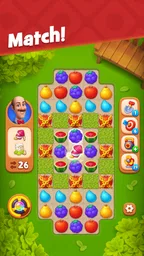



Gardenscapes review
 Analysis by Appsdrops
Gardenscapes works best when you want a match-3 game with a visible sense of progress beyond the board. I like that each solved puzzle feeds into a garden-restoration story: the puzzles give me something immediate to do, while the garden gives those wins a longer purpose. That combination makes it easier to return for a short session than it would be with a string of disconnected levels. It is still a casual game at heart, though, and the gradual pace and in-app purchase prompts will not suit everyone.
Why the garden gives each puzzle a purpose
At its core, this is a match-3 game from Playrix. The familiar appeal is there: study the board, make matches, and work toward the level’s objective. What gives Gardenscapes its own identity is the way puzzle progress connects to repairing and shaping a garden. Rather than treating each board as the whole experience, the game makes it part of a broader project.
That structure is the strongest reason I would recommend it over a more stripped-down match-3 alternative. A puzzle win feels like a step toward improving a place, not just a number added to a level counter. The garden also creates a natural reason to keep playing when I want something more relaxed than a competitive game. I can enjoy the small task in front of me without needing to master a complicated system before I start.
The garden theme is more than decoration in this setup. It gives the experience a steady rhythm: solve a puzzle, make progress, and return to the larger setting. I find that loop satisfying when I have a few spare minutes. It is particularly appealing if you enjoy seeing a setting change over time, but prefer making choices through small, manageable steps rather than taking on a large simulation game.
A useful rhythm for short play sessions
One practical strength is that a session has a clear shape. I can open the game, focus on a single puzzle, and leave after making progress. That makes it an easy fit for a quiet break, a commute with a stable connection, or a few minutes of downtime at home. It does not demand the kind of long, uninterrupted attention that a story-heavy adventure might.
For example, if I have a short wait before an appointment, I can play a level rather than scroll through a feed. If it goes well, the garden gives me a reason to continue later; if I need to stop, the game’s central loop is easy to pick up again. This is a better match for scattered pockets of free time than for someone seeking a deep session with intricate strategy and a strong endpoint.
There is a useful trade-off here. The game is approachable because the basic match-3 idea is familiar, but that familiarity can also make individual boards feel routine. The garden progression helps distinguish it from a plain puzzle collection, yet it does not turn every match into a fresh kind of challenge. I would choose it for the combination of puzzle play and gradual restoration, not because every level reinvents the genre.
Progress feels rewarding, but it can be gradual
The game’s strongest emotional hook is the sense that small wins add up. A restored garden provides a more concrete reward than simply clearing another board, and that can make persistence feel worthwhile. I also think this structure is a good fit for players who like light customization and visual improvement but do not want the demands of a full building or management game.
Still, progression is not instant. If you expect to transform the whole setting quickly, the step-by-step structure may feel slow. Match-3 outcomes can also be frustrating when a level takes more attempts than expected. That friction is part of the genre, but it matters more here because puzzle success is tied to the broader garden project. A difficult board can temporarily hold up the part of the game you were most eager to see advance.
My practical advice is to treat a hard level as a pause rather than a test of patience. If a board stops being enjoyable, take a break and return later with fresh attention. That is often a better approach than turning a casual game into an obligation. The garden is most satisfying when the pace stays light; it loses some of its charm if I feel pressured to push through every obstacle in one sitting.
What to expect from the free-to-play model
Gardenscapes is free to download, but it includes in-app purchases priced from $0.49 to $99.99 per item. That range is worth considering before you start, especially if you know that optional purchases can tempt you when a puzzle becomes stubborn. I would go in expecting a game that can be played without an upfront purchase, while keeping a clear boundary around spending.
For a more relaxed experience, I recommend deciding in advance whether you are comfortable buying anything at all. If the answer is no, approach the game as a gradual pastime and accept that some progress may take longer. If you dislike games that combine puzzle progression with optional spending, a paid puzzle game with a straightforward purchase model may be a better fit.
That does not make the purchase system a deal-breaker for every player. Someone who enjoys the game and is comfortable with optional purchases may appreciate having that choice. But I would not recommend treating spending as a way to guarantee a smooth, uninterrupted run. The more rewarding approach is to enjoy the puzzles and garden at a pace that feels comfortable to you.
Who will enjoy it, and who should look elsewhere
I would point casual players toward this game if they like matching puzzles, garden themes, and a sense of ongoing improvement. It is also a sensible choice for someone who wants a familiar game to dip into rather than a demanding hobby that requires long sessions. Its Everyone age rating makes it broadly accessible, though a younger player should still have an adult’s guidance around in-app purchases.
On the other hand, I would steer away from it if you want every level to feel dramatically different, dislike retries, or prefer games with no purchase prompts. It is also not the best choice if what you really want is an open-ended garden-design tool. The garden is part of a puzzle-led progression experience, so its appeal depends on enjoying the match-3 loop that drives it.
Compared with the usual alternatives in casual puzzle games, Gardenscapes offers more of a continuing setting than a basic level-to-level match game. A pure puzzle title may be preferable if you want nothing but boards and challenges. A full gardening or simulation game may be preferable if you want extensive control over a space. This one sits between those options: the puzzles remain central, while the garden makes their rewards feel connected.
A popular, approachable choice with clear limits
The game has an average rating of 4.8 from around 13 million ratings, and it has passed 500 million installs. Those figures suggest broad appeal, but they do not change my main point: the experience is strongest for people who enjoy both the puzzle loop and the garden’s gradual development. Its long-running popularity is less useful as a promise of personal enjoyment than as a sign that this particular combination has found a large audience.
Gardenscapes first arrived on August 24, 2016, and the current version is 10.0.6. I mention that context because this is an established casual game rather than a new experiment in the genre. Its identity is easy to understand from the first session: solve match-3 puzzles, then use that progress to keep the garden project moving. If that loop sounds appealing, there is little barrier to trying it, since the game is free to start.
My verdict is that Gardenscapes is a good recommendation for anyone who wants familiar match-3 play with a more personal sense of progress. I enjoy the way the garden gives each puzzle a purpose and makes short sessions feel worthwhile. I would not call it the right fit for puzzle purists, players who want fast and frictionless advancement, or anyone uncomfortable with optional purchases. But if you like a gentle, ongoing project and can accept the occasional slowdown, it is an easy casual game to return to.
What we like
- Creative level goals add variety beyond matching tiles.
- Garden areas give progress a clear visual payoff.
- Characters and story scenes make the renovation feel personal.
- Boosters can help clear difficult match levels.
- New events and updates add fresh goals over time.
What could be better
- Lives limit how many levels you can attempt in a row.
- Some later levels can require repeated attempts.
- Optional purchases may speed up progress.
- Story progress depends on completing match levels.
- Events can make the game feel demanding for casual players.







