

My Talking Tom Friends review
 Analysis by Appsdrops
I see My Talking Tom Friends as a gentle, character-led game for short visits rather than a challenge to master. Its appeal is the chance to spend time with Tom and his friends, look after them, and make up little stories around their shared world. That makes it an easy fit for a relaxed break, especially for players who enjoy familiar characters and playful routines more than competition or complex goals.
It is a casual game from Outfit7 Limited, released on June 11, 2020. The game is free to download, and it is rated for Everyone. Those details make trying it straightforward, but “free” does not mean every optional purchase is free: in-app purchases range from $0.99 to $99.99 per item. I would treat it as a no-cost starting point, then decide whether the experience is enjoyable without spending before considering anything offered inside.
What the free start offers
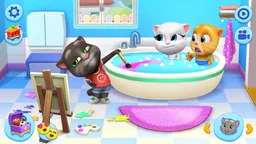
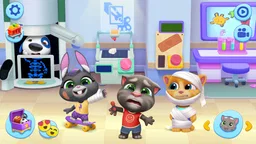
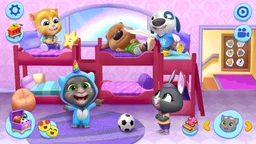
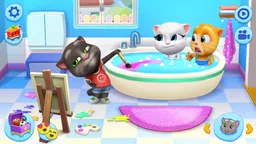
The central idea is simple: care for a group of characters and use their activities as prompts for play. That gives the game a different rhythm from a typical level-based casual title. Instead of focusing only on clearing a board or beating a timer, you can move between looking after the characters and trying mini-games, with room to invent your own little scenes along the way.
That flexible rhythm is useful when I have a few spare minutes and do not want to commit to a long session. A child might open the game to check on the characters, choose an activity, and leave when attention moves elsewhere. An adult looking for a light, familiar diversion may appreciate that same low-pressure quality. It is not the kind of game I would pick when I want a tightly structured story or a demanding skill test.
The free download lets you find out whether this kind of character care suits you before paying anything. That is meaningful value on its own: you can sample the game’s basic appeal rather than buying an experience sight unseen. Still, purchases are present, and the listed range extends from $0.99 to $99.99 per item. I would be cautious about treating optional offers as necessary, especially if a child uses the device.
For a family, a practical approach is to agree on spending expectations before handing over the phone or tablet. The game is rated Everyone, but that age rating does not answer whether in-app spending fits your household. If you want a completely purchase-free experience, check the device’s purchase controls and supervise play rather than assuming the free download alone settles the question.
How the play feels in everyday use
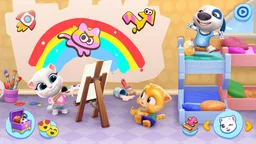
The strongest reason to try it is the way care and make-believe sit alongside each other. Looking after several characters gives a session a small sense of purpose, while the mini-games provide a change of pace. The story-making angle also means players can bring their own imagination instead of relying only on a fixed objective. I find that combination more inviting for casual play than a loop that asks me to repeat one task over and over.
A realistic use case is a short pause at home: a child has finished a snack, asks for a little screen time, and wants something they can explore without needing an adult to explain a complicated ruleset. The caregiver can set a time limit, let the child choose a character or mini-game, and then use the end of the session as a natural stopping point. The game’s relaxed premise supports that routine better than a competitive match that may leave someone eager for “one more round.”
There is a useful distinction between the game’s built-in prompts and the stories a player creates. If a child enjoys pretending, the characters can become a starting point for their own scenes rather than just objects to tap through. I would encourage them to narrate what is happening or decide what the friends are doing next. That makes the play feel more personal without requiring any purchase or a particular way of playing.
For adults, the appeal is more modest. This is not a deep simulation, and its charm depends on enjoying the characters and gentle routine. If I am commuting and want a demanding puzzle, a more focused puzzle game is likely a better fit. If I want a quick, friendly distraction that does not demand a sustained plan, this one makes more sense.
Where its value comes from—and where it stops
The game has a substantial audience: it has over 500 million installs, with a 4.3 average from around 4.1 million ratings. Those figures suggest that the basic concept has broad reach, but they do not guarantee that its style will suit every player. I would use them as context, not as a substitute for trying the free version yourself.
Its value is less about a single standout mechanic and more about combining familiar characters, care-oriented play, and mini-games in one casual package. That can make it easier to return to than a game built around one narrow activity. A player who likes switching between small tasks may get more out of it than someone who wants a clear campaign, a competitive ladder, or a progression system with a strong endpoint.
Compared with the usual alternatives in the casual category, it leans more on character attachment and pretend play than on a score-first puzzle loop. That is a real difference, but also a limitation. Players who mainly want to improve a score or solve increasingly difficult stages may find a conventional puzzle title more satisfying. Those who want an open-ended creative tool may prefer a game designed around drawing or building, rather than care routines and mini-games.
The tradeoff I would keep in mind is that the easygoing format can feel repetitive if the characters and routine do not hold your interest. Mini-games add variety, but variety alone does not turn a relaxed character game into a deep one. If you prefer games with long-term strategic choices, precise controls, or a strong sense of achievement, you may enjoy it briefly and then move on. That is not a flaw for its intended audience, but it matters when deciding whether to make it a regular game.
In-app purchases are the clearest point where value needs a personal boundary. Since items can cost as much as $99.99, I would not make assumptions about what a particular purchase unlocks or whether it is worth buying; the sensible choice is to inspect an offer in the app and judge it on its own terms. The free entry point is the known advantage. Spending is optional in the sense that the game can be downloaded for free, but families should still manage purchasing access deliberately.
Who is likely to enjoy it
I would recommend giving it a try to younger players who enjoy talking characters, gentle care activities, and inventing stories. It can also suit a parent or caregiver looking for a casual game to explore together, because choosing what the friends do next can become part of the interaction. The Everyone rating makes it broadly accessible by age classification, though supervision and household spending rules remain sensible for children.
It is also a reasonable choice for someone who wants short, low-pressure play rather than a game that demands daily mastery. The best way to approach it is to treat each visit as a small activity, not as a commitment to unlock everything. Try the free experience, notice whether the characters and mini-games keep your attention, and avoid spending simply because an offer appears.
I would skip it if you dislike virtual-character care, find repeated casual activities dull, or want a precise puzzle challenge. I would also look elsewhere if your main goal is a game with a clearly defined story campaign or a competitive community. In those cases, a traditional puzzle game or a more structured adventure is more likely to deliver what you want.
On Android, the stated minimum operating system is version 7.0, which is worth checking before downloading. The game is free to install, but I would still review purchase settings on the device before letting a child play independently. Those two checks—compatibility and spending controls—answer the most practical questions before a first session.
My verdict on trying it
For me, My Talking Tom Friends is best understood as an accessible, character-focused casual game with a free starting point and optional spending. Its most appealing quality is the freedom to move between caring for the friends, playing mini-games, and making up small stories. It is a better match for relaxed, imaginative play than for players seeking demanding mechanics or a substantial narrative.
I would start without spending, see whether the routine remains enjoyable after the novelty wears off, and keep purchases behind an adult’s clear approval if children are playing. If the characters make a short break more fun, the free access may be all the value you need. If you find yourself wishing for more challenge or a different kind of creativity, there is little reason to force it: a puzzle-focused or more open-ended alternative will probably serve you better.
What we like
- Each character has a distinct personality and set of animations.
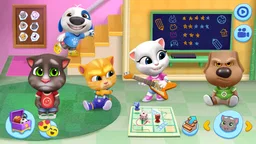
- Players can switch between several characters in one shared home.
- Daily tasks give players simple goals to work toward.
- Mini-games offer a change of pace from caring for the characters.
- The bright visuals are easy for young players to follow.
What could be better
- Frequent prompts can encourage in-app purchases.
- Progress may feel slow without regular play.
- The game requires an internet connection for some features.
- Managing several characters can become repetitive.
- Ads may interrupt play depending on the version and settings.







