






Going Balls review
 Analysis by Appsdrops
I enjoy casual games most when they give me something clear to focus on without demanding a long session, and Going Balls fits that mood. Its central appeal is easy to grasp: guide a rolling ball along a platform and react as the route throws challenges in your way. That simple premise makes it approachable, but the narrow paths and need for careful control mean it can still ask for real attention. I see it as a quick-play game for people who like balancing, timing, and recovering from small mistakes—not as a deep adventure or a substitute for a full physics puzzle game.
Easy to start, demanding to steer
Going Balls is a free casual game from Supersonic Studios LTD. It has a 4.2 average from around 988,000 ratings, and has passed 100 million installs. Those figures suggest it has reached a broad audience, though popularity alone does not tell me whether its particular style will suit you. The game is rated for Everyone, and the listed minimum operating system is Android 7.0.
The first thing I appreciate about the design is how little explanation its premise needs. You are guiding a ball across a suspended course, so the objective is immediately legible even if you have never played it before. The challenge comes from keeping your movement controlled as the available surface changes. A ball that seems easy to guide on a broad stretch can feel much less predictable when the route narrows or asks for a careful adjustment.
That makes the game a good fit for short breaks when I want a task that occupies my hands and attention without requiring me to remember a story or manage a complicated set of systems. It is also easy to hand to someone who is curious about a casual game: the basic idea is understandable before any lengthy explanation. The trade-off is that the experience depends heavily on whether you enjoy steering and correcting movement. If you prefer games built around collecting, dialogue, or deliberate strategy, this may feel too focused on one core action.
Why small corrections matter
My practical advice is to think in terms of gentle corrections rather than treating the ball like a character that should be pushed hard in one direction. On a narrow section, a big adjustment can carry you past the safe line before you have time to compensate. I find it more useful to watch the path ahead, make a restrained movement, and then reassess than to react only when the ball is already close to trouble. This approach is especially helpful when a route changes direction or gives you little room to recover.
That distinction also explains why a seemingly simple level can feel tense. The visual task is not just to move forward; it is to judge how much control a particular stretch allows. Players who enjoy that small loop of reading the route, acting, and correcting will likely find the game satisfying. Those who want every obstacle to yield to fast, forceful input may find it frustrating instead.
A useful game for ordinary pauses
In an everyday setting, I would use it during a short wait or a quiet break when I can give the screen my attention for a little while. The rolling-ball format is more engaging than a game that asks for no thought at all, but it does not require the kind of planning that makes me reluctant to start when I have only a brief window. If I am distracted, though, the careful steering can become the very thing that makes a quick session annoying: this is not ideal to play while walking, talking through an important conversation, or dividing attention between several tasks.
I would also distinguish it from the usual alternatives in casual mobile gaming. A match-three game tends to invite pattern spotting, while an idle game can keep moving with little direct involvement. Going Balls asks for more continuous attention to motion and position. Compared with a traditional platform game, its appeal is less about controlling a character through a varied world and more about managing a rolling object on a precarious route. If you want a relaxed game that barely reacts to moment-to-moment input, an idle or simple puzzle title may be a better choice. If you want a compact challenge that rewards precision, this has a clearer case.
Progress can feel rewarding—and pressuring
The tension comes from the relationship between forward movement and the risk of losing control. When I am moving well, the game’s premise makes progress feel immediate: I can see the path, understand the danger, and try to respond. When I make a poor adjustment, the setback can feel personal because the mistake is tied to my own steering rather than to a complicated rule I failed to learn. That clarity is a strength, but it can also make repeated trouble feel sharper than in a game where progress depends on a broader mix of choices.
For a fair test, I would not judge the game from a single rushed attempt. A moment of distraction can make a narrow section seem harsher than it is, and a deliberate second try gives you a better chance to learn how much movement is enough. At the same time, persistence is only enjoyable if you like practicing control. If repetition feels like a chore to you, the same design that makes a successful run satisfying can make a difficult stretch feel like needless pressure.
One useful habit is to treat a failed attempt as feedback about the size or timing of a correction, rather than immediately assuming that the game expects a purchase or a special trick. That keeps the focus on the skill the game visibly asks of you: guiding the ball along the route. I would avoid playing when I am already impatient, since a small steering error is more likely to provoke frustration when I am not in the mood to try again.
What spending does—and does not—tell me
The game is free to download, with in-app purchases listed from $0.99 to $29.99 per item. That is the concrete purchase context I can give a reader: optional items exist at a range of prices. I cannot responsibly infer from that alone what any individual purchase contains, whether it changes play, or whether spending is necessary to make progress. For that reason, I would approach the game as something to try without paying first, then decide whether any in-app offer is worth considering after seeing it in context.
For parents or anyone managing a shared device, the practical point is simple: a free download does not mean there are no purchase opportunities. The Everyone age rating is reassuring about the intended audience, but it is separate from spending decisions. I would use the device’s purchase controls if I wanted to prevent accidental transactions, and I would review an offer before confirming it rather than treating a displayed price as a reason to buy.
Fairness: what can be judged from play
When I think about competitive fairness, I separate the challenge of controlling the ball from claims about purchases or competition. The basic experience described here is about navigating a platform, and the visible skill demand is precision. The purchase range by itself does not establish that paid items provide an advantage, and it would be unfair to claim that the game is pay-to-win without evidence about what those items do. I would judge fairness by playing the free experience and paying attention to whether success feels connected to my control and decisions.
This is also why I would not compare it with a head-to-head competitive game as if the same standards automatically applied. Going Balls is best approached as a personal control challenge. If you are looking for ranked matches, team play, or a transparent competitive economy, choose a game whose core experience is clearly built around those needs. Here, the more useful question is whether the rolling-ball challenge feels satisfying to you and whether you are comfortable with a free game that offers purchases.
Version, expectations, and trust
The current version is 3.46, and the game was released on February 2, 2021. I mention those details as context rather than as proof of quality: a version number does not tell me what a particular update changed, and a release date does not guarantee that the current experience will match anyone’s memory of an earlier one. The developer is Supersonic Studios LTD, which gives the game a clear publisher identity, but my recommendation rests more on the kind of play it offers than on a name or a large audience.
My trust verdict is measured. The basic proposition is straightforward, the free-to-download model is clear, and the listed purchase range gives a useful warning that spending is possible. I would feel comfortable recommending a no-cost trial to someone who likes steering challenges, while advising them to keep purchases deliberate. I would not promise that every stage is easy, that every offer is worthwhile, or that spending improves the experience; those claims cannot be established simply from the game’s price and purchase range.
Who I would recommend it to
I would suggest Going Balls to someone who wants an immediately understandable casual game and enjoys careful movement more than elaborate rules. It is particularly suited to players who like turning a simple control task into a test of patience and precision. It can also work as a short, focused distraction, provided you have enough attention to respond to the route rather than playing entirely on autopilot.
I would skip it if you dislike narrow-platform pressure, repeated attempts, or games where small input decisions matter so much. I would also choose a different casual title if I wanted a more varied set of activities, a quiet experience that does not punish distraction, or a clearly competitive format. Its appeal is specific, and that is a virtue when it matches your taste but a limitation when it does not.
Overall, I find Going Balls easiest to recommend as a free, skill-focused diversion rather than an all-purpose mobile game. Try it in a calm moment, use modest steering adjustments, and decide from the feel of the control whether the challenge is enjoyable. If it clicks, the simple premise gives you a clear reason to keep improving; if the pressure outweighs the satisfaction, there is little reason to force it.
What we like
- Simple swipe controls make it easy to start playing.
- Short levels suit quick gaming sessions.
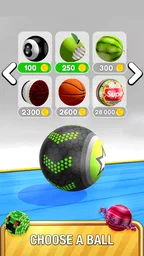
- Collectible balls add a light customization goal.
- Restarting a level is quick after a fall.
- The rolling physics give each run a distinct feel.
What could be better
- Narrow paths can make later stages frustrating.
- Frequent ads may interrupt the flow of play.
- Some obstacles depend heavily on precise timing.
- Progress can feel repetitive across similar levels.
- Accidental swipes can send the ball off course.







