




Coin Master review
 Analysis by Appsdrops
The first thing that makes Coin Master easy to pick up is that it asks for very little commitment at the start of a session. I spin, watch the result, and use what I earn to move my village forward—or deal with the consequences when another player’s turn brings trouble. That simple action-and-response pattern is the point: this is a casual game built around quick bursts, not deep planning or long stretches of precise play.
One spin sets the session in motion
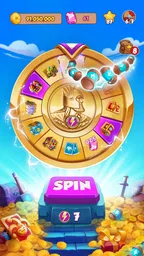
Made by Moon Active, this free casual game puts a slot-style spin at the center of its routine. A result can give me coins, create an opportunity to attack, or lead to a raid. The appeal is immediate: I do not have to learn a complicated control scheme before something happens. The uncertainty of each spin supplies the surprise, while coins give the result a practical purpose.
That combination also sets expectations. I am not directing every outcome or building a strategy that guarantees a particular reward. The satisfying decisions come after a spin: whether to spend coins on village progress, how to make use of an attack or raid opportunity, and when to stop. If you enjoy games where careful skill reliably determines the result, this may feel too dependent on chance. If you want a lightweight game whose next turn is quick to understand, the premise works well.
The game’s social angle gives the action a sharper edge than a solitary spinning game. Friends and other players are part of the context for attacks and collecting coins, so progress can feel connected to a shared circle rather than tucked away in a private puzzle. That can make a small win more entertaining—and a setback more noticeable. I would approach the social side as playful rivalry, not as a dependable way to coordinate a group or measure serious competitive skill.
A useful way to try it is to treat the first few turns as a test of whether you like the rhythm, rather than as a race to build as quickly as possible. The spin is the prompt; the coin total and village are the visible feedback. If the uncertainty itself is enjoyable, the loop has room to draw you in. If you find yourself wishing each turn had a predictable, skill-based outcome, the basic design is unlikely to change into that kind of experience.
Quick feedback, with chance in control
Coin Master makes feedback easy to read: an outcome arrives, coins or an action opportunity follow, and I can see whether that result helps my current progress. This is a strong fit for short breaks because I do not need to remember a complicated chain of moves between visits. The game can be approached in small pieces, with each spin providing a clear moment of anticipation and resolution.
There is a trade-off in that clarity. The compact loop can make several turns feel similar, especially if what you want is a new tactical problem every few minutes. Here, variation comes chiefly from what the spin gives you and how that affects your next decision, not from mastering a large set of controls. I find that distinction important: the game is easy to understand, but ease of understanding is not the same as a deep skill ceiling.
One practical tip is to decide what counts as a satisfying stopping point before starting a session. For example, you might play until you have spent the coins you intended to use on progress, or until the current run of turns stops feeling fun. That small boundary helps keep a chance-driven game in its proper place: entertainment for a spare moment, rather than an obligation to keep chasing a better result.
The same approach helps when playing around other people. Attacks and raids can make the experience more lively, but they can also make progress feel less secure than it would in a purely solo puzzle. I would keep expectations casual and avoid treating every loss as something that needs to be immediately recovered. The game is at its best when the setbacks are part of the joke and the next spin is an invitation, not a demand.
Coins turn results into visible progress
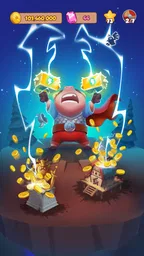
Coins give each outcome a reason to matter beyond the animation of a spin. They feed into the broader village-building progress, so a good result can feel like a small step toward something concrete. That visible connection is more compelling than collecting an abstract score that never changes what I see. It also creates a useful choice: enjoy the immediate thrill of a result, then decide how to put its reward to work.
The reward structure is satisfying in short bursts, but I would not mistake it for a steady progression system in which every minute produces guaranteed advancement. Chance is central, and a session can feel generous or underwhelming depending on its outcomes. That variability is a source of excitement for some players and a source of frustration for others. If you prefer games that let you earn progress through repeatable tasks or careful puzzle-solving, a conventional match-three or logic game may be a better fit.
There is also a spending consideration worth keeping in view. The game is free to download, but it includes optional in-app purchases, with listed items ranging from $0.49 to $374.99. Those amounts cover a broad range, so I would check the price of an individual item before buying and decide on a personal limit in advance. You can enjoy the core idea without treating purchases as a necessary part of the experience; the important question is whether the free-play rhythm feels enjoyable to you.
For an everyday use case, imagine waiting for a friend or sitting through a short commute as a passenger. A few turns give you a self-contained bit of anticipation, and the village offers a reason to care about the coins. It suits those gaps better than a game that expects an uninterrupted stretch of concentration. I would not choose it while driving, working through a task that needs attention, or looking for a story that rewards long, focused sessions.
Why the next session starts—and when to stop
The reset is part of the design’s pull. A session ends without making the whole game feel finished: there is still village progress to pursue, and another spin could bring a different outcome. That open-endedness makes it easy to return after a pause. It is also the main point where I would use a little self-awareness. When a result is disappointing, the urge to take just one more turn can be stronger than the actual enjoyment of the last few turns.
I find it helps to distinguish between wanting to play and wanting to undo a bad result. If I am still curious about what the next spin might bring, continuing can be fun. If I am only trying to recover coins or make a session feel successful, stopping is usually the healthier choice. This is not a complicated game-management rule; it is a practical way to keep a random reward loop from deciding how long your break lasts.
For comparison, many casual mobile games give players a fixed puzzle, a level objective, or a skill challenge that is complete once solved. Coin Master is less about working out the right answer and more about reacting to uncertain results, then choosing how to use them. That makes it more immediately accessible than a game with layered rules, but less suitable for someone who wants every success to reflect deliberate mastery. If you like quick rewards and a touch of social rivalry, the difference is a strength; if you want controllable outcomes, it is a limitation.
The game is rated Teen, so it is not positioned as a title specifically for very young children. I would also bear in mind that its social rivalry and chance-based turns may not suit everyone in a family. For someone deciding whether to try it, the best test is simple: do a few sessions without spending, notice whether the spins feel entertaining rather than frustrating, and then decide whether the village progression gives you a reason to return.
Who will enjoy the loop
There is a substantial audience for the formula: Coin Master has a 4.7 average from around 10 million ratings, and it has passed 100 million installs. It first appeared on February 4, 2016, and version 3.5.2790 is the current release. Those details help explain why it is a familiar choice in casual play, but popularity does not make its chance-led structure right for everybody.
I would recommend it to a friend who wants a low-effort game for spare moments, enjoys seeing coins feed into a visible village, and is happy with surprises rather than precise control. It is less likely to satisfy a player looking for an intricate strategy game, a carefully authored story, or a puzzle where practice consistently improves performance. The game also makes a weaker choice if you dislike social attacks, find uncertain rewards stressful, or prefer not to encounter optional purchases in a free game.
My overall verdict is that Coin Master understands its appeal: one spin creates an immediate result, coins make that result tangible, and the unfinished village gives the next session a reason to exist. I like how little effort it takes to start, and I appreciate that the game’s reward is easy to understand. I am less keen on the way chance can dominate progress and tempt a player to keep going after the fun has faded. Play it as a quick, casual diversion, set your own stopping point, and it can be an entertaining companion for idle moments. If you want control, depth, or predictable advancement, another kind of casual game will probably serve you better.
What we like
- Simple controls make spins and village upgrades easy to learn.
- Raids add a fun chance to earn coins from other players.
- Frequent events offer changing goals and bonus rewards.
- Cards give collectors a useful reason to keep playing.
- Friends can exchange cards and share extra spins.
What could be better
- Progress depends heavily on waiting for more spins.
- Coin rewards and raids can feel unpredictable.
- Some upgrades become costly as villages advance.
- Limited spins may encourage in-app purchases.
- Ads and pop-ups can interrupt the playing experience.







