
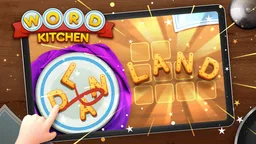
Word Kitchen review
 Analysis by Appsdrops
I approached Word Kitchen as a casual word game for the small gaps in a day: a few minutes while waiting, a quiet break between tasks, or a low-effort way to keep vocabulary puzzles in rotation. Its kitchen framing gives the familiar word-making idea a clear identity, but the real question is whether that theme and its pace make it a game I would return to. My impression is that it suits players who enjoy working out words at their own speed, provided they are comfortable with a straightforward mobile puzzle rather than a deep competitive challenge.
What the kitchen theme adds to a word puzzle
Word Kitchen is a free word game from Gimica GmbH, aimed at Everyone. It had a March 1, 2023 release, and version 1.13.0 is listed for devices running Android 7.0 or later. The game’s average rating is 4.5 from around 43,000 ratings, with about 1,400 written reviews and over a million installs. Those figures suggest it has found a substantial audience, though popularity alone cannot tell you whether its particular style will suit you.
The kitchen concept is a light wrapper around the central appeal of word puzzles: noticing possible words, testing ideas, and shifting your attention when an obvious answer does not come to mind. I like this kind of framing when it gives a simple activity some personality without demanding that I learn a complicated setting. Here, the appeal is less about a story and more about settling into a familiar mental rhythm.
That makes it easy to recommend as a casual option to someone who wants a word-focused game rather than an action game or a long narrative. It is also a reasonable choice for short sessions, when I want a small puzzle to occupy my attention without committing to a long playthrough. If you want an elaborate campaign, detailed character progression, or a social contest, this is probably not the first game I would suggest.
How I would fit it into an ordinary day
Imagine having a few minutes before a bus arrives. A word puzzle is a useful fit because the goal is mental rather than reflex-driven: I can focus on finding a word, pause to think, and decide whether I want to continue. The same quality works during a coffee break, when a quick distraction is welcome but a game that demands constant attention would be awkward.
A practical tip for this style of play is to avoid treating every stalled moment as a reason to spend money or hunt for an immediate shortcut. I would first change my approach: look for shorter possibilities, reconsider familiar word endings, and take a brief break if I am simply repeating the same guesses mentally. That turns the game into a small vocabulary exercise rather than a test of how quickly I can clear a puzzle.
Word puzzles also reward playing when you are alert enough to notice patterns. If I find myself tapping through possibilities without really thinking, I get less out of the session. For me, the better use is a focused five-minute pause, not an attempt to make the game fill every idle moment.
Progress feels best when the challenge stays pleasant
The central pleasure of a word game is the moment a combination clicks. A useful puzzle makes me look at familiar letters in a new way, and a kitchen theme can make that routine feel warmer than a plain list of word prompts. The trade-off is that this format is only as engaging as its variation. Players who already spend a lot of time with word-search or letter-combination games may recognize the basic mental loop quickly and want more surprises than a casual design is meant to provide.
I would approach progression with a light touch. Rather than racing through every puzzle, take a moment to try a different word length or rearrange the letters mentally before entering another guess. That small habit can make a familiar format feel more rewarding, and it avoids turning a relaxing game into a repetitive tapping exercise.
Pressure can enter a word game through the player’s own expectations. If I decide that every level must be finished immediately, even a calm puzzle starts to feel like a chore. Word Kitchen is a better fit when I treat a difficult moment as an invitation to think, not as a failure. Players who specifically want strict timers, head-to-head matches, or a high-stakes ladder should look for a game built around those demands instead.
Spending, fairness, and what can be judged
The game is free to download, with in-app purchases priced from $0.99 to $25.99 per item. That is useful context for deciding whether to try it, but it does not by itself show how purchases affect play. I cannot responsibly call the game pay-to-win, or claim that paying is necessary, based only on the existence of paid items. My advice is to start without spending and see whether the ordinary puzzle loop is enjoyable on its own.
For a single-player word game, fairness is not only about beating another person. It is also about whether a player can make satisfying progress without feeling pushed to buy help. When you reach a difficult puzzle, consider whether you are enjoying the attempt before making any purchase. If you prefer games where every helpful tool and progression rule is clearly visible before you start, compare the in-game purchase prompts carefully with a word game that has a simpler, more transparent payment structure.
One useful boundary is to decide in advance whether you want a free distraction or are open to optional spending. That makes it easier to judge prompts on their merits instead of reacting in the middle of a frustrating puzzle. The listed purchase range gives you a reason to be deliberate, but it is not a reason to assume that spending is required.
Who will enjoy it, and who may want another option
I would point a casual puzzle fan toward Word Kitchen if they like forming words, prefer a gentle theme, and want something they can pick up without needing to coordinate with friends. It can also suit someone who enjoys testing their vocabulary in short bursts and does not mind returning to a familiar puzzle format. The Everyone age rating makes it broadly suitable in content terms, although each household can make its own decision about screen time and in-app purchases.
I would steer a competitive player toward a word game with explicit multiplayer or timed challenges if those are the main reasons they play. Likewise, anyone who wants extensive story, a rich strategic layer, or a very different puzzle mechanic may find this game too focused on the basic pleasure of word discovery. A crossword-style game may be better for someone who likes clue solving, while a word-search game is a closer alternative for players who prefer spotting complete words in a grid rather than building them from letters.
Compared with those alternatives, the appeal here is the directness of the word-making task and the kitchen identity. The trade-off is that there is less variety in the kind of thinking involved than in a game that mixes clues, grids, and other puzzle forms. If you tire of one repeated puzzle loop, switching genres is a better solution than expecting this game to become a broader brain-training package.
What I would check before settling in
For an Android user, the listed minimum operating-system requirement is version 7.0, so I would check the device’s software before trying to install it. The current version is 1.13.0, which gives you a practical reference point when checking that you have the current app-store build. If you are choosing between phones or platforms, verify compatibility in the relevant app store rather than assuming the same system requirements apply everywhere.
Some day-to-day questions matter more than a headline rating: whether the puzzle style holds your attention, whether you like the pace, and whether any purchase prompts fit your preferences. The audience size and average score are helpful signals, not a promise that you will enjoy it. I would use the free entry point to test the core experience before deciding whether it deserves a regular place on your phone.
It is also worth choosing a setting that suits the kind of attention the game asks for. This is a better companion for a quiet pause than for a moment when you need to watch your surroundings or respond to someone immediately. Word puzzles reward concentration, and keeping sessions intentional makes the game more enjoyable than opening it automatically every time there is a spare second.
My verdict on Word Kitchen
My recommendation is measured but positive: Word Kitchen is worth trying if you want an accessible, themed word game for brief, low-pressure sessions. The free download makes it easy to sample, while the optional purchase range is a good reason to keep spending decisions deliberate. Its strongest case is simple: it gives word-puzzle fans a focused activity with a friendly kitchen identity, without asking them to commit to a large game.
I would not choose it as my main recommendation for someone craving competition, varied puzzle mechanics, or a substantial story. But for a player who likes making words and wants a small mental break, it is a sensible option to test. Start with a few puzzles, notice whether the word-finding loop feels satisfying rather than repetitive, and only keep it if that small daily pleasure is genuinely there.
What we like
- Quick rounds make it easy to play in short breaks.
- Simple controls are suitable for players of different ages.
- Word puzzles offer a relaxing way to practice vocabulary.
- Hints help players move forward when a puzzle gets tricky.
- The cozy kitchen theme gives the game a distinctive feel.
What could be better
- Some puzzles may rely on less familiar words.
- Hints can be limited and may require extra resources.
- Later levels can feel repetitive to some players.
- Small letter tiles may be harder to use on compact screens.
- Progress may depend on an internet connection for some features.







