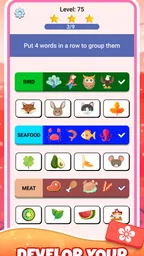
Word Connect Association review
 Analysis by Appsdrops
Word Connect Association is a gentle word game built around spotting links between letters and words, and its appeal is less about racing than settling into a small mental challenge. I’d recommend it to someone who enjoys anagram-style puzzles and wants an easy game to pick up in spare moments. Its calm approach is a strength, though players looking for deep strategy, a strong competitive edge, or a tightly explained learning tool may find it too slight.
A relaxed puzzle loop with room to think
The central pleasure is recognizing how a set of letters can form words and then testing those possibilities. That makes each puzzle a compact exercise in vocabulary and pattern recognition. Rather than demanding a long session, the format suits brief pauses: I can start a round while waiting for a kettle, give it my attention, and stop when I’m ready to move on.
The word-association framing also gives the game a slightly different feel from a plain word search. A word search asks me to scan a fixed grid; this kind of puzzle asks me to make connections and consider combinations. That shift is small but meaningful. It rewards a flexible mindset, especially when the obvious word is not the only useful one to try.
PlaySimple Games developed the game, which sits firmly in the word-puzzle corner of mobile gaming. It is free to install, with optional in-app purchases ranging from $0.99 to $199.99 per item. That broad range is worth noticing before spending: the basic premise is easy to understand without treating purchases as part of the core appeal, so I’d suggest playing first and deciding later whether anything offered is worth paying for.
The game is rated Everyone, making its subject matter suitable for a broad audience. It has a 4.8 average from around 43,000 ratings, with about 2,200 written reviews and over one million installs. Those figures suggest that it has found a substantial audience, but they don’t tell me whether its pace or puzzle style will suit a particular player. The more useful question is whether you enjoy making words from letters without needing a story or elaborate rules to keep you engaged.
What makes the format satisfying
The best moments come when I stop trying to force one answer and start looking at the letters from another angle. A quick mental routine helps: first identify short, familiar words; then rearrange the remaining letters rather than repeatedly staring at the same sequence; finally, take a short pause if every attempt feels stuck. That last step is surprisingly useful in a game like this, because fresh attention often reveals a combination that was hiding in plain sight.
This makes the game a reasonable choice for a short reset between tasks. I wouldn’t call it a substitute for a structured vocabulary course, but it can encourage me to notice spelling patterns and recall words in a low-pressure setting. The benefit depends on how I play: taking a moment to consider a difficult arrangement is more mentally engaging than tapping through guesses as quickly as possible.
It also works well as a shared, informal puzzle. Two people can look at the same letters and suggest different possibilities without needing a lengthy explanation of the rules. That is useful on a quiet commute or during a break with a friend, though it’s better suited to casual collaboration than to a serious head-to-head contest.
How it compares with familiar word games
Compared with a crossword, this is a lighter commitment. Crosswords often rely on clues, general knowledge, and a larger grid; here, the immediate task is to work with letters and associations. If clues are what you enjoy most, the simpler prompt may feel thin. If you prefer the satisfaction of finding a word yourself, the directness is a welcome change.
It is also different from a word-search game, where the answer is already placed in a grid and the main task is visual scanning. Word Connect Association puts more weight on generating candidates in your head. Players who like anagrams may find that distinction appealing, while anyone who finds rearranging letters frustrating may prefer a visual search or a clue-led puzzle instead.
Against competitive word games, the trade-off is equally clear. A live match can bring urgency and the fun of measuring your speed against another person. This game’s calmer puzzle-first approach is better when I want to think at my own pace. That calmness is not a flaw in itself, but it means the experience may not provide enough tension for someone who needs time pressure or social competition to stay interested.
Where the experience can lose momentum
The same simple loop that makes the game easy to approach can also become repetitive. Once I understand the basic task, the variety has to come from the letters and the words I discover; there is less room for a complicated strategy to develop. If I want a game with a changing campaign, character progression, or a narrative reason to keep playing, this is not the one I’d choose.
There is also a difference between a relaxing puzzle and a puzzle that always feels effortless. A letter combination can leave me circling the same obvious guesses, and that can turn a quick break into mild irritation. My practical advice is to avoid treating every round as a test of speed. Try a few fresh combinations, step away if the puzzle stops being enjoyable, and return later rather than tapping at random.
Optional purchases are another point to approach deliberately. Because the listed items span from under a dollar to nearly two hundred dollars, I would not assume every purchase is a small add-on or that I need to buy anything to enjoy the word-game concept. Check the purchase screen carefully, especially if a child will be playing or if the device is shared. The age rating is Everyone, but that does not remove the need for an adult to manage spending choices.
One useful way to keep the game mentally engaging is to make a personal rule before starting: try to find words methodically before using any available assistance or moving on. I’m not assuming a particular hint system here; the point is to give yourself time to solve the puzzle rather than turning the activity into rapid tapping. This small habit makes the game feel more like a deliberate word exercise and helps reveal whether the basic puzzle loop is satisfying enough for you on its own.
Who is likely to enjoy it
I’d put this on the shortlist for people who like anagrams, approachable vocabulary puzzles, and games that can be played in short sessions. It may also suit a family looking for a simple word activity that does not require everyone to learn a complicated ruleset. Since it is rated Everyone, its content is broadly accessible, though younger players may still benefit from an adult helping them handle optional purchases.
A realistic use case is a ten-minute pause between errands. You open a puzzle, work through the letters at a comfortable pace, and put the phone away when your break ends. That is where the game’s modest scope becomes a benefit: it does not ask for a long commitment or demand that I remember a plot. For people who want a quiet activity rather than another stream of urgent notifications and competitive pressure, that is a sensible fit.
I’d suggest skipping it if you mainly want a deep language-learning program, detailed explanations of word meanings, or a robust multiplayer contest. A dedicated study tool is better for lessons and progress tracking; a competitive word game is better for matches where timing and opponents matter. Likewise, if you dislike forming words from letter combinations, a crossword with clues or a visual word search will probably feel more natural.
The game’s current version is 1.70.0, and it supports Android 8.0 or later. Those details matter most if you are checking an older device before installing. Its free entry point makes it easy to try, but I’d still keep the distinction clear between downloading at no cost and choosing to make optional purchases.
A clear, modest recommendation
My verdict is that Word Connect Association is a pleasant pick for short, low-pressure word sessions, not an all-purpose puzzle destination. Its strongest quality is the straightforward act of reshaping letters into words, which can feel satisfying without asking for much setup. Its main limitation is the same simplicity: players who need variety, a substantial sense of progression, or competitive stakes may tire of the repeated format.
If you enjoy anagrams and want something you can play in small gaps throughout the day, I think it is worth trying. Give it a few sessions before considering any purchases, and pay attention to whether the letter puzzles leave you curious or merely stuck. That is the best test of fit. For the right player, its relaxed pace is exactly the point; for everyone else, a clue-driven or more competitive word game will likely be a better use of their time.
What we like
- Quick rounds make it easy to play in short breaks.
- Word links encourage flexible thinking and vocabulary recall.
- The simple controls are easy for new players to learn.
- Gradual challenges provide a steady sense of progression.
- Offline play can make it suitable for travel.
What could be better
- Some word connections may feel subjective or unclear.
- Later puzzles can become repetitive for experienced players.
- Hints may be limited or tied to in-app purchases.
- Frequent ads can interrupt the flow between puzzles.
- The game offers little depth beyond its core word puzzles.







