
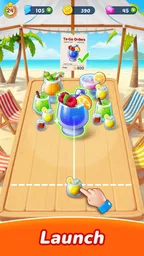






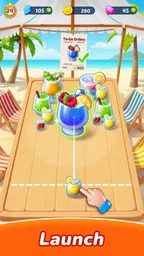
Tasty Travels: Merge Game review
 Analysis by Appsdrops
I like casual games that give me a small, satisfying task without demanding a long session, and Tasty Travels: Merge Game is built around that kind of stop-and-start play. Its culinary theme gives the experience a warmer identity than a plain board of matching objects: the idea is to move through a food-focused world while working through merge puzzles. That makes it an easy game to pick up when I have a few spare minutes, though its slower, resource-conscious rhythm will not suit everyone.
How a typical session flows
The central appeal is the familiar merge loop: bring matching items together, clear space, and use the results to make progress. The food framing helps each task feel connected to a larger journey rather than like an abstract exercise in combining identical pieces. I find that this kind of structure works best when I treat a session as a short planning problem, not as a race to tap everything on the board.
In practice, I would start by looking over the available pieces and deciding which goal deserves attention first. It is tempting to merge whatever is immediately convenient, but that can leave the board crowded with items that do not help with the task at hand. A better habit is to keep the current objective in mind, make the combinations that clearly support it, and pause before using up space on a side path.
That small change in approach is useful because merge games ask you to manage both progress and room. When the board begins to feel busy, I take a moment to identify what can be combined now and what should stay put for a more useful match. This is more deliberate than simply tapping through every available action, and it helps prevent a session from turning into a pile of half-finished plans.
The game is a casual puzzle game from Century Games PTE. LTD., and its food-centered theme is a natural fit for brief breaks. I can imagine opening it while waiting for a meal or winding down at home, completing a few useful actions, then leaving the next decision for later. It is not the sort of game I would choose when I want a story-heavy adventure or a complex strategy challenge; its pleasure is in the small, orderly satisfaction of making progress.
Build a repeatable routine, not a tapping habit
Experienced players can get more from each visit by following the same simple sequence: check what the game is asking for, inspect the board, make the most relevant merges, and then reassess before spending more resources or filling open space. The benefit is not a secret shortcut. It is avoiding decisions that feel productive for a second but make the next objective harder to manage.
I also recommend ending a session at a sensible stopping point rather than continuing just because there are more possible taps. If a board is already crowded or the next useful move is unclear, waiting can be better than forcing a low-value merge. This is a practical way to keep the game relaxing, especially for players who dislike feeling that they must stay online to maintain momentum.
For anyone wondering whether the game is suitable for a quick daily check-in, its merge format naturally lends itself to short visits. The exact length of a session depends on how much you want to do and what is available in your current progress, but the basic puzzle decisions are easy to break into pieces. I would approach it as a game to return to when convenient, rather than one that needs to become part of a rigid routine.
Check the options that affect your comfort
Before settling into a longer stretch, I would look through the in-game settings and make sure the presentation and sound suit the place where I am playing. That is especially helpful if I tend to open a colorful casual game in public or while someone else is nearby. I would not assume that any particular control or convenience option exists; the useful habit is simply to check what the game actually offers instead of relying on guesses or advice meant for another merge title.
It is also worth checking the app’s purchase prompts with care. The game is free to download, but it includes in-app purchases ranging from $0.99 to $99.99 per item. That wide spread makes it sensible to decide on a personal spending boundary before playing, particularly if you share a device with a child or prefer to keep casual games entirely free. I would treat optional purchases as a choice, not as a requirement for enjoying the basic puzzle loop.
Parents may also want to review the device’s purchase controls and the game’s age guidance before handing it over. The content rating is Everyone, which makes the stated audience broad, but an age label does not decide whether a particular child should spend money or play for long stretches. A quick check of household settings is more useful than assuming the rating handles every family preference.
On Android, the listed minimum operating system is 7.0, so compatibility is one practical point to check before installing on an older device. The current version is 68.0.0. I would keep the game updated through the app store when convenient, then revisit the options after an update if a familiar control or display choice seems different. That is a sensible general routine, without assuming that an update adds any particular feature.
Make merges work harder for you
One non-obvious improvement is to think in terms of board space as a resource. A match that produces a useful item can still be a poor move if it blocks several pieces you need to combine later. Before creating a new object, I try to picture where it will sit and whether it will make the next round of choices easier or more cramped. This is particularly valuable in merge games, where clutter can make even a simple goal feel awkward.
A second useful habit is to avoid scattering attention across too many objectives. If I switch between several requests at once, I can end up with a board full of promising items that do not complete anything. Focusing on one clear goal at a time gives each merge a purpose. I still leave room to take an obvious opportunity when it appears, but I do not let every possible combination pull me in a different direction.
Third, I would use the natural pause between sessions to remember what I was working toward. There is no need to turn that into a complicated tracking system: a quick mental note about the current priority is enough. When I return, I can inspect the board and decide whether that goal remains practical. If the situation has changed, adapting is better than continuing a plan only because I started it earlier.
These approaches are especially useful for players who enjoy gentle optimization. They do not make the game less casual; they make the casual loop feel less wasteful. If your favorite part is tapping quickly and seeing what happens, a deliberate routine might feel overly careful. But if board clutter frustrates you, taking a few seconds to plan can make the same game more comfortable.
Where the merge format has limits
The biggest trade-off is that the core activity remains a merge puzzle. The culinary theme gives it personality, but it does not turn every session into a different genre. If you grow tired of combining items and managing space, a new theme may not be enough to restore your interest. I would choose a narrative adventure for character-led storytelling, a conventional match puzzle for quick pattern solving, or a deeper strategy game for decisions with more varied consequences.
There is also a natural tension between relaxed play and the desire to advance quickly. Players who want continuous action may find the measured puzzle rhythm slow, while players who dislike purchase prompts may prefer a game with no in-app spending at all. The presence of optional purchases does not by itself tell me how often a player will encounter them, so I would judge the experience personally and keep spending decisions deliberate rather than assuming every item is necessary.
Another limitation is that merge games reward patience more than reflexes. That is a strength when I want something low-pressure, but a weakness if I am looking for a lively challenge that tests timing or rapid decisions. The game is better suited to sorting out a board at my own pace than to filling a short break with constant action.
The audience figures suggest it has found a sizable casual-game community: it has over 10 million installs, an average rating of 4.5, and around 199,000 ratings. Those figures offer useful context, but they do not guarantee that its pace will fit your taste. I would use them as a sign that the format has broad appeal, then make the decision based on whether food-themed merging and gradual progress sound enjoyable to you.
Who I would recommend it to
I would recommend Tasty Travels: Merge Game to someone who enjoys tidy, low-pressure puzzles and likes the idea of a food-themed setting giving their combinations a sense of place. It is a reasonable fit for short breaks, quiet evenings, or a few relaxed minutes between other activities. The game is free to start, rated Everyone, and its casual structure makes it approachable for players who do not want to learn a complicated control scheme.
I would be more cautious recommending it to someone who wants a fully hands-off experience with no optional spending, or who expects a new kind of challenge in every session. The in-app purchase range is broad, so players who are sensitive to spending prompts should set limits before they begin. And if repeated merging feels monotonous to you, a puzzle game built around different mechanics is likely to be a better use of your time.
The game was released on February 5, 2024, and its continued version numbering has brought it to 68.0.0. Its review history includes around 8,400 written reviews, another indication that many players have spent time with it, though personal preference still matters more than a popularity signal. I would judge it by a few relaxed sessions: do you enjoy planning combinations, and does the culinary journey give you enough motivation to come back?
My verdict is that this is a pleasant choice when I want a gentle merge game rather than a demanding project. Its strongest practical quality is how easily a player can build a calm, repeatable routine around checking a goal, protecting board space, and making purposeful combinations. Give it a try if patient, food-themed puzzle progress sounds comforting; skip it if you need fast action, more varied mechanics, or a game with no in-app purchases to think about.
What we like
- Combining matching ingredients creates satisfying progress.
- Food-themed visuals give the game a cheerful style.
- New recipes add variety as the journey continues.
- Merge puzzles are easy to learn.
- Short play sessions suit quick breaks.
What could be better
- Energy limits can interrupt longer play sessions.
- Progress may slow when requested ingredients are hard to find.
- Frequent tasks can make the game feel repetitive.
- Some rewards may require watching ads.
- Limited board space can make item management tricky.







