
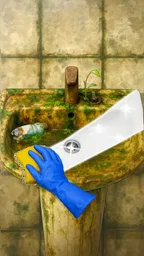




Perfect Makeover Cleaning ASMR review
 Analysis by Appsdrops
When I want a small, low-pressure game rather than a challenge that demands my full attention, I’m drawn to the simple satisfaction of making a mess look right again. Perfect Makeover Cleaning ASMR is built around that feeling: you work on messy objects by washing, wiping, and fixing them, with the aim of leaving each one looking refreshed. My first impression is that it suits short breaks particularly well. It gives you a clear task to focus on, without asking you to learn a complicated set of rules before you can enjoy it.
What to expect from the cleaning sessions
This is a casual cleaning game from Game District LLC, not a home-design simulator or a demanding puzzle game. The appeal is the before-and-after transformation: an object starts out messy, and your attention goes toward the work of cleaning or repairing it. If you enjoy tidy-up videos, gentle makeovers, or the satisfaction of completing a small job, the central idea should feel familiar in a good way.
The ASMR framing points toward a soothing presentation, but I’d treat the game as a relaxing activity rather than a guaranteed way to unwind. What feels satisfying will depend on how much you enjoy repetitive, hands-on tasks. The basic loop is easy to understand, which makes it approachable for a first-time player, though that simplicity may also leave people wanting more variety or strategy after a while.
It is free to install, and the game is rated Everyone, so it is an easy option to consider for a broad range of players. The store shows an average rating of 4.6 from around 74,000 ratings, alongside more than 10 million installs. Those figures suggest that the straightforward cleaning concept has found a sizeable audience, but they don’t guarantee that its pace or presentation will suit you personally.
A useful way to decide is to ask what you want from a casual game. If you like seeing a task through to a visible result, this is a more fitting choice than an open-ended game where you have to invent your own goals. If you want a story, competitive play, a deep upgrade system, or a difficult logic challenge, I’d look elsewhere. Its strength is focus, not breadth.
Getting started without overthinking it
On first opening the game, I’d approach it with one simple goal: find an object to work on and pay attention to what the screen is asking me to do. The concept is deliberately easy to grasp, so there is no need to plan a long session or prepare a strategy. Begin with the available task, follow the visible prompts, and let the first makeover teach you the rhythm.
The most reassuring part for a newcomer is that the activity itself gives you a natural starting point. You do not have to understand every possibility before making progress. Concentrate on the current object rather than trying to guess what later tasks might involve. That keeps the first session calm and makes it easier to tell whether the hands-on cleaning loop is enjoyable for you.
For a practical first try, set aside a few minutes when you have a little attention to spare, rather than opening it while rushing between other tasks. Cleaning games depend on noticing where an action is needed and carrying it through. A short, unhurried session is a better test of whether the interaction feels satisfying than a distracted minute with one eye on something else.
One non-obvious tip is to treat each object as a sequence of small decisions, not as a race to tap quickly. Look at what appears unfinished before moving on. That habit helps you stay engaged with the transformation and reduces the chance that the game feels like a string of arbitrary gestures. The payoff is less about speed than about watching a messy item become presentable.
How to reach a first satisfying result
Your first meaningful success is completing an object and seeing the result of the work. I’d focus on finishing the task in front of you before worrying about how many activities there are or whether the game will keep you occupied for a long stretch. A completed makeover gives you the clearest sample of the main pleasure on offer: attention, action, and a visible change.
This also makes the game easy to fit into an everyday routine. For example, after getting home and before starting dinner, you might open it for a brief mental reset. You can concentrate on a small cleaning task, finish the transformation, and put the phone down without needing to remember a complicated plot or resume a lengthy match. That kind of contained session is where I think the game makes the most sense.
Another useful approach is to notice which part of the process you enjoy most. Some players will like the act of cleaning itself; others will care more about the final neat appearance. If the steps feel pleasant, the central loop is doing its job. If you only enjoy the final reveal and find the work leading up to it dull, that is a good sign that a more varied makeover game may suit you better.
It’s also worth being realistic about the word “ASMR.” A calming theme can make a game feel gentle, but it cannot guarantee that every sound or action will be relaxing for every person. I’d try it in a quiet moment and judge the experience for yourself. If you prefer silent play or find repeated sound effects tiring, your enjoyment may depend on how comfortable the presentation feels during an actual session.
Where new players may get confused
The biggest potential misunderstanding is expecting a broad makeover toolkit or a detailed repair simulation. The game’s premise is about cleaning, wiping, and fixing messy objects, but that does not automatically make it a realistic restoration app. I would come to it as a light game built around a satisfying transformation, not as a guide to cleaning real belongings or learning practical repair skills.
Another point to keep in mind is that simple controls and a clear goal can be both an advantage and a limitation. They make the opening approachable, but players who want more decisions per task may find the loop too straightforward. If you notice yourself tapping through without caring about the object’s progress, take that as useful feedback rather than assuming you have missed a hidden layer of strategy.
The game is free, but it includes in-app purchases priced from $0.99 to $4.99 per item. I’d start by playing without buying anything and decide whether the core cleaning experience is worth more time first. If a purchase prompt appears, pause and consider whether it is offering something you actually want for your play style. The price range is clear, but the best choice is still to avoid spending simply because you are curious or eager to move on.
For a first-time player, the version number is 1.0.30, and the stated minimum operating-system requirement is 7.0. If you are deciding whether to install it, checking that your device meets the requirement is a sensible first step. After that, judge the game on its basic loop rather than expecting a large tutorial or a long onboarding process to be the main event.
Who will enjoy it, and what to try next
I’d recommend Perfect Makeover Cleaning ASMR to someone who likes small, self-contained tasks and the pleasure of turning a messy object into a cleaner one. It is especially suitable if you want a casual game that is easy to understand and can be approached in short sessions. Its Everyone age rating also makes it a broadly approachable choice, though parents should still decide what feels suitable for their own household.
I’d skip it if your idea of a good mobile game involves precise challenges, a strong narrative, competitive rankings, or complex long-term goals. It is also not the best fit if repetitive actions quickly lose their appeal for you. In those cases, a puzzle game with varied rules or a deeper simulation will likely give you more to think about. Compared with many casual alternatives that rely on matching tiles or endless score-chasing, this one puts the focus on tactile cleanup and the satisfaction of a finished object.
If you do enjoy the first task, the sensible next step is simply to continue at your own pace and see whether the same kind of transformation remains rewarding. There is no need to turn it into a daily commitment. I’d use it as a short reset between chores, during a quiet break, or whenever I want a low-stakes activity that has a clear endpoint.
Overall, this is a focused casual game with a comforting premise and an easy entry point. Game District LLC has made the central appeal immediately understandable: take something messy, work on it, and enjoy the cleaner result. The trade-off is that a simple loop may not satisfy players looking for depth or constant novelty. For me, that makes it a good pick when I want a small, orderly task on my phone, and an easy one to leave behind when I’m in the mood for something more demanding.
What we like
- Satisfying cleaning sounds make each task relaxing.
- A variety of messy spaces keeps activities feeling fresh.
- Simple tap controls are easy for casual players.
- Bright visuals make dirt and clutter easy to spot.
- Short tasks suit quick play sessions.
What could be better
- Some cleaning actions can feel repetitive over time.
- Progress may rely on watching ads.
- Frequent prompts can interrupt the relaxing flow.
- The gameplay offers limited challenge for experienced players.
- The app may need an internet connection for some features.







