
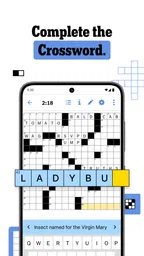
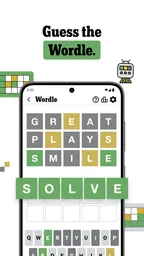
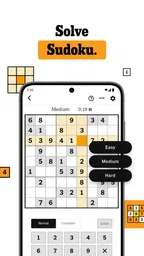
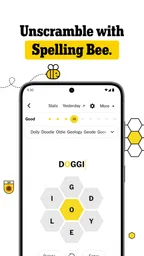
NYT Games: Wordle & Crossword review
 Analysis by Appsdrops
I like word games best when they give me a clear reason to play now, then let me stop before a quick break turns into an obligation. NYT Games is built around that kind of routine: it brings the New York Times’ word puzzles and number games together, so I can choose a small mental challenge rather than commit to a long session. It is a free word game from The New York Times Company, and its appeal lies less in elaborate progression than in having familiar puzzle formats ready when I want them.
Small goals that make it easy to begin
The first useful goal is simply picking a puzzle that fits the time and mood I have. The app’s mix of word and number games gives me more than one way to start: I can look for a vocabulary challenge, a crossword-style session, or something more numerical. That flexibility matters on a commute or during a short wait, when I may not have the concentration for a long grid but still want something more engaging than scrolling.
That makes the app feel different from a single-purpose word game. A standalone daily puzzle can be satisfying, but once I have finished it, the session is over unless I move to another app. Here, the broader collection makes it easier to switch formats without changing my overall routine. The trade-off is that the app’s variety may tempt me to keep browsing when I intended to solve just one puzzle.
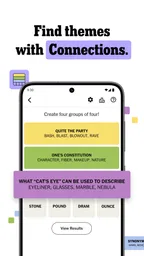
The title signals its main draws clearly: NYT Games combines the familiar pull of Wordle with crossword play, while its wider collection also includes number games. I would recommend it to someone who likes to alternate between quick pattern-spotting and slower clue-solving. If you only want one specific puzzle and dislike having a collection around it, a focused standalone alternative may suit you better.
Progress you can feel without a long campaign
This is not the kind of game I would approach expecting a character to level up or a world to unlock. Its satisfying progress is local: I work through a puzzle, test an idea, and eventually reach a solution. That keeps the basic loop understandable. I do not need to learn a complex progression system before I can enjoy the central activity.
For me, the strongest progress signal is the change in how I read a puzzle. Early guesses or clues narrow the possibilities; later, one answer can make several others easier to see. With a crossword, it can be helpful to leave a stubborn entry and fill in easier crossings first. That is a practical way to avoid wasting time on a guess that has no support, and it makes solving feel like a process rather than a test of instant recall.
A second useful habit is matching the puzzle to my attention, not just my available minutes. If I am tired, I choose a format that feels approachable; if I have a quiet stretch, I can settle into a more involved clue-solving session. The app’s range supports that choice, though it does not remove the basic requirement that I enjoy wordplay and mental trial and error.
Challenge depends on the format and the day
One reason I keep coming back to word puzzles is that difficulty is not always linear. A clue that looks obvious can lead nowhere, while an answer that seemed unlikely becomes clear after another crossing. That uncertainty creates a welcome challenge, but it also means a puzzle can feel tougher than expected when I am distracted or unfamiliar with a particular expression.
Wordle-style play rewards careful elimination: I get more from considering what a guess can reveal than from entering a word at random. In crosswords, the better move is often to collect the answers I can solve confidently and use their letters as evidence. These approaches are different enough that switching between them can refresh a session. They also ask for different kinds of patience; someone who dislikes ambiguity may find both formats frustrating on a difficult day.
Compared with simple word-search games, this collection asks me to reason about meanings, patterns, and constraints rather than just scan a board for visible words. Compared with a large, open-ended puzzle library, its New York Times identity gives the experience a more editorial feel, with a recognizable mix of word and number challenges. I would choose a casual word search for effortless play, but I prefer this app when I want to think through a problem instead of merely pass time.
How the routine stays inviting—and where it can press
The app’s strongest retention tool is the natural appeal of a puzzle that feels finishable. I can make a small start, get absorbed in the clues, and stop when I reach a satisfying endpoint. That is a healthier fit for short breaks than a game that constantly pushes me toward another round. Still, a collection with several puzzle styles can make it easy to extend a session, so I would set my own stopping point if I only have a few minutes.
There is also a difference between wanting a daily ritual and feeling pressured by one. If I enjoy returning to a familiar puzzle habit, the app can fit neatly into a morning coffee or an evening wind-down. If I miss a day, I would not treat that as a failure; the more useful question is whether solving still feels enjoyable when I open it. Players who want a constant stream of escalating rewards or competitive pressure may find this quieter style less compelling.
Practical expectations matter, too. The game is free to download, but in-app purchases range from $0.99 to $299.99 per item, so I would check the purchase details in the app store before spending. It is rated Everyone, which makes it broadly suitable from a content standpoint, though younger players will still need to enjoy reading clues and handling word-based challenges. The current version is 6.50.0, and it requires Android or iOS 10 or later.
Who will get the most from it
I think it works especially well for people who already enjoy solving a daily word puzzle and would like other formats close at hand. It is also a good fit for someone who wants a small, repeatable challenge during a commute, lunch break, or quiet moment at home. One realistic routine would be to tackle a short word puzzle while waiting for a train, then save a crossword for a calmer part of the day rather than trying to force both into the same brief window.
I would be more cautious about recommending it to anyone who wants a game with a strong story, action, elaborate unlocks, or a clear campaign to complete. Those are not the reasons I would open this collection. It is also not ideal if you prefer puzzles with no reading, or if a difficult clue tends to turn relaxation into irritation. In those cases, a visual logic game or a simpler casual puzzle may be a better match.
The game has a 4.8 average from around 151,000 ratings, and it has been installed over 10 million times. Those figures suggest a broad audience, but they do not tell me whether its particular puzzle mix matches your taste. The more useful test is whether you like the thought of switching between word and number challenges and are happy to make your own stopping point.
My verdict on its pace and progression
NYT Games is at its best when I treat it as a flexible puzzle shelf, not a progression-heavy game. Its early goals are easy to understand, its progress comes from solving and learning how to approach clues, and its challenge varies with the format and my own focus. That gives the experience a steady rhythm without requiring a long commitment.
The collection is free to start and comes from The New York Times Company, a name closely associated with its puzzle offerings. It was released on November 17, 2016, and has developed into a well-established option for people who want word and number games in one place. I would recommend it to a friend who enjoys thoughtful, bite-sized puzzles and appreciates having a few different styles to choose from. I would not recommend it as a substitute for a story-driven game or a no-effort time-killer. If you want a calm mental workout with room to choose your own pace, it is a worthwhile one to try.
What we like
- Daily puzzles offer a simple routine for short play sessions.
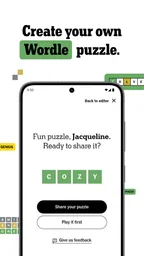
- Wordle's share feature lets players post results without revealing the answer.
- Crossword difficulty varies to suit different skill levels.
- Progress syncing helps keep activity available across devices.
- Clean layouts make puzzles easy to read on phones.
What could be better
- Some puzzles and features require a paid subscription.
- The daily Wordle gives only one new puzzle per day.
- Crossword clues may rely on US culture or wordplay.
- A stable internet connection may be needed for some features.
- The app can feel crowded if you only want to play Wordle.







