Jam Bus:Sandfall review
 Analysis by Appsdrops
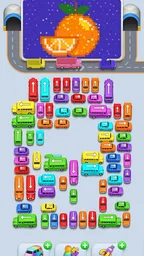
My first impression of Jam Bus:Sandfall is that it aims for a quieter kind of puzzle challenge: the fun comes from reading a crowded bus-and-color layout and working out a route, rather than racing a timer or competing against other players. That makes it an easy game to consider for a short break, especially if you enjoy sorting puzzles but want something less hectic. I’d approach it as a small logic game, not as a deep strategy title.
What to expect from the puzzle
This is a casual puzzle game from Nova Games Technology Limited. Its central appeal is the combination of buses, colors, sand layers, and route planning. Those ingredients suggest a puzzle you solve by observing what is in the way and choosing a sensible order of actions. The key skill is not speed; it is resisting the urge to make the first move that looks convenient.
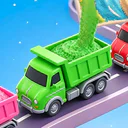
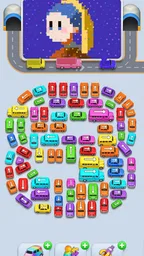
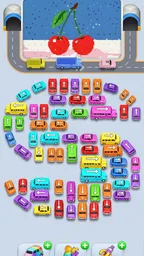
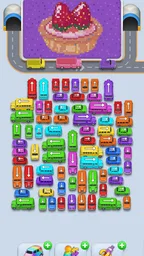
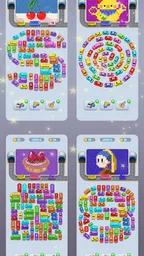
The sand-layer idea gives the board a visual element to interpret, while the bus-jam framing makes the problem easy to understand at a glance: vehicles and colors need to be handled in a useful sequence. I find that kind of setup especially approachable for people who like untangling a compact puzzle without learning a complicated set of rules first. The challenge is in noticing how one choice affects the next, not in memorizing a long tutorial.
That also sets a fair expectation. If you want a story, a substantial collection of characters, or a demanding campaign, this is probably not the right pick. It is better suited to a player who enjoys repeated, self-contained brain teasers and is happy to judge a game by the quality of its individual puzzle decisions.
The game is free to install and is rated for Everyone. It has a 4.7 average from around 84,000 ratings, and it has been installed over a million times. Those figures make it a widely tried option in the casual-puzzle space, but they do not tell me whether its particular style will suit you; the bus-and-sand theme is the more useful clue.
Getting started without overthinking it
On a first run, I would begin by scanning the whole puzzle before touching anything. Look at the visible colors, the bus positions, and which parts of the board appear layered or blocked. That short pause is useful because a move that clears one immediate obstacle may leave a more important route unavailable. Treat the screen as a small planning problem rather than a reflex test.
There is no need to arrive with puzzle-game experience. The visual premise gives you a natural starting point: identify what seems to need room, then consider which action could create that room. If the first board feels obvious, use it to learn the game’s visual language. If it feels less obvious, slow down and compare the consequences of two possible moves before committing.
A practical first-session goal is modest: understand what the colors and layers are telling you, then complete a puzzle by making a deliberate sequence rather than tapping at random. That is a more useful measure of whether the game clicks than simply opening it and seeing its theme. Once the relationship between the visible pieces becomes clear, the route-planning aspect has a chance to become satisfying.
I would also avoid treating every puzzle like a speed challenge. The relaxed framing is a good reason to take a moment, especially when the board looks crowded. If you tend to play while distracted, try a short, focused session instead. A few seconds of attention to the full layout can save the frustration of making a move based only on the nearest color or vehicle.
What a first success should feel like
Your first meaningful success is not merely clearing a board; it is recognizing why the order worked. Before acting, pick out one likely obstruction and ask what needs to move first to open a useful path. After the puzzle resolves, notice which choice made the rest easier. That simple habit turns a one-off win into a method you can carry into later boards.
One non-obvious tip is to think in terms of preserving options. When two moves appear equally helpful, prefer the one that leaves more routes or colors available for the next decision. In a jam-style puzzle, an action can look productive while quietly narrowing your choices. I would rather make a slightly less dramatic move that keeps the board flexible than clear a visible issue and discover that everything else is awkwardly boxed in.
Another useful approach is to separate observation from action. First trace a possible sequence with your eyes; then make the move that starts it. This is particularly helpful when sand layers make the visible arrangement feel busier than the underlying task. You do not need to calculate the whole puzzle perfectly. Even planning the next two steps can make a crowded layout feel manageable.
If you are playing in a spare moment, use the first puzzle as a quick calibration exercise. Notice whether the game rewards careful sequencing or whether you can solve it by reacting to obvious openings. That answer helps you decide how much concentration to give the next one. It also prevents a relaxing game from turning into an unnecessary test of patience.
Where new players may get stuck
The most likely confusion is assuming that matching a visible color or clearing an obvious space is always the right move. The route element means the order matters: what looks locally helpful may not support the larger sequence. When you hit a dead end, do not immediately repeat the same kind of move. Recheck which part of the layout is actually limiting progress, then look for an earlier action that would change that constraint.
The layers can also draw attention away from the full board. My advice is to inspect both the immediate visual detail and the broader arrangement before deciding. If you focus only on the most colorful or prominent area, you may miss a route dependency elsewhere. That is a general reading strategy for this particular mix of sand and traffic, not a reason to tap faster.
There is a trade-off in this style. A compact puzzle can be satisfying because its rules and goal are easy to grasp, but repeated boards can feel too similar to players who need a strong sense of progression or a constantly changing mode. If you usually prefer action games, long narrative adventures, or puzzles with elaborate mechanics, Jam Bus may work as a brief diversion rather than a main game.
It is also worth keeping purchases in perspective. The game is free, with optional in-app purchases ranging from $0.99 to $99.99 per item. I would start by playing without buying anything and decide whether the core puzzle loop is enjoyable on its own. If you are setting this up for a child, the Everyone age rating is reassuring, but it is still sensible to review purchase controls on the device before handing it over.
Choosing whether to keep playing
After the first successful puzzle, the best next step is to carry the same observation routine into another board: scan the layout, identify the tightest point, and choose a move that preserves useful options. If that feels satisfying, the game is doing what it is meant to do for you. If you find yourself tapping mechanically or wishing for more variety, that is a sign that its focused format may not be your kind of casual game.
Compared with many casual games built around quick reactions, this one is a better fit for a quiet pause when you can give a little attention to a board. Compared with broader sorting games, its bus-and-route framing gives the puzzle a more spatial feel: you are not just noticing matching colors, but considering how movement and access interact. That distinction is a reason to try it if you enjoy planning, though it may be less appealing if you want a purely automatic, no-thought distraction.
The game is at version 37.0 and requires Android 6.0 or later. Its release date is June 17, 2026. I would check that your device meets the system requirement before installing, then give the opening puzzles enough attention to learn the visual cues rather than judging it from the theme alone.
For an ordinary everyday use, I can picture opening it while waiting for a drink or taking a short break between tasks: one focused puzzle, a small sense of progress, then back to the day. I would not recommend it for someone who wants a long, uninterrupted session with a deep narrative, nor for a player who dislikes thinking through move order. For everyone else who likes calm, visual problem-solving, it is an approachable option with a clear first goal: read the board carefully, make one purposeful move, and see whether the resulting route makes sense.
Overall, I’d recommend Jam Bus:Sandfall to friends who want a low-pressure puzzle they can learn by looking closely rather than by studying instructions. Its strongest quality is the way the bus-jam premise encourages deliberate sequencing; its main limitation is that this focused loop may not offer enough breadth for players who need a bigger variety of activities. Start free, take your time with the first board, and keep playing only if planning the next route feels enjoyable rather than like busywork.
What we like
- Short puzzle levels make it easy to play in spare moments.
- Colorful visuals give the game a cheerful look.
- Bus and passenger themes are simple to understand.
- Finding the right order adds a satisfying logic challenge.
- The basic gameplay is accessible to new puzzle players.
What could be better
- Some puzzles may feel repetitive after extended play.
- Later levels can require trial and error.
- The bus theme offers limited variety in the core mechanics.
- Progress may feel slow for players seeking a fast challenge.
- Ads or optional purchases may interrupt the experience.







