






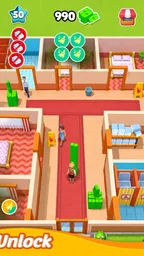

Hotel Legacy: Merge Game review
 Analysis by Appsdrops
I can see why Hotel Legacy: Merge Game would catch someone’s eye: it pairs a familiar casual-game format with the promise of bringing a hotel back to life. That combination gives the simple act of combining items a visible purpose. Rather than chasing a score alone, you have a place to improve, and each renovation can make the next bit of progress feel more tangible.
I’d approach it as a relaxed game for short sessions, not as a deep hotel-management simulation. Its appeal is the steady relationship between merge play and renovation: make progress through the game’s tasks, then see that progress reflected in the hotel. That loop can be satisfying when I want something easy to dip into, though anyone expecting detailed business decisions or a complex story should set their expectations accordingly.
Why the first sessions feel inviting
As a casual merge game, it is built around an approachable idea: combine items to make progress, then use that progress to renovate a hotel. The theme gives otherwise abstract puzzle work a sense of direction. I’m not just clearing a board for its own sake; I’m working toward a more appealing property, which makes small achievements easier to care about.
The hotel setting also helps the game feel distinct from merge titles that rely on a generic garden, house, or collection of objects. Renovation gives the central loop a strong visual destination. If you enjoy seeing an environment change as you play, that is likely to be the most immediately rewarding part. The game’s store summary puts the emphasis on merging and renovation, and that pairing is the right way to understand its basic appeal.
The developer is Century Games Innovation Pte. Ltd., and the game is free to download. Its Everyone age rating makes it broadly approachable for younger players and families, although that doesn’t automatically mean every play pattern will suit every household. For a parent, I’d still consider whether optional purchases and time spent on a mobile game fit the child’s habits, rather than treating an age label as a complete guide.
In the first week, I’d judge it less by how quickly the hotel changes and more by whether the merge-and-renovate rhythm feels pleasant. A useful way to try it is to play in short, natural breaks and notice whether each session gives you a clear next step. If you regularly finish a session unsure why you were combining items, the theme may not be enough to hold your interest. If each renovation gives the board a purpose, the loop is doing its job.
A satisfying loop, with a specific kind of payoff
The strongest design choice is the connection between the puzzle activity and the hotel’s visible improvement. That link can make even modest progress feel more personal than a simple score increase. I find this kind of structure especially appealing after work or during a quiet wait, when I want a gentle task rather than a game that demands fast reactions or a long stretch of concentration.
There is a trade-off, though. A renovation theme can suggest a wide-ranging management game, but the central experience here is a casual merge game. If what you want is to plan room layouts, set staff schedules, or make detailed financial choices, this is not the alternative I’d pick. Its focus is narrower: merge play provides the activity, while hotel renovation supplies the motivation.
What keeps it useful beyond novelty
A game like this earns a regular place on my phone only if the core loop remains enjoyable after the initial curiosity about the hotel wears off. The practical test is whether I still like making progress when a new room or change is no longer a surprise. The game’s long-term value therefore rests on two things: how satisfying the repeated merge activity feels, and whether the renovation goals continue to make that activity worthwhile.
For a low-pressure routine, I would treat it as a game to check in on when I have a few spare minutes, not as a daily obligation. That distinction matters. A casual title can be a pleasant habit when it fits around real life; it becomes a burden if I start feeling that I must keep up with it. I’d avoid building a rigid schedule around progress and instead see whether the game naturally earns attention over time.
One practical tip is to pause before spending anything. The game is free, with optional in-app purchases ranging from $0.99 to $99.99 per item. That is a broad range, so I would decide on a personal spending boundary before a tempting moment arrives. If progress feels slower than I’d like, first ask whether I’m still enjoying the puzzle and renovation loop at its normal pace. Paying to move faster is poor value if the underlying activity has already begun to feel repetitive.
Another useful approach is to separate “I want to play” from “I want to finish this task.” In merge games, it is easy for a visible goal to turn a relaxing session into a checklist. I’d stop when the session stops feeling enjoyable rather than pushing on just to complete one more step. That keeps the hotel’s gradual improvement rewarding instead of making every unfinished objective feel like homework.
Maintenance, attention, and everyday fit
Its maintenance burden is likely to be less about learning a complicated system and more about deciding how much attention you want to give it. The game’s current version is 19.0.0, and it supports Android 7.0 or later. Those details are useful when checking whether an older device can run it, but compatibility alone doesn’t tell me whether the game will suit someone who prefers to install a title and return only occasionally.
For everyday use, I can imagine opening it while waiting for a friend, during a commute as a passenger, or at home when I want a small, contained distraction. The hotel theme makes those sessions feel like incremental progress rather than a disconnected round. But I would not recommend it as a substitute for a longer, story-led game if you want a strong narrative arc, or as a hands-on management sim if you want control over the operation of a resort.
The best personal workflow is to keep the game in the same category as a puzzle book: available when I feel like it, easy to put down when I don’t. That also makes it easier to notice whether its recurring value is real. If I open it because I enjoy merging and improving the hotel, it has found a useful role. If I open it from habit and leave feeling that I have only cleared chores, the habit is no longer serving me.
Where fatigue can set in
The main risk is repetition. The merge loop is the center of the experience, so a player who tires quickly of combining items may find that hotel renovations cannot carry the game indefinitely. I would be cautious if you already know that this genre loses its appeal for you after a few sessions. A different casual game with more varied moment-to-moment challenges may be a better fit.
There is also a mismatch to watch for between the scale of the theme and the scale of the activity. “Hotel” can evoke a bustling property with many systems to master, while the game’s stated premise is merging and renovating. That distinction is not a flaw if you want a focused puzzle game, but it matters when choosing. I’d recommend it to someone who likes gradual visual improvement, not someone seeking a detailed simulation of hospitality work.
Optional purchases can add another source of friction if you prefer games with no spending prompts or if you are managing a child’s access to purchases. The free entry point is useful, but the presence of paid items means it is sensible to review purchase settings on the device and talk through spending expectations where appropriate. I would treat every purchase as optional and avoid buying simply because I feel behind.
Players also differ in how much visible change they need. If every renovation feels meaningful to you, the setting can keep small sessions engaging. If you want substantial changes in every visit, gradual progress may feel underwhelming. My advice is to try it with a modest expectation: enjoy the small steps, and don’t use the speed of renovation as the only measure of whether the game is fun.
How it compares with familiar alternatives
Compared with a standard match or merge puzzle, Hotel Legacy has a stronger sense of place because the activity is tied to improving a hotel. That can be a meaningful advantage for players who like a project to grow over time. Compared with a management simulator, however, it is a lighter choice: the appeal is the merge-and-renovate premise rather than the promise of detailed operational control.
That makes the decision straightforward. Choose this if you want a casual puzzle with a hotel-centered reason to keep going. Choose a more involved simulation if you want to make layered management decisions, or a puzzle game without renovation goals if you care most about quick, varied challenges. The game does not need to be all things to all players; it just needs to make its particular loop enjoyable for the people it suits.
Its audience response is encouraging: it has a 4.7 average from around 20,000 ratings, and it has passed 1 million installs. I see that as a sign that the premise has broad appeal, not a guarantee that the repeated gameplay will work for everyone. Ratings can tell me that many people have tried it; my own decision would still come down to whether I enjoy the basic merge activity and the pace of renovation.
Who should keep playing after the first week
I’d recommend Hotel Legacy: Merge Game to someone who enjoys casual puzzle sessions, likes watching a setting improve, and is comfortable with progress arriving in small steps. It is particularly suitable for a player who wants a familiar activity with a clear visual goal, rather than a demanding game that needs full attention. The first-week test is simple: if you look forward to returning to the hotel, rather than feeling obligated to do so, the game may have lasting value for you.
I’d suggest skipping it if you dislike repeated merge play, want a deeply tactical hotel sim, or strongly prefer games without optional purchases. A different genre would serve those needs better than trying to make this one fit. Likewise, if you are looking for a rich story as the main reason to play, the renovation theme alone may not provide the kind of narrative engagement you want.
My long-term verdict is cautiously positive. The hotel gives the merge loop a more appealing destination than a bare puzzle board, and the free download makes it easy to find out whether that combination suits you. Its staying power depends on your tolerance for repetition and whether gradual renovation continues to feel satisfying. I’d give it a place on my phone as an occasional, low-pressure game—not an essential daily routine—and let enjoyment, rather than completion pressure or spending, decide how long it stays.
What we like
- Merging items gives each task a clear sense of progress.
- Hotel renovations provide visible rewards for completing orders.
- The relaxed pace suits short play sessions.
- New areas give players fresh restoration goals.
- The story adds context to the hotel’s upgrades.
What could be better
- Energy limits can interrupt longer play sessions.
- Some upgrades require repeated merging to obtain rare items.
- Progress may slow when event tasks compete for resources.
- The merging board can become crowded with unfinished items.
- Waiting for energy to refill may encourage in-app purchases.







