




Hollywood Merge review
 Analysis by Appsdrops
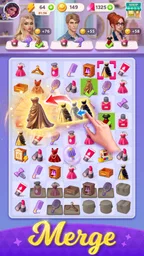
I’m drawn to casual games that give me a clear little objective when I have a few spare minutes, and Hollywood Merge has an appealing premise for that kind of play: it pairs merging with fashion and the rise of a would-be screen star. The idea gives the game a stronger identity than a plain matching puzzle. Instead of treating each action as an isolated board task, it frames progress as part of a show-business makeover story.
That theme will be the main reason to give it a try. If you enjoy light, goal-led play and the pleasure of seeing a character’s world develop, it has an easy starting point. If you want a demanding strategy game, a deep fashion simulator, or a story you can follow without interacting with puzzle mechanics, this is less likely to be your kind of entertainment.
Small goals give the opening its shape
The central appeal is the combination of merge puzzles, fashion, and dramatic progress. The Hollywood setting gives everyday tasks a sense of direction: you are not simply matching items for its own sake, but playing toward the fantasy of a newcomer becoming a star. That framing can make short sessions feel more satisfying, especially when I want a game that is easy to understand without committing to a long, complicated ruleset.
I would approach the early stretch as a series of small steps rather than expect a grand story payoff immediately. Casual games work best for me when I can pick up the thread quickly, complete something manageable, and put the phone down without needing to remember a dense chain of objectives. The merge-and-fashion premise is well suited to that rhythm, though the enjoyment depends on whether the game keeps its goals clear as it develops.
One practical way to get more from that structure is to decide what counts as a satisfying session before opening the game. I might aim to make visible progress on one current objective, then stop, rather than keep playing simply because another task is waiting. That approach suits a game built around incremental advancement and helps keep a short break from turning into an unplanned stretch of screen time.
The fashion theme also gives progress a more personal flavor than a generic puzzle board. Players who like styling and makeover stories may find that the premise makes each step feel connected to the character’s ambitions. On the other hand, anyone expecting detailed outfit design or a realistic account of working in entertainment should keep expectations modest: the known pitch is a casual game, not a professional fashion tool or a Hollywood simulation.
What progress feels like
In a merge game, progress is most satisfying when the connection between an action and a goal is easy to understand. I find it useful to check the current objective before spending time on a chain of merges, rather than assume every available combination is equally helpful. That simple habit is a concrete way to keep play purposeful: work toward what the game is asking for, and avoid treating every possible board move as equally valuable.
There is a trade-off here. Goal-led play is welcoming because it gives casual players a reason to return, but it can feel less free-form than a puzzle game where the board itself is the whole challenge. If I want to experiment without worrying about a larger progression path, a straightforward match game may suit me better. If I enjoy seeing puzzle actions contribute to a character’s broader makeover journey, this format has the more appealing hook.
The strongest progress signal in a game with this premise should be a visible sense that the protagonist is moving toward the glamorous life promised by the setup. That is a useful standard for deciding whether the game is working for you: do the tasks feel like steps in a journey, or do they start to feel like chores detached from the story? Players who care about narrative motivation will notice that distinction sooner than players who are content to merge for the puzzle loop alone.
How to handle the challenge and pace
I would not judge the difficulty solely by whether a puzzle feels easy or hard in one moment. For a casual merge game, the more important question is whether the challenge remains enjoyable as goals accumulate. A gentle start can be inviting, while a later rise in friction may create useful tension—or make progress feel like waiting. Since the appeal here rests on accessible play, anyone seeking a steep learning curve or demanding tactical depth should look to a more strategy-focused alternative.
A helpful habit is to treat each session as a small decision rather than an obligation to finish everything in sight. If a goal feels like it will take longer than the break I have available, I can make a little progress and leave the rest for later. That is especially useful for casual games, where the temptation to chase one more milestone can blur the line between a quick diversion and a longer play session.
Pacing is also a question of personal taste. Some players enjoy a steady stream of bite-sized objectives because it removes the pressure to plan far ahead. Others want a clear sense of challenge that comes from mastering a complicated system. The merge-and-fashion concept suggests a lighter, more accessible experience; I would choose it for a relaxed change of pace, not as a substitute for a puzzle game whose main pleasure is rigorous problem-solving.
When progression encourages another session
The Hollywood-rise premise naturally invites players to come back and see what comes next. That can be a strength when I want a casual game with a continuing sense of direction. It can also become a source of pressure if I start playing only to keep up with a sequence of goals rather than because the merge loop remains enjoyable. I recommend paying attention to that difference: a good return session should feel like a choice, not a duty.
There is a practical way to keep the balance. Before playing, choose a stopping point that makes sense for your day—perhaps a single meaningful objective or a short break—and stop when you reach it. This is not a special in-game feature; it is simply a useful boundary for any progression-based pastime. It helps preserve the game’s role as a pleasant diversion instead of letting the promise of future progress dictate your schedule.
Another trade-off to consider is spending. The game is free to start, with in-app purchases priced from $0.99 to $99.99 per item. I would treat optional purchases cautiously and decide in advance whether I am comfortable spending anything at all. If you prefer games with no paid extras, or you find purchase prompts distracting, a fully paid game or a puzzle app without in-app purchases may be a better fit.
Its broad audience is reflected in its Everyone age rating, but that does not mean every play style will suit every player. The theme and casual format are approachable, while the ongoing progression may be less appealing to someone who dislikes goals that encourage repeated visits. If you are choosing it for a younger player, the most useful conversation is not about difficulty; it is about keeping any optional spending under control.
Who I think will enjoy it
I can see Hollywood Merge working well for someone who likes the combination of simple puzzle actions and a makeover story. It is a reasonable choice for a commute, a quiet wait, or a short evening break when I want a light activity with a theme. It may also appeal to players who enjoy casual games that give each small task a larger context, rather than asking them to chase a high score as the only reward.
I would steer away from it if you mainly want a pure fashion game where styling decisions are the central activity, or a narrative adventure that puts dialogue and plot ahead of puzzle work. The same goes for players who want a demanding merge system with substantial strategic planning: this is positioned as casual entertainment, and that is the expectation I would bring to it. A conventional match puzzle is a cleaner choice if you prefer a self-contained challenge without a makeover storyline.
There is also a useful comparison with other casual games. A basic match-three title usually puts the board and its levels at the center; a fashion app tends to emphasize appearance and customization; a story game may prioritize scenes and character relationships. This game’s appeal is the overlap between merging and a star-making fantasy. That blend is distinctive, but it also means it may not satisfy someone who wants any one of those elements in especially deep form.
Availability and overall verdict
Developed by VoyagerOne IE, this free casual game has a 4.7 average from around 215,000 ratings and more than 10 million installs. It has about 1,200 written reviews, which gives prospective players plenty of public feedback to consult alongside the overall rating. The current version is 0.1.58, and it requires Android 7.0 or later. It was released on January 29, 2026.
My recommendation is to try it if the mix of merging, fashion, and a climb toward screen-star status sounds more fun than a plain puzzle board. Go in expecting casual progression, keep your sessions and spending intentional, and judge the game by whether its goals make the journey enjoyable rather than merely giving you another reason to return. For a player who wants a tougher puzzle or a deeper fashion sandbox, another genre-specific option will be a better match.
As a progression-driven diversion, its promise is straightforward: small puzzle steps tied to a glamorous makeover story. That is enough to make it an appealing option for the right player, especially someone who likes a clear objective and a bit of drama with their casual play. I would recommend it as a light, theme-led game—not as a serious strategy challenge, and not as a replacement for a dedicated fashion or story experience.
What we like
- Combines makeover tasks with match-style merging for varied play.
- Bright visuals give characters and locations a polished look.
- Story chapters provide goals beyond collecting items.
- Energy refills let players return to progress after a break.
- Merge chains offer a satisfying sense of progress.
What could be better
- Energy limits can interrupt longer play sessions.
- Some upgrades require repeated merging of lower-level items.
- Waiting for generators may slow progress.
- In-app purchases can speed up resource collection.
- Later stages may require more time to complete.







