


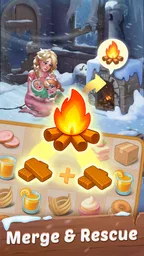




Frost Valley™: Merge & Story review
 Analysis by Appsdrops
I’d approach Frost Valley™: Merge & Story as a relaxed puzzle game rather than something to rush through. Its central appeal is the mix of combining items and following a story, a pairing that can make a short play session feel more purposeful than simply clearing a board. The setting promises a place to build up over time, while the merge puzzles provide the hands-on activity. That combination is appealing, but it also means the game suits players who enjoy gradual progress more than those looking for fast, competitive action.
Where the first session can feel unclear
Frost Valley is a casual game from Tuyoo Games (HK) Limited. It is free to download, rated Teen, and currently at version 1.14.1. The game has a 4.8 average from around 179,000 ratings, with more than 10 million installs. Those figures suggest a large audience, but they cannot tell you whether its pace or style will fit your own habits.
Merge games often ask you to learn by trying things: identify matching pieces, combine them, and work out how the resulting items help you progress. If that loop is familiar, Frost Valley’s basic premise should be easy to approach. If it is your first merge game, the initial friction is more likely to be understanding what deserves attention than mastering a complicated control scheme. I’d take a moment to read prompts carefully instead of tapping quickly through them.
The story element changes the feel of the genre. Rather than treating every merge as an isolated puzzle, the game frames progress around a place and its narrative. That can be a welcome reason to return, especially if you like seeing a setting develop alongside your puzzle progress. The trade-off is that players who want a pure, uninterrupted puzzle board may find story-led pacing less direct than a minimalist matching game.
One useful habit is to decide what you want from a session before opening the game. If you have only a few minutes, focus on the next clear task and stop when you reach a natural pause. If you have more time, follow the story and explore how the merge activity connects to it. This keeps a casual game from turning into a string of aimless taps when you are not sure what to do next.
Simple checks before settling in
Before starting, check that your device runs Android 7.0 or later if you are playing on Android. That is a more practical first step than troubleshooting the game itself on an unsupported system. On any device, make sure the app has finished installing and that you can open it normally before judging its performance. A first launch that is interrupted by a weak connection or a pending update can make the experience seem less smooth than it is during ordinary play.
It is also worth thinking about how you prefer to play. Merge puzzles are naturally suited to short, focused visits, but the story can encourage longer sessions. If you tend to play while commuting or between errands, choose a moment when you can pay attention to the screen; trying to follow a narrative while repeatedly putting the phone away can make it harder to remember your next goal. For a quiet break at home, the slower, incremental rhythm is likely to feel more satisfying.
The game is free to play, with in-app purchases ranging from $0.99 to $99.99 per item. I’d treat that as a reason to decide on your own spending boundary before playing, not as a reason to buy anything immediately. See how enjoyable the core merge-and-story loop is first. If a purchase prompt appears, pause and consider whether it solves a genuine problem for you or merely offers a quicker route through a game you would otherwise enjoy at its own pace.
That distinction matters in casual games: convenience and enjoyment are not always the same thing. If you like gradual progress, waiting or taking a break may feel perfectly natural. If you find yourself wanting to pay mainly because the current session has become frustrating, stepping away can be the better choice. I would not recommend treating optional purchases as necessary just to find out whether the game suits you.
Getting back into a session without frustration
If you return after a break and have forgotten what you were doing, avoid trying to reconstruct your whole history at once. Start by looking for the most visible current objective, then work backward only far enough to understand what action it calls for. This is a useful approach in a story-driven merge game because the narrative and puzzle activity can each provide context. It is usually easier to regain momentum from one clear next step than to tap around the board at random.
When an action does not seem to produce the result you expected, slow down and check the on-screen prompt again. A mismatch between what you think an item does and what the game is asking for can look like a stalled puzzle, even when the issue is simply a missed instruction. I would also avoid making several unrelated moves in a row while confused; that makes it harder to tell which action helped and which added clutter to your decision-making.
If the game closes unexpectedly or appears stuck, use ordinary recovery steps before assuming your progress is lost: close and reopen the app, check that the device has a stable connection if the screen seems to be waiting, and make sure the app is up to date. Restarting the app is a sensible first attempt; repeatedly reinstalling it is not. Reinstallation can create needless concern about saved progress, so I would only consider it after simpler checks and after thinking carefully about whether your progress is safely retained.
For a more orderly return, make a mental note of the last objective you understood before ending a session. That small routine is surprisingly useful when a game mixes puzzle actions with story beats: you do not need to remember every detail, just the immediate reason you were merging items. It also helps distinguish a genuine technical interruption from the ordinary feeling of being temporarily unsure after time away.
When the phone or connection may be the issue
Not every pause or slow response points to a problem with Frost Valley. A device under heavy load, a low battery, or an unstable connection can affect many apps at once. If the game behaves oddly, check whether other apps are also slow, close anything you do not need, and try again when your connection is steadier. These are general checks rather than guarantees, but they can help you avoid blaming the game for a broader device issue.
If the problem happens only in one session, give the app a clean restart before changing settings or deleting anything. If it happens repeatedly, note what you were doing when it occurred and whether it followed an update or a change in connectivity. That information makes it easier to describe the issue if you contact the developer through an appropriate support channel. I would avoid sharing account or payment details in public discussions while trying to solve a routine performance problem.
There is also a difference between a technical obstacle and a design choice you dislike. If you can open the game and play but find the story interrupts the puzzle rhythm, that is probably a matter of taste rather than a fault to troubleshoot. Similarly, if gradual progress feels too slow for your preferences, repeated restarts are unlikely to change the game’s basic character. Recognizing that distinction saves time and helps you decide whether to keep playing or choose a more direct puzzle game.
Who will enjoy its particular rhythm
I can see Frost Valley working well for someone who enjoys gentle, ongoing goals and likes a reason for puzzle progress to matter beyond the next move. The story gives the merge activity a broader frame, which can make a small session feel like part of a larger journey. It may also suit players who want a casual game they can revisit, rather than a demanding experience that requires long stretches of concentration.
It is less suited to anyone who wants immediate action, head-to-head competition, or a puzzle experience stripped of narrative. Compared with a conventional match-and-clear game, Frost Valley asks you to care about progression and setting as well as individual moves. Compared with a story game that asks mostly for reading, it gives you a more active puzzle task. That middle ground is its most distinctive appeal, but it is also the reason it will not be everyone’s first choice.
The Teen content rating is worth considering when choosing a game for someone else, particularly a younger player. I would not rely on the casual label alone to make that decision; check the rating in the relevant app store and use your own judgment about what is appropriate. The same practical caution applies to purchases: the game costs nothing to download, but optional in-app spending is available, so family settings and personal boundaries may matter.
A practical verdict for everyday play
My recommendation is to try Frost Valley if you like merging items and want that activity tied to a story and a changing setting. Give it a few calm sessions rather than deciding from a rushed first launch. Read prompts, keep track of the next clear goal, and avoid spending until you know whether the normal pace is enjoyable. Those small choices make it easier to tell whether you like the game itself rather than simply reacting to a confusing moment.
Skip it if you strongly prefer self-contained puzzles, fast rounds, or competition, or if story-led progression feels like an interruption. A more straightforward casual puzzle game would be a better match in those cases. For players who do enjoy the blend, Frost Valley offers a clear reason to return: each session can move both the puzzle activity and the surrounding narrative forward, without requiring you to treat it like a demanding hobby.
Overall, Frost Valley™: Merge & Story is most appealing when approached on its own terms: relaxed, incremental, and built around the relationship between merging and narrative progress. Its large player community and strong average rating make it easy to see why it has attracted attention, but the best test is whether that particular rhythm feels rewarding to you. I’d start free, set a sensible spending limit, and keep playing only if the story-and-puzzle combination makes your short breaks more enjoyable.
What we like
- The merge mechanic is easy to learn and satisfying to progress through.
- Story quests give each area a clear sense of purpose.
- New items and characters keep the board feeling fresh.
- The winter setting gives the game a distinctive visual identity.
- Short play sessions work well for casual play.
What could be better
- Energy limits can interrupt longer play sessions.
- Board space may become tight as items accumulate.
- Some upgrades require repeated merges to complete.
- Waiting for energy can slow story progression.
- Frequent tasks may feel repetitive over time.







