

Cryptogram: Logic Puzzle Game review
 Analysis by Appsdrops
I like word puzzles that give me something to work out without demanding a long, uninterrupted session. Cryptogram: Logic Puzzle Game is built around that kind of quiet concentration: the point is to infer the words behind a coded message, using patterns and logic rather than quick reactions. In my experience, that makes it a more thoughtful pick than a conventional word search, though it asks for patience when a clue is not immediately obvious.
Reading the puzzle is the main event
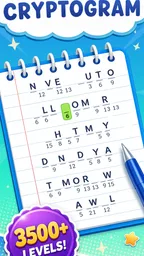
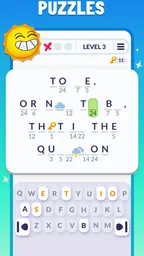
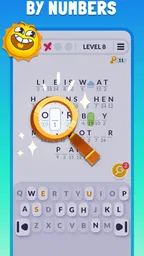
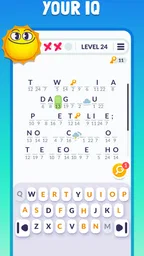
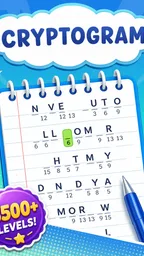
The game’s central challenge is language-based deduction. I look for familiar word shapes, repeated letters, and the way a possible answer fits the surrounding message. That gives each puzzle a useful rhythm: make a tentative guess, see how it affects other words, then revise if the sentence stops making sense. It is satisfying when a small observation unlocks several letters at once.
This is a word game from Tripledot Studios Limited, and its appeal is easy to understand if you enjoy solving a phrase rather than simply finding letters on a board. The hidden-message format gives the reasoning a clear destination: I am not just filling boxes, but trying to make a sentence cohere. That can make a successful solve feel more earned than a quick round of word matching.
There is also a particular reading demand here. A cryptogram depends on noticing letter patterns and holding a few possibilities in mind. Readers who enjoy language puzzles may find that engaging; anyone who finds dense text tiring may have a harder time, especially when the answer is not apparent from context. I would approach it as a focused puzzle, not as a game that can be played comfortably while trying to read something else.
Navigation and the pace of solving
The most useful way to approach a difficult message is to avoid committing too early. I start with short, common-looking words and repeated patterns, then test whether a guess makes the rest of the sentence more plausible. A letter that appears in several places can provide more leverage than a confident-sounding guess for a single long word. This method keeps the puzzle from turning into random trial and error.
If I get stuck, stepping away briefly can be more productive than staring at the same arrangement. When I return, I tend to spot a pattern I had been overlooking. That makes the game suitable for short breaks, provided I am comfortable leaving a thought unfinished and picking it up again. I would not assume every session will end with a neat, quick solve; the enjoyment comes partly from working through uncertainty.
Cryptograms are less forgiving than many familiar word-game alternatives. A word search lets me scan for a visible answer, while a crossword often supplies crossing letters and explicit clues. Here, I have to build the clue from the coded text itself. That is the game’s strength for people who like deduction, but it is also why someone seeking a relaxed, immediately readable puzzle might prefer a simpler word search.
The store description presents the game as a way to exercise logic, and that is a fair way to think about its basic appeal without treating it as a promise of measurable cognitive benefits. I am making connections between letter patterns and plausible language. The value is in the activity and the satisfaction of solving, not in any guaranteed result beyond the puzzle.
Motor and sensory considerations
Because the challenge is centered on reading and reasoning rather than fast action, the game may suit players who prefer a slower pace. There is no need to react to an opponent or keep up with a rapid sequence of events. That can make a cryptogram feel calmer than many games, particularly when I have only a few minutes and want to focus on one small problem.
At the same time, a text-based puzzle is not automatically easy for everyone. It relies on being able to inspect letters and compare repeated patterns. If small or closely spaced text is uncomfortable to read, or if selecting individual letters is difficult, that can become a meaningful barrier. I would check how the game looks and feels on the device I plan to use rather than assuming the puzzle format itself guarantees an accessible experience.
A practical tip is to play when I can give the message proper attention. Reading the sentence aloud, or quietly forming possible phrases in my head, can help me notice whether a guess sounds natural. That does not require any special skill, but it does make the game’s language focus more useful. It is less helpful if I am in a noisy place or trying to split my attention between several tasks.
For sensory preferences, the slower reasoning loop may be welcome if rapid movement and time pressure are not what I want from a game. Still, I would not treat it as a substitute for a dedicated accessibility tool or assume that every visual or input preference is covered. The deciding question is simple: can I comfortably read the coded text and make the required selections on my screen?
Where it fits into an ordinary day
I can see myself opening it during a quiet wait, such as sitting before an appointment, or while taking a short break between tasks. A cryptogram is a better fit for that moment than a game that expects me to keep track of a fast-moving round. I can spend a little time testing a word, pause when I need to, and return when I have enough attention to think through the sentence again.
That same scenario has a limit: if I have only a few seconds or need to stay alert to what is happening around me, a word puzzle that asks for careful reading is not ideal. Nor would I choose it as background entertainment while listening closely to a conversation. The game’s low-pressure style does not remove the concentration its central task requires.
It may also work well for someone who wants a solo activity with a clear mental challenge rather than a social game. The experience is built around my own reasoning; the satisfaction is in finding the pattern. If I am looking for competition, shared play, or a story-led adventure, this is probably not the kind of word game I would choose first.
On Android, it is listed as free and rated Everyone, with a minimum operating-system requirement of 7.1. The current version is 1.17.00, and the game includes optional in-app purchases ranging from $0.49 to $99.99 per item. I would keep that in mind if I am installing it for a child or simply prefer to avoid spending inside games: free to download does not mean every possible purchase is free.
Who is likely to enjoy it—and who may not
The strongest audience is people who enjoy cryptograms already, or who like working out phrases from clues and patterns. It is also a reasonable starting point for a player curious about coded messages, as long as they are willing to spend time thinking through a puzzle instead of expecting instant answers. If I enjoy the moment when a small deduction makes the whole sentence click, this format has a clear appeal.
I would be more cautious about recommending it to someone who wants a word game that is easy to dip into without reading carefully. A word search is usually more direct; a crossword can provide more explicit clues; a spelling game may feel more like quick practice. Those alternatives are better if the player wants visual scanning, familiar definitions, or a brisker pace rather than inference from a coded sentence.
It is also worth considering how comfortable the player is with ambiguity. A cryptogram may leave several possible interpretations open until more letters fall into place. That uncertainty is part of the puzzle, not necessarily a sign that the player is doing something wrong. But if a person finds open-ended guessing frustrating, this may feel like work rather than a relaxing diversion.
The game has an average rating of 4.9 from around 13,000 ratings, and it has passed 500,000 installs. Those figures suggest that it has found an audience, but they cannot tell me whether its reading and input style will suit a particular person. I would put more weight on whether the core activity—carefully decoding a sentence—sounds enjoyable to the person who will play it.
What to keep in mind before installing
The main trade-off is focus. Cryptogram: Logic Puzzle Game offers a specific kind of word challenge, and that focus is welcome when I want to reason through a message. It is less versatile than a collection of different puzzle types would be, and it will not satisfy someone who wants each round to rely on a completely different skill. The experience stands or falls on whether coded text is appealing to me.
Another useful expectation is that getting stuck is part of the process. I would try a few likely patterns, reconsider a guess when it makes the sentence awkward, and take a break rather than forcing an answer. That approach makes the puzzle feel more like deduction and less like repeatedly tapping at possibilities. It is a small change in how I play, but it can make a difficult message feel manageable.
For families, the Everyone age rating makes the game broadly suitable by content, while the puzzle itself still asks for reading and language reasoning. Younger players may enjoy the challenge if they are comfortable with written words, but the age label alone does not say how easy the puzzles will feel to them. I would treat it as a shared activity if a child needs help discussing possible words, rather than assuming every player will find the same level of difficulty.
One more consideration is the purchase model. Since optional items can range from inexpensive to much more costly, I would review any purchase prompt carefully before confirming it. That matters most for people who want a strictly no-spend experience or are setting up a device for a child. The game can still be considered as a free download, but I would not ignore the possibility of paid items while deciding how to use it.
A measured recommendation
For a clear sense of its appeal, Cryptogram: Logic Puzzle Game is best approached as a quiet exercise in reading patterns, not as a fast or varied word-game collection. I would recommend it to a friend who likes solving coded phrases and has a comfortable way to read and select letters on their device. The everyday convenience is real: it can fill a calm pause with a focused puzzle, and a good deduction can make the whole message fall into place.
I would suggest a different option for someone who needs larger or more adaptable text, who struggles with letter-by-letter interaction, or who wants quick rounds with little reading. Those are not minor preferences in a game where the words themselves are the interface and the challenge. For players who do enjoy this format, though, the deliberate pace is a genuine advantage rather than a flaw.
Overall, I find it a promising choice for patient word-puzzle fans, with a distinct appeal that separates it from crosswords and word searches. Its inclusive fit depends less on a label than on the player’s comfort with text, attention, and input. If those line up, Cryptogram: Logic Puzzle Game offers a satisfying reason to pause, look again, and let a hidden sentence slowly make sense.
What we like
- The interface is clean and easy to navigate.
- Hints can help when a quote is difficult to solve.
- Puzzles offer a calm way to exercise pattern recognition.
- Short levels make it easy to play in spare moments.
- New quotes provide variety across puzzle sessions.
What could be better
- Some quotes may be unfamiliar to younger players.
- Repeated puzzle formats can feel predictable over time.
- Hints may reduce the challenge for experienced players.
- Ads can interrupt the flow of play.
- Progress may depend on an internet connection.







