
Crostic Crossword-Word Puzzles review
 Analysis by Appsdrops
I can see Crostic Crossword fitting into a shared household routine more naturally than a long, attention-hungry game. One person can open it while waiting for dinner, another can take a turn later, and the appeal is easy to explain: work through word puzzles at your own pace. My main reservation is that a shared device can blur whose progress or preferences are being used, so I would treat it as a game for one player at a time rather than assume it offers household profiles or coordinated play.
How it fits into a shared day
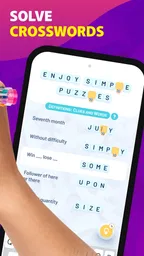
The game is a word puzzle from Severex, built around crossword-style solving and logic clues. That makes it a good candidate for small breaks: I can imagine opening a puzzle during a quiet few minutes, trying a few answers, then putting the phone down when something else needs attention. It asks for concentration, but the basic idea is familiar enough that someone else nearby can understand what I am doing without a tutorial or a long explanation.
A realistic household use is a short handoff after a meal: one person starts a puzzle, pauses when the conversation moves on, and another takes a look later. The useful part is that solving can invite discussion—someone may notice a word pattern or suggest a different interpretation. The trade-off is that this kind of shared solving works best when everyone agrees not to overwrite another person’s train of thought. If you prefer a game that explicitly supports multiple players taking turns or competing, I would choose a title designed for that rather than rely on informal cooperation here.
Its daily-puzzle framing can also give a household a simple routine: a person who enjoys word games may make it part of a morning coffee break, while others dip in only when they feel like it. I would not turn that into a commitment. A daily rhythm is appealing when it creates a pleasant prompt, but it can feel like an obligation if the player is trying to keep up rather than enjoy the solving.
Keep the device handoff simple
On a shared phone or tablet, I would decide up front whether the game belongs to one person or is an open puzzle everyone can contribute to. That small agreement avoids a common frustration: one player has a clue in mind, another changes the board, and neither remembers where the first person left off. If you want distinct progress for different household members, check the game’s current account and save options in the app before making that assumption. I would not count on separate profiles or family coordination tools without seeing them available.
For a casual group, a low-tech approach is often enough: let one person control the device and invite suggestions from the others. It keeps the puzzle readable and makes it clear who is entering answers. If the household prefers independent play, each person can use their own device instead of treating a single installation as a shared record. That is less social, but it avoids mixing one player’s pace with another’s.
There is also a practical distinction between sharing the screen and sharing an account. A child or guest might be able to play a puzzle on the device, but that does not automatically mean their activity, settings, or purchases are separated from the main user. I would check who has access to the device’s app-store account before handing it over, especially if in-app purchases are enabled. The game is free to download, with optional purchases listed from $0.99 to $12.99 per item, so a quick household rule about asking before buying is sensible.
Who will enjoy solving these puzzles
I would recommend it to people who like recognizing word patterns, testing possible answers, and taking a measured approach rather than racing through a level. It sits between a traditional crossword and a light logic challenge: the satisfaction comes from working out how words fit, not from fast reactions. If you enjoy solving quietly, or like having a puzzle that can spark a bit of group brainstorming, this is a stronger fit than a reflex-based mobile game.
One useful way to play is to separate “I know the word” from “I know why it fits.” When a possible answer comes to mind, I would pause and check whether it satisfies the clue and the crossings rather than entering the first plausible word. That habit is especially helpful when several answers seem close. It turns the puzzle into a reasoning exercise instead of guesswork, and it gives a shared-device group a clearer basis for discussing a suggestion.
Another practical tip is to change the kind of thinking when you get stuck. Rather than repeatedly trying near-synonyms, look at the letters already established and ask what word shapes remain possible. If the app’s puzzle layout gives you intersecting answers, those crossings can narrow the choices; even when they do not immediately reveal a solution, they help identify which assumption may be wrong. This is a more useful reset than tapping randomly, and it keeps the experience calm for players who do not want hints to become the whole game.
The game is less suitable for someone who wants broad social features, a competitive leaderboard experience, or a multiplayer mode as the main attraction. It is also not my first pick for a player who dislikes written clues or prefers visual, spatial puzzles. Compared with a standard newspaper-style crossword, this app is more convenient for casual phone play and presents its puzzles in a mobile format; compared with word-search games, it asks for more inference and less scanning. If your priority is a large, themed crossword grid or a specific puzzle tradition, a dedicated crossword app may be a better match.
Age, purchases, and household trust
The content rating is Everyone, which makes the game broadly suitable in age terms, but that label is not a substitute for a parent deciding what a child should play or whether purchases should be available. The word-solving premise is easy to understand, and adults can join in without the game needing to be treated as a children-only activity. In a household with younger players, I would still show them how to ask before making any purchase and keep the device’s normal purchase protections in mind.
I would also set expectations about help. If someone in the household is learning new vocabulary, working through a clue together can be more rewarding than immediately giving them the answer. A good routine is to offer a hint in the form of a question—what letters are already fixed, or what kind of word could fit—then let the player make the final choice. That keeps the puzzle theirs while making it accessible to a range of experience levels.
There is no need to assume the game provides family accounts, child-specific settings, or a way to coordinate household progress. Before relying on any such feature, I would look at the current options inside the app and the device’s own account settings. For shared use, the simplest trustworthy arrangement is to keep purchases under the account owner’s control and to agree whether other players may change the active puzzle.
What the numbers say—and what they do not
Crostic Crossword has a 4.7 average from around 286,000 ratings, with about 1,500 written reviews and over 10 million installs. Those figures suggest that the word-puzzle format has reached a large audience, but they do not tell me whether a particular household will like its style. I would put more weight on whether the people using it enjoy clue-based reasoning and can tolerate a puzzle that takes a little thought.
The game was released on October 7, 2022, and its current version is 7.4.0. It requires Android 8.0 or later, and it is free to start. That makes it easy to try without paying upfront, although the optional purchases mean I would check the purchase flow before letting someone else use the device. Its Everyone age rating is reassuring for general content suitability, while ordinary account supervision remains the household’s responsibility.
For a household deciding between this and familiar alternatives, I would frame the choice around how people want to spend a break. A word search is better when you want something visually quick and low-pressure; a classic crossword may suit someone seeking a more traditional grid and a longer solve. This game is appealing in the middle: it gives word lovers a reason to pause and reason, without asking the household to organize a full game session. That middle ground is also its limitation if you need distinct player records, explicit turn-taking, or a strong social layer.
My household verdict
I would recommend it as a relaxed word game for one person, with the option of letting nearby family members contribute ideas. Its best household use is informal: a shared puzzle on a quiet evening, a quick solo session between tasks, or a small daily ritual for someone who enjoys clues. It is not a substitute for a multiplayer party game, and I would not treat a single device as a reliable system for keeping several people’s progress separate.
Severex has made a straightforward choice for players who like words and logic more than speed. The free entry point lowers the risk of trying it, while the optional purchases make a little purchase-awareness worthwhile on a shared device. If your household is comfortable agreeing who controls the screen and who may make purchases, I think it can be a pleasant, low-key addition. If you want family profiles, coordinated turns, or a more traditional crossword experience, I would look for an alternative built specifically around those needs.
What we like
- Clues use short text passages rather than isolated definitions.
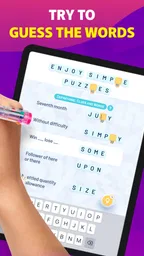
- Completed answers reveal letters that help solve other entries.
- Puzzles offer a calm alternative to timed word games.
- The format rewards attention to spelling and letter patterns.
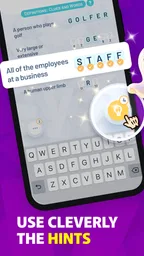
- A hint option can help when a clue feels difficult.
What could be better
- Some clues may require vocabulary beyond everyday words.
- A single wrong answer can make connected entries harder to solve.
- Players seeking a competitive challenge may find the pace slow.
- Puzzle variety may feel limited after many sessions.
- Hints can reduce the satisfaction of solving clues independently.







