




Coin Master - Board Adventure review
 Analysis by Appsdrops
I found that Coin Master makes its appeal easy to grasp: each roll can move you toward building a town or give you a chance to interfere with a friend’s score. That quick loop suits short visits better than a game that asks for a long, uninterrupted session. The interesting question is whether those small goals keep feeling worthwhile once the novelty wears off. In my view, they can, provided you enjoy a relaxed, luck-driven pace and don’t expect every session to deliver a meaningful step forward.
Small goals make the first sessions easy to follow
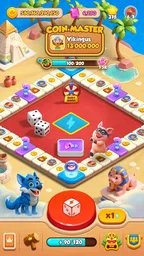
As a casual game from Moon Active, Coin Master gives new players a simple direction: use dice rolls, make progress on your town, and see how your results compare with friends. I like that the basic objective is understandable without a complicated strategy lesson. You can start with a modest aim—make a little progress, check what the next step asks of you, then decide whether to keep playing or put the game away.
That clarity matters on a phone. If I have a few spare minutes while waiting for a ride or taking a break, I don’t want to spend the whole session learning menus before I can act. The game’s central loop is easy to pick up, and its town-building gives the rolls a visible purpose beyond simply chasing a score. For players who enjoy seeing a place develop in small increments, that connection between chance and construction is the main early hook.
The trade-off is that rolling is not the same as making a careful tactical choice. You can decide when to engage, but the appeal depends heavily on accepting uncertainty in what a roll will lead to. If you want a puzzle where every move rewards planning, this may feel thin. I’d approach it as a lightweight game for passing time, not as a test of deep decision-making.
Progress you can notice, even when it is gradual
The town gives progress a more tangible shape than a number alone. Instead of treating every session as a race for a personal best, you have a setting to build and a sequence of goals to work through. That’s a useful design choice for casual play: a small contribution can still feel like it belongs to a larger project. When I’m deciding whether to open a game again later, a clear next objective is more motivating than an abstract score that has no context.
There is also a social nudge in the invitation to challenge friends’ high scores. It can make a routine session feel more lively if your friends already play and you enjoy comparing outcomes. But this is a different kind of motivation from cooperative play. The emphasis is on your own result against someone else’s, so people who prefer shared goals or a quiet solo experience may not find the social angle especially compelling.
A practical way to enjoy the progression is to set a small stopping point before you begin. For example, I might play until I’ve made a useful bit of town progress, then leave the next goal for another break. That keeps a casual game from turning into an open-ended attempt to force one more favorable outcome. It also makes it easier to judge whether I’m having fun with the loop itself, rather than simply hoping the next roll will be better.
Challenge comes from uncertainty, not intricate tactics
The challenge here is best understood as managing expectations. Dice rolls introduce unpredictability, while town-building supplies a longer-term reason to care about what happens. That pairing can be satisfying: a session may feel lively because the outcome is uncertain, but the overall direction remains easy to understand. It’s a softer kind of challenge than mastering a complex control scheme or learning a competitive strategy.
That distinction helps set expectations for different players. If you like casual games where luck and incremental goals share the spotlight, the uncertainty can keep a short session from feeling entirely routine. If you dislike outcomes you can’t control, the same quality can become frustrating. I wouldn’t recommend it to someone who expects every attempt to translate into predictable progress or who wants a skill-based contest to be the main event.
Compared with many familiar casual alternatives, Coin Master puts more weight on its combination of rolling, town advancement, and score comparison than on a sequence of logic puzzles or dexterity challenges. That makes it a better fit for relaxed checking-in than for focused play where I want to improve through precise execution. Neither style is inherently better; the important difference is whether uncertainty feels playful to you or like a barrier between effort and reward.
A steady rhythm, with reasons to pause
The game’s easy entry can also create a retention pressure: because the basic action is simple, it’s tempting to keep going for just one more result. I find that most manageable when I decide what counts as a satisfying session before opening the game. A short break with a clear endpoint is a healthier fit than treating every unfinished objective as something I must complete immediately.
Spending is another reason to be deliberate. Coin Master is free to download, but it offers in-app purchases priced from $0.49 to $249.99 per item. That broad range is worth noticing before you begin, especially if you’re prone to making impulse purchases when progress feels slow. I’d recommend playing without assuming that buying something is necessary; decide on a personal spending limit in advance, or simply keep purchases disabled if you want the experience to remain free.
For an ordinary day, I can see the game working well as a small routine: open it during a lunch break, make a little progress, compare a score if friends are involved, and close it when the session stops being enjoyable. It is less suited to someone looking for a fully self-contained, story-led experience to sink into for hours. The value comes from returning to a simple cycle, so players who tire quickly of repetition may find the long-term rhythm less appealing than the first few sessions.
Who will enjoy returning—and who should look elsewhere
Coin Master is a reasonable pick for people who want low-pressure mobile entertainment, like watching a town develop, and don’t mind chance playing a large role. Its Everyone content rating makes it broadly accessible, though I’d still suggest that families discuss optional purchases and screen-time expectations. The game is free, which makes it easy to try without paying upfront, but that should not be confused with a promise that every part of the experience is free of purchase prompts or spending temptation.
Its audience is substantial: it has over five million installs, with a 4.8 average from around 78,000 ratings and about 6,200 written reviews. Those figures suggest many players have found the casual loop appealing, but they don’t guarantee that it will suit your tastes. I’d put more weight on whether you enjoy luck-based progress and social score comparisons than on popularity alone.
If your usual alternative is a match-three or word game, ask yourself what you want from a break. Those games often center on solving a defined challenge; Coin Master instead gives you a broader building goal and a more chance-led session. If you want a strategic board game, a detailed city builder, or a game where skill reliably determines outcomes, another option will likely serve you better. This one is at its best when the goal is simply to enjoy a few casual minutes without demanding full concentration.
Version, access, and the long-term verdict
The current version is 3.5.2782, and it runs on Android 7.0 or later. Those details are useful if you’re checking compatibility before installing, while the free entry point keeps the initial decision straightforward. I’d still review the purchase settings on the device you plan to use, particularly if the game will be available to children or shared with family members.
What keeps the progression working is the contrast between a small immediate action and a larger visible aim. A roll is quick; developing the town gives it context; a friend’s score can add a personal comparison. None of that removes the central limitation: progress is tied to outcomes that may not match your preferred pace. My most useful advice is to treat each visit as a short opportunity, not a commitment to complete a goal at any cost.
Overall, I’d recommend Coin Master to a friend who enjoys casual games, likes incremental building, and can take uncertain results in stride. I would steer a friend toward a more skill-focused or puzzle-driven game if they want dependable progress from every move. The game’s early goals are clear, its progress is easy to recognize, and its pacing can fit everyday breaks—but it works best when you set your own stopping point and keep the spending pressure at arm’s length. For that kind of player, Coin Master offers an approachable reason to return without pretending to be a deep strategy game.
What we like
- Quick rounds make it easy to play during short breaks.
- Village upgrades provide clear goals and a sense of progression.
- Raids add variety beyond spinning the slot machine.
- Friends can share rewards and compete on leaderboards.
- The cartoon visuals are bright and easy to follow.
What could be better
- Progress depends heavily on random spins.
- Waiting for spins can interrupt longer play sessions.
- Optional purchases may encourage repeated spending.
- Raids can cause other players to take your coins.
- Frequent events and offers may feel distracting.







