




Charades Guess Game — Guessly review
 Analysis by Appsdrops
I like party games that get people talking before anyone has time to worry about playing well. Charades Guess Game — Guessly is built for that kind of gathering: one person tries to identify a word while friends or family help them along. Its appeal is less about mastering a complicated system than about turning a small prompt into a lively group moment. That makes it easy to consider for a casual evening, though it also means the people in the room matter as much as the game itself.
A quick start for a roomful of people
Guessly is a free word game from smak apps, aimed at players who want a shared activity rather than a solo puzzle. It has a 4.6 average from around 77,000 ratings, and more than a million installs. Those figures suggest that the basic party-game idea has broad appeal, but they don’t guarantee every group will click with it. Charades works best when everyone is willing to guess, gesture, explain, or laugh at a wrong answer.
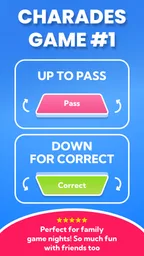
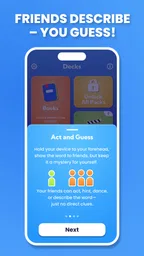
The central loop is familiar: a word is presented, and the player or team has to work it out with help from others. That familiarity is a strength. A new player can understand the point without a tutorial-heavy introduction, and the host can explain the rules in a sentence before handing over the phone. In my view, that low barrier is exactly what makes a word party game useful when guests have different ages or gaming experience.
The game is rated Teen, so I would still check that it suits the people joining in, especially if younger children are part of a family gathering. The game is currently at version 1.9.0 and requires Android 7.0 or later. It is listed as free, with in-app purchases ranging from $7.99 to $49.99 per item, so I’d look at the purchase options in the app store before letting a child use it or treating it as a no-cost activity.
Make the group part of the setup
For a smoother first round, I’d decide who holds the phone and how the group will take turns before starting. Passing a device around can interrupt the flow, particularly in a crowded room, so having one person manage the screen while everyone else participates can keep attention on the guesses. If the group is large, split into teams or take turns in a clear order; otherwise, the loudest players can unintentionally dominate.
A practical use case is a family visit where conversation has started to flag. Rather than asking everyone to learn a new board game, the host can bring out Guessly and begin with a short round. It also suits a casual get-together where people are standing or moving around, since the fun comes from communicating a word, not from settling in for a long session. I’d be less likely to choose it for a quiet meal or a group where some people dislike being put on the spot.
Words set the mood
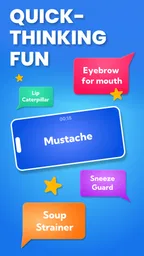
Charades has a simple visual language: the screen supplies the prompt, and the players supply the performance. That division gives the phone a practical role without making it the centre of attention. The room becomes the setting, and gestures, facial expressions, and improvised clues become the “art direction” the group creates for itself. The result can feel silly and energetic, but it depends on players being comfortable making a little spectacle of themselves.
That simplicity is also a trade-off. A word game’s personality depends heavily on whether its prompts feel suitable and understandable for the people playing. A mixed-age group may interpret the same clue differently, and a word that is obvious to one person can be obscure to another. I’d treat a confusing prompt as a chance to keep the round moving rather than a reason to debate the answer. A good host can preserve the mood by switching turns or letting the group agree on a reasonable guess.
One useful way to make the experience more welcoming is to establish a no-pressure rule: players can pass, and nobody has to perform if they would rather guess. This is a small social adjustment, not a game feature, but it matters. It helps shy guests join the group without making them feel that the entertainment depends on being theatrical. Conversely, if your friends love acting out clues, let them take the lead and give quieter players the role of guesser.
Sound, timing, and the room
The most important rhythm in a charades game comes from the people playing. A prompt creates a brief burst of action, followed by a guess, a reaction, and the next turn. That stop-and-start pattern works well when rounds stay brisk. If players pause for too long, the group’s attention can drift; if everyone shouts suggestions at once, the person guessing may have trouble following any of them. I’d encourage one clue-giver at a time, then let the rest of the group add ideas if the first attempt stalls.
I wouldn’t plan a gathering around assumptions about particular sound effects or audio controls. Instead, make the room itself work for the game: keep conversation low enough for guesses to be heard, and place the phone where the active player can see it without blocking the group. In a noisy setting, use clear gestures and short spoken clues, and avoid having several conversations compete with the round. These choices do more to protect the pace than trying to turn every moment into a performance.
Another practical tip is to use Guessly in short bursts rather than letting it run indefinitely. A few rounds can break the ice; a longer stretch may tire people who are not keen on acting or rapid guessing. I’d pause when the energy drops and return to the game later, rather than pushing through until it feels like an obligation. That makes it a better fit for a flexible social evening than for a tightly scheduled event with a fixed-length program.
Where it sits among word games
Compared with a crossword or a word-search app, Guessly is explicitly social: the puzzle is in the exchange between the person holding the prompt and the people trying to decode it. Those solo alternatives are better when you want a quiet activity, a personal challenge, or something you can play in short pauses without recruiting anyone else. Guessly, by contrast, needs a willing group to reach its potential, and its strongest moments come from shared misinterpretations and spontaneous clues.
It also differs from a board game that asks players to manage pieces, points, or a longer strategy. The lighter format is convenient when there is little time to explain rules or set up a table. The downside is that the social experience can be uneven: one confident performer may carry a round, while a hesitant player may feel exposed. I’d choose a more structured team game if my group preferred clear turns and tactical decisions; I’d choose a solo word puzzle if I were playing alone.
For a group with mixed confidence, a useful workflow is to rotate roles deliberately. Let one person guess in one round and offer clues in another, rather than leaving the same outgoing player in charge throughout. It gives everyone a way to participate and helps reveal whether the game suits the group. If people are enjoying the guessing but not the acting, keep the clue-giving simple and let them contribute from their seats.
Free to begin, with a purchase decision to consider
Because the game is free to download but includes paid in-app items, I’d distinguish “free to try” from “free of all spending.” The listed item prices range from $7.99 to $49.99. Before a party, I’d check what is offered and whether any purchase is needed for the way I intend to use the game. I would not assume that a paid item is necessary for a good time, but I would make sure the person hosting knows where purchase prompts may appear.
That caution is especially useful if the phone will be passed to guests or used by children. Keep purchase decisions with the host, and don’t make a purchase just because a group is waiting for the next round. A party game should be easy to start without turning the middle of a gathering into a billing decision. The app’s free entry point is convenient, but the in-app price range is worth knowing before you settle on it as the evening’s main activity.
Who I’d invite to play
I’d recommend Guessly to friends and families who enjoy quick wordplay, expressive clues, and a bit of harmless chaos. It is especially promising as an icebreaker for people who already feel comfortable joking together, or as a short change of pace between other activities. The developer is smak apps, and the game’s focused charades premise gives it a clear role: bring people around a prompt and see how they communicate.
I’d skip it when the group wants a calm, individual pastime, when participants dislike performing, or when the setting is too loud for people to hear one another. It may also be a poor fit if you need a highly structured game with detailed strategy or a dependable session length. The simplicity that helps newcomers join is the same simplicity that may leave players wanting more depth after several rounds.
My overall impression is that Guessly is at its best when treated as a social spark, not as a complete evening plan. It gives a group an easy reason to gesture, guess, and laugh together, while the people in the room provide most of the atmosphere. Set expectations, keep turns moving, and make participation low-pressure. If that sounds like your kind of gathering, this word game is worth trying; if you want a quiet puzzle or a more elaborate game, another option will serve you better.
What we like
- Easy-to-understand rules make it quick to start playing.
- A lively option for parties and group gatherings.
- Guessing prompts can encourage teamwork and conversation.
- Rounds can be played without complicated setup.
- Suitable for players with different levels of experience.
What could be better
- The game is less enjoyable with only a few players.
- Some prompts may not suit every age group.
- Gameplay can feel repetitive after several rounds.
- A noisy room can make clues difficult to understand.
- Players may need extra space to act out clues.







