


Ball Bounce review
 Analysis by Appsdrops
The appeal of Ball Bounce is easy to understand: aim a shot, watch balls rebound through a field of bricks, and try to make each turn count. I like it best as a small, focused game for brief breaks rather than something that asks for a long, uninterrupted session. Its simple premise leaves room for satisfying little moments of planning, though it also means the experience depends heavily on whether you enjoy repeating a familiar kind of shot.
A bright, uncluttered first impression
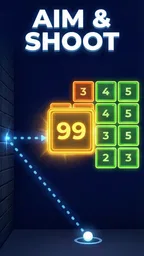
This is a casual game from Gimica GmbH, built around the familiar pleasure of sending a ball into a crowded arrangement and seeing what happens. The visual idea is straightforward, which helps the action register quickly on a phone screen: bricks give you clear targets, while the balls’ bouncing paths supply the movement and surprise. I don’t need a tutorial-heavy introduction to understand the basic attraction.
The game’s mood comes less from a detailed setting or cast of characters than from its clean, arcade-like focus. There is little narrative to distract from the central loop, and that is part of the point. If I have a spare moment while waiting for a kettle to boil or sitting through a short commute, I can pick it up, take a shot, and get the satisfaction of watching a chain of impacts unfold.
That immediate readability is a real strength, but it also sets expectations. Ball Bounce is not the choice I’d make when I want a richly illustrated world, a story to follow, or a big range of activities. Its personality is in the play itself: aiming, anticipating rebounds, and deciding how to get more value from a shot.
Visual language built around the bounce
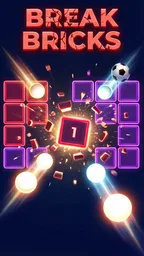
The brick-and-ball setup gives the screen a clear visual hierarchy. The bricks are the problem to solve; the balls are the means of solving it; and the trajectories are the part I watch most closely. That clarity matters in a game where a single launch can produce a lot of movement. I can focus on the board rather than sorting through decorative details.
In this kind of game, art direction does useful work when it makes the important objects easy to distinguish and the outcome of a shot easy to follow. Ball Bounce’s basic visual language supports that kind of quick reading. The trade-off is that players who want changing scenery or a strong sense of place may find the presentation more functional than transporting. I see it as an arcade tabletop mood, not an attempt to build an expansive world.
A practical tip is to pause for a beat before firing rather than treating every turn as a reflex test. Look for places where a ball might travel through several openings or contact multiple bricks before returning. That small habit makes the board feel less like a random target field and more like a route-planning puzzle, without requiring elaborate preparation.
Rhythm, sound, and the pace of a session
The rhythm is naturally shaped by the contrast between a quiet aiming moment and the flurry that follows. The shot is the decision; the bouncing storm is the payoff. I find that pattern easy to enjoy in short bursts because it gives each turn a clear beginning and resolution, even when the action itself is busy.
Sound can make repeated impacts feel more tactile, but the core appeal does not depend on a complicated audio landscape. The game’s mood is primarily carried by the visual cascade and the timing of the turn. If you usually play with your phone muted, the basic idea still makes sense; if you prefer games where music and sound effects build a distinctive atmosphere, this one may feel comparatively restrained.
Its pacing also has a useful everyday quality: I can fit in a quick session without needing to remember a plot or manage a lengthy sequence of objectives. The downside of that convenience is repetition. When the same basic decision-and-bounce pattern stops feeling rewarding, there may not be enough variety in the central mechanic to hold my attention for a long stretch. I’d treat it as a regular short-session option, not assume it will become my main game.
What makes a shot feel thoughtful
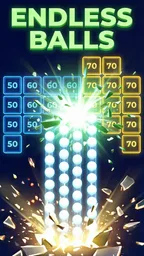
The satisfying part is not simply launching as many balls as possible; it is choosing a line that lets their rebounds do useful work. Aiming toward a gap or a position that opens up more contact can turn one shot into a much busier sequence. The store summary’s idea of stacking balls points toward that central pleasure, but the appeal in practice is the anticipation: I try to picture where the shot will travel before the board fills with motion.
One useful approach is to value access as well as immediate hits. A shot that reaches a less crowded area may create better opportunities on the next turn than one that only produces a quick cluster of impacts. That is a small but meaningful trade-off: the most visually dramatic result is not always the most helpful one. I’d recommend paying attention to where the balls finish and how the remaining arrangement changes, not just to the number of bricks struck in the moment.
Another tip is to resist firing as soon as the board looks busy. When several possible angles are available, take a moment to compare which route seems likely to keep the balls active and which might send them straight back. That habit gives the game a little more strategy without turning it into a slow, demanding puzzle. It is especially useful for players who enjoy improving through small decisions rather than relying on quick reactions.
Compared with many casual alternatives that focus on matching symbols, dodging obstacles, or tapping in time, Ball Bounce puts more weight on angle and rebound. That makes it a better fit if you enjoy visualizing a path and watching a plan play out. A match-three game may be a better pick if you want combinations and changing tile patterns; a reflex arcade game may suit you more if you want constant input. Here, the most rewarding moment often comes after the launch, while the balls trace the consequences of your choice.
Who will enjoy it, and where it can fall short
I’d recommend it to someone who likes compact arcade puzzles, enjoys aiming at a crowded board, and wants a game that is easy to understand in a few moments. It can also work well as a low-commitment distraction during a break: the turn-based rhythm gives me a natural point to stop instead of demanding that I keep moving at full speed.
It is less suited to players who need a steady stream of new mechanics, a strong narrative, or a highly varied visual world. The same focus that makes the game accessible can make it feel repetitive over longer sessions. If you know you tire quickly of repeating a core action, I’d suggest trying it in short visits and seeing whether the planning-and-rebound loop remains satisfying before making it a regular habit.
The game is free to play, with optional in-app purchases priced from $0.99 to $3.49 per item. I would approach those purchases as optional rather than as the reason to try it: the central appeal is the basic act of lining up a shot and watching the rebounds. It is rated Everyone, so its uncomplicated casual presentation is suitable for a broad audience. The key question is not whether you need a particular gaming background, but whether you enjoy this specific kind of repeated aiming.
A familiar loop with a clear audience
The numbers suggest that plenty of players have found the same quick appeal: it has a 4.5 average from around 142,000 ratings, and it has passed 5 million installs. Those figures offer a sense of its broad reach, but they do not tell me whether its rhythm will suit you. My own recommendation is based on the game’s particular balance of a simple launch, a busy rebound sequence, and just enough room to make a more considered choice.
Ball Bounce was released on December 23, 2021, and its current version is 1.13.0. It supports Android 7.0 and later. I mention that because it is a straightforward option for someone checking whether an older Android device meets the basic requirement, rather than a game whose appeal depends on a cutting-edge setup.
For an ordinary use case, picture a short wait where you want something more engaging than scrolling but don’t want to commit to a long story or a multiplayer match. This is where the compact loop makes sense: inspect the board, choose a promising angle, watch the cascade, and decide whether you want another turn. If you have a longer session and want substantial progression or frequent changes in play, I would choose a different style of casual game instead.
My take on its playable mood
What holds the experience together is the match between its visual idea and its pacing. A clean field of bricks gives each decision a readable target, while the burst of bouncing movement supplies the excitement. The result is a light arcade mood that stays focused on the board rather than building a more elaborate world around it. For me, that is coherent, even if it is not especially deep.
I’d try Ball Bounce if you like aiming puzzles and want short, self-contained sessions with a satisfying moment of payoff after each launch. I would skip it if your idea of a casual game depends on constant novelty, character-driven storytelling, or a wide variety of mechanics. Its strongest quality is also its main limitation: it knows exactly what it wants to do, and keeps returning to that same pleasure. With over 11,000 reviews, it has clearly inspired a substantial audience, but the best reason to give it a chance is simple: you enjoy thinking about a shot, then watching the board answer back.
What we like
- Simple one-touch controls are easy to learn.
- Short levels suit quick play sessions.
- The bouncing ball makes movement feel lively.
- Timing jumps can provide a satisfying challenge.
- Its straightforward goal is easy to understand.
What could be better
- Repeated obstacles can make later stages feel familiar.
- Precise jumps may take practice to master.
- A missed landing can send you back through a level.
- The simple gameplay may not hold everyone's interest.
- Some sections can feel frustrating when timing is tight.







