
Associations - Colorwood Game review
 Analysis by Appsdrops
I can see why Associations - Colorwood Game might earn a place in someone’s daily routine: it asks you to make connections between words, not race through a timer or master a complicated rule set. In my experience, that makes it an easy game to pick up when I want a small mental reset. The key question is whether that simple pleasure keeps working after the first few sessions. My answer is a qualified yes: it suits players who enjoy spotting themes, though anyone looking for deep strategy or a constant stream of novelty may tire of the format.
Why the first few sessions feel inviting
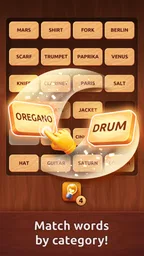
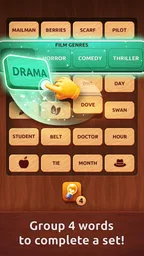
This is a word puzzle game from Burny Games, built around grouping related words into categories. The basic appeal is immediate: scan a collection, look for a shared idea, and test whether the words belong together. I like that the challenge comes from interpretation rather than memorizing controls. You can settle in quickly, even if you only have a little time or are not a regular puzzle player.
The early pleasure comes from the small moment of recognition when several words suddenly make sense as a set. That click is satisfying without requiring a long run-up, and it gives the game a gentler feel than word searches that reward speed or crosswords that depend on definitions and trivia. If you enjoy noticing how everyday words connect, the central activity is likely to feel natural rather than like homework.
For a realistic use case, I’d reach for it while waiting for a takeaway order or winding down after work. A short puzzle can occupy that in-between moment without demanding the attention I’d give a story-driven game. It also works as a low-pressure shared activity: one person can suggest a grouping, another can challenge it, and the conversation becomes part of the fun. That is a better fit than playing when you need a completely hands-off distraction.
The game’s broad accessibility is part of its appeal. It is rated Everyone, and its uncomplicated word-association premise can suit different ages and experience levels. That does not mean every puzzle will be equally obvious to every player; associations depend on vocabulary, familiarity, and how a person interprets a clue. Still, the basic task is easy to understand, which helps make it approachable for casual play.
What makes the puzzle feel different
Unlike a standard word search, where the main job is to locate visible letter patterns, this game asks me to infer a relationship among words. Compared with a crossword, it places less emphasis on recalling a precise answer to a clue. The trade-off is that a grouping can feel subjective: the intended link may be clear once I see it, but my own plausible interpretation can lead me in another direction.
That ambiguity is also where the game can be most rewarding. I find it more engaging when I pause to ask what kind of connection is being tested rather than simply matching words that share an obvious topic. A useful habit is to look for a common role, context, or association, not just a literal category. This approach can help when a group seems almost right but one word refuses to fit.
Its store presence suggests that many players have found the format appealing: the game has an average rating of 4.6 from around 177,000 ratings, with over 5 million installs. I take that as a sign of broad interest, not a guarantee that every player will enjoy the same pace or puzzle style. The word category is a good match for people who prefer thoughtful, compact challenges over reflex-based play.
How it holds up beyond the novelty
The month-to-month question is less about whether the core idea works and more about how much variety a player needs. Grouping words has a satisfying loop, but the same basic action remains at the center. If I enjoy the act of sorting and reconsidering, that consistency can be comforting. If I need new mechanics, a developing story, or a steadily expanding set of skills to stay interested, the format may begin to feel repetitive.
I would treat it as a regular small puzzle rather than a game that must occupy a long evening. That expectation matters. A few focused rounds can feel refreshing; stretching a session simply because the game is available may make repeated category solving feel more alike. The strongest recurring value is its convenience and the moment-to-moment satisfaction of making a connection, not a promise of a radically different experience each time.
One practical way to keep the game enjoyable is to stop when I notice myself guessing mechanically. When I’m engaged, I compare possible links and revise my thinking. When I’m tired, I start trying combinations without considering why they belong together, and the puzzle loses its appeal. Taking a break at that point is more useful than pushing through; the game’s simple premise is better enjoyed with a little attention than treated as background tapping.
It can also be a good alternative to endlessly scrolling when I want something more deliberate but still light. I would not use it as a substitute for a serious study tool or a structured language course, since its appeal is casual wordplay rather than systematic instruction. For someone who simply likes playing with language, though, the act of noticing connections can make a short session feel more mentally active than passive browsing.
Low upkeep, with a few practical trade-offs
There is little to learn before playing, so the maintenance burden is low in the everyday sense: I do not need to remember a complicated strategy or schedule a long session to get value from it. That is useful for a game I might open irregularly. Its current version is 1.34.23387, and the game is free to download, with in-app purchases ranging from $0.99 to $99.99 per item. I would check purchase prompts carefully and decide whether any optional spending fits my own habits rather than assuming the free entry point means every part of play is cost-free.
The Android minimum operating-system requirement is 7.0, which gives the game a broad compatibility range for devices running that version or later. That makes it easier for people with older Android phones to consider, though performance still depends on the device itself. If you are choosing a game for a shared family device, I’d also keep in mind that an Everyone age rating describes its content suitability, not whether every player will find the word associations equally easy.
There are around 3,500 written reviews alongside the rating activity, but I would still judge the game by the kind of puzzle experience I personally want. Ratings can help establish that it has an audience; they cannot tell me whether I prefer loose association puzzles to more exact-answer formats. Burny Games is the developer, and the game’s appeal is specific enough that trying it for yourself is the clearest way to see whether its central loop clicks.
A small but useful choice is matching the game to your energy level. When I have enough focus to compare words, it can be a pleasant reset. When I’m exhausted or distracted, the same open-ended reasoning may feel more frustrating than relaxing. In that situation, a simple matching game or a familiar word search may be a better fit because the goal is more visually direct. This is not a flaw so much as a reminder that “relaxing” depends on whether the puzzle’s kind of thinking suits the moment.
Where repetition and frustration can creep in
The main fatigue risk is the narrowness of the central loop. Once I understand that I am looking for categories, the broad shape of each session is familiar. That clarity is welcoming at first, but it can also make the experience feel samey for players who want fresh systems or a stronger sense of progression. I would skip it if my usual preference is for intricate crosswords, competitive word games, or puzzles with several distinct mechanics.
Another possible friction point is interpretation. Words can belong together in more than one reasonable way, and a player who expects a single obvious answer may become impatient when the intended relationship is not the one they noticed first. My advice is to consider whether a set shares a broader context instead of insisting on the first category that comes to mind. If that kind of flexible thinking feels enjoyable, the ambiguity becomes part of the puzzle; if it feels arbitrary, another word game may be more satisfying.
The game is also not the strongest choice for someone who wants an always-on social competition or a narrative reason to return. Its appeal is the puzzle itself, so the habit has to come from enjoying that activity, not from a larger outside goal. I would recommend it to casual players who like short, self-contained thinking breaks, but not to a friend who needs a deep campaign or clear long-term mastery to stay invested.
To keep it from becoming another app opened automatically and abandoned, I’d give it a particular role: a brief puzzle when I want to think without committing to a long session. That boundary preserves its best quality. It also makes it easier to notice whether I genuinely enjoy the word links or am only opening it out of habit. For a compact word game, that is a more honest test of lasting value than expecting it to replace every other kind of entertainment.
My long-term verdict
Associations - Colorwood Game earns lasting space for players who enjoy turning a set of words into a neat idea and want a low-commitment way to do it. The first-week appeal is its approachable premise and the satisfaction of spotting a connection. Over time, its value depends on whether that core activity remains enjoyable, because the same association-focused loop is both its strength and its limit.
I would recommend it to a friend who likes wordplay, wants a gentle mental break, and is happy with short sessions that do not require a story or a complicated learning curve. I would steer a friend toward a crossword, word search, or more varied puzzle game if they need precise clues, visually obvious goals, or substantially different challenges from one session to the next.
Overall, this is a sensible free-to-start option for casual word-puzzle fans, with in-app purchases to keep in mind and a format that rewards patience more than speed. I would give it a try for the pleasure of finding connections, then keep it only if I still enjoy that small act of reasoning after the novelty wears off. That is where its lasting value lies: not in being an all-purpose game, but in doing one particular kind of word puzzle in a way that can fit naturally into spare moments.
What we like
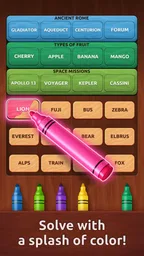
- Colorful visuals make the board easy to scan.
- Short rounds suit quick play sessions.
- Simple controls are easy for new players to learn.
- Sorting challenges offer a relaxing change of pace.
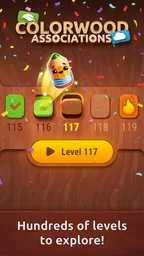
- Levels provide a clear sense of progress.
What could be better
- Some puzzles may feel repetitive after extended play.
- Later stages can require more careful planning.
- Ads may interrupt the flow of play.
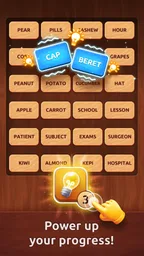
- A small screen can make crowded boards harder to read.
- Players seeking fast action may find the pace slow.







