
Talking Tom & Friends: World review
 Analysis by Appsdrops
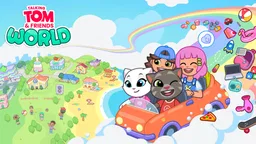
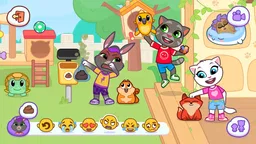
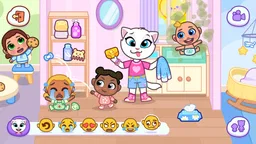
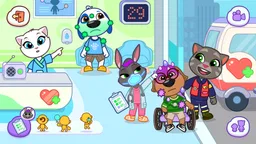
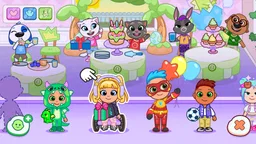
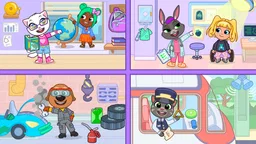
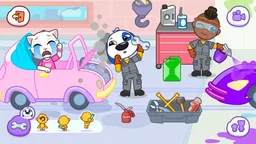
Talking Tom & Friends: World is best approached as a playful place for children to make up small stories, rather than as a structured lesson app or a game with a clear finish line. I like that its central idea is open-ended: children can imagine a scene, explore the characters’ world and decide what happens next. That freedom is the appeal, but it also means parents should not expect a guided learning plan or a tightly paced adventure.
A familiar cast, with room for children to invent
Outfit7 Limited’s educational app sits in the Talking Tom universe, where the characters are the main draw. Instead of treating the experience as a series of lessons, it gives children a setting for imaginative play. That makes it easier to pick up casually: a child can spend a short stretch exploring and inventing a story without needing to understand a complicated objective first.
In my view, the strongest use is not simply keeping a child occupied, but giving them a prompt for conversation. A parent might ask what a character is doing, what should happen next, or how the child would change the scene. Those questions turn screen time into a little storytelling exercise. The app can provide the spark; the richest part may happen when an adult joins in rather than leaving the child to play in silence.
That distinction matters because the educational label can create expectations. I would not choose this as a replacement for a reading, counting or language-learning tool when a child needs a specific skill practised. Its value is more informal: imagination, choosing, and explaining ideas. If your goal is a lesson with visible steps and a defined outcome, a dedicated learning app is likely a better match.
Why the open-ended approach works
Many children enjoy deciding what a game is about instead of following instructions from beginning to end. A character-focused world can make that kind of play feel inviting, especially for a child who already recognizes Talking Tom and Friends. The familiar cast gives them a starting point, while the invitation to create a story leaves room for their own ideas.
A useful way to try it is to give the child a small storytelling challenge before handing over the device: “Make up a reason everyone is together,” or “Tell me what happens after this.” This avoids turning the app into passive background entertainment and gives the session a natural stopping point. It also helps an adult see whether the child is genuinely engaged or simply tapping through without much interest.
For a rainy afternoon or a brief wait before dinner, that flexibility can be more useful than a game that demands a long uninterrupted session. A child can dip in, make a scene or story of their own, then put the device down when the moment is over. I would still set the boundary outside the app; open-ended play does not automatically provide a built-in stopping routine.
Where it may frustrate families
The same freedom that makes the app approachable can leave some children unsure what to do. A child who likes clear goals, challenges and a sense of progression may ask what the point is after the first round of exploration. In that case, an adult may need to supply prompts, or the child may prefer a more directed game. I see this as the main trade-off, not a flaw that every family will notice equally.
It is also worth being realistic about the word “educational.” Story-making can support creativity and conversation, but it is not the same as a curriculum or a tutor. If you are looking for deliberate practice in a school subject, check that the app’s style suits that need before making it part of a learning routine. For many families, it will work better as imaginative play with a conversational bonus than as formal study.
Cost deserves a little attention too. The app is free to download, but it includes in-app purchases ranging from $0.59 to $299.99 per item. That broad range makes it sensible to review purchase controls on the device before a child uses it independently. I would treat the free download as a chance to see whether the play style suits your child, not as a promise that every option inside will be free.
The audience rating is Everyone, and the app is intended for a broad age range, but that does not remove the need for adult judgement. Younger children may need help navigating choices and understanding purchases, while older children may want more challenge than open-ended character play provides. I would pay attention to how the particular child uses it rather than assuming the age label guarantees a perfect fit.
How it compares with other choices
Compared with a conventional educational app built around lessons, quizzes or repeated practice, this is the less structured option. That makes it a more natural pick for a child who would rather invent a scene than answer a sequence of questions. The trade-off is that progress is harder to measure: there may be no clear “lesson completed” moment for a parent to point to.
Compared with a general-purpose drawing or storytelling activity, the Talking Tom setting provides recognizable characters and a ready-made world. That can help a child who finds a blank page intimidating. On the other hand, a child who wants to make everything from scratch may prefer drawing, blocks or a more open creative tool. The best choice depends on whether familiar characters encourage the child or make the play feel too predefined.
One practical tip is to use the app as a starting point rather than the whole activity. After a short session, ask the child to retell the story, draw a character, or act out what they imagined. This makes the experience feel more complete without requiring the app itself to deliver a formal lesson. If the child has little to say about what happened, that may be a sign that a more hands-on activity is a better fit for that day.
Who I would recommend it to
I would recommend Talking Tom & Friends: World to families whose children already enjoy the characters and like imaginative, self-directed play. It is particularly suitable when you want a light activity that can lead into a conversation, rather than a demanding game that needs constant attention. The app is free to start, has an Everyone content rating and supports devices running Android 6.0 or later, which makes it accessible to a wide range of Android users.
I would be more cautious if your child needs firm structure, gets frustrated when objectives are unclear, or tends to keep playing unless an activity provides a definite stopping point. I would also look elsewhere if your main priority is measurable educational progress. A focused literacy or numeracy app will be more useful for that purpose, while a physical creative activity may be better for a child who needs a break from screens.
The app has an average rating of 3.3 from around 20,000 ratings, with over 10 million installs. I read those figures as a sign that it has reached a large audience, not as proof that every child will enjoy its loose format. The number of ratings is substantial, yet a middling average fits the kind of experience that depends heavily on a child’s appetite for imaginative play and a family’s expectations.
My verdict after weighing the trade-offs
At version 1.8.7.22692, Talking Tom & Friends: World makes the most sense as a character-led play space with an educational angle, not as a substitute for a lesson plan. Its appeal is the freedom to invent, the familiar cast and the possibility of turning screen time into a shared storytelling moment. Its weaknesses are just as clear: children may need prompts, progress is not the point, and purchases require sensible adult oversight.
If your child enjoys making up stories and already likes the Talking Tom world, I think it is worth trying during a short, supervised session. Notice whether they create ideas of their own or simply move through the app, and whether they can stop comfortably when you suggest it. That quick test will tell you more than the general promise of a playful world. For the right child, it can be an enjoyable spark for imagination; for a child who wants clear goals or a genuinely structured learning tool, I would choose something more focused.
What we like
- Familiar characters make the game approachable for younger players.
- Short activities suit quick play sessions.
- Bright visuals are easy to recognize on small screens.
- Character interactions add personality to the experience.
- A colorful setting encourages exploration.
What could be better
- Some content may require in-app purchases.
- Ads may interrupt play depending on the version.
- The activities may feel repetitive over time.
- Young children may need help with purchase controls.
- Performance can vary across older devices.





