


Deepstash: Smarter Every Day! review
 Analysis by Appsdrops
I can see Deepstash working best in the small gaps a household shares: a few minutes before dinner, a quiet spell while someone else uses the living-room screen, or a commute when you want something more thoughtful than another round of scrolling. It is an education app built around compact ideas and book-based learning, so it gives you a low-commitment way to explore a subject without sitting down for a full course. My main reservation is just as important: quick reading can spark curiosity, but it is not a substitute for careful study or a book you want to understand in depth.
Small reading windows that fit a shared day
In a household, the appeal is not that everyone has to use the app together. It is that each person can pick it up independently when a spare moment appears. One person might browse ideas about communication over breakfast, while another looks for inspiration around work or personal growth later. The short format makes that kind of casual use more realistic than asking the family to commit to a scheduled lesson.
I would treat it as a personal reading shelf rather than a shared family activity space. If a useful idea comes up, you can bring it into a conversation at dinner, but the app itself should not be mistaken for a group planning tool. That distinction matters: it can supply a prompt for discussion, while the actual coordination still belongs in conversation or in whatever calendar and notes tools your household already uses.
A practical routine is to choose one idea during a natural pause and then decide what to do with it. For example, if you read something about listening, try one small change in your next conversation rather than collecting several more articles. That turns a quick session into a useful experiment. Without that step, a stream of interesting takeaways can become another kind of feed—pleasant to browse, but easy to forget.
What the short format does well
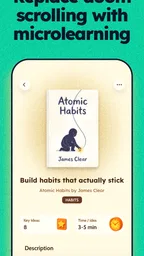
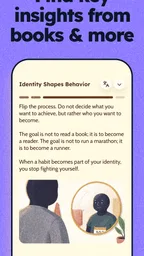
Deepstash’s central trade-off is compression. A compact explanation can help me decide whether a topic deserves more attention, and a book-derived idea can give me a starting point without requiring a long reading session. The format is especially handy when I want a little mental variety: a short exploration of a new subject can feel more rewarding than opening a social app out of habit.
Compression also leaves things out. A concise idea may strip away the qualifications, evidence, and context that make a longer argument reliable. I would use a takeaway as an invitation to think or investigate, not as proof that a complicated subject has been settled. For decisions involving health, money, relationships, or work, I would check a fuller source before acting on a memorable summary.
This is where the app differs from a conventional ebook reader. An ebook is better when I want an author’s full reasoning and sustained narrative; Deepstash is more suited to sampling and revisiting concise concepts. It also differs from a course app, where lessons usually build in a deliberate sequence. If I need a curriculum, exercises, or measurable progress through a subject, a structured course is likely the better fit.
Boundaries, accounts, and shared devices
On a device used by several people, I would set expectations before anyone starts browsing. Treat each person’s reading as their own, and avoid assuming that one household account or screen automatically creates separate private spaces. If distinct histories or recommendations matter, each person should use an appropriate individual setup rather than passing a device around as though every session were isolated.
That boundary is useful even when everyone is comfortable sharing the physical device. Reading interests can be personal, and one person’s browsing may shape what another person sees or make it harder to pick up where they left off. A simple household rule—close your session and hand the device back, rather than leaving it open—can reduce accidental mix-ups without requiring any special family feature.
I would also avoid using a shared device for sensitive notes or private reflections unless I had checked how the app handles the relevant account and saved content. The safest everyday assumption is that a device shared among family members is not the same thing as a private reading environment. For a child who needs close supervision, browse together and keep the device in a setting where an adult can guide what is being read.
How to make the ideas useful across the household
One low-effort way to coordinate is to let each person bring one takeaway to a weekly conversation, without requiring everyone to read the same thing. That keeps the app from becoming homework and makes room for different interests. A teenager might share an idea about learning, while an adult brings up something about focus. The useful part is the conversation, not whether everyone has completed a matching reading list.
For personal follow-through, I recommend turning a promising idea into a question or action in a separate place you already use. A note such as “try this in tomorrow’s meeting” is more actionable than relying on memory after a quick read. This is a practical workaround for the broader limitation of bite-sized learning: useful points can arrive faster than you can apply them, so a small capture habit helps separate ideas worth testing from those that were merely interesting.
When choosing what to read, I would look for a topic connected to a real need rather than trying to browse everything. If you are preparing for a difficult conversation, for instance, a short idea about listening or communication can help you frame what to consider. It cannot tell you what the other person thinks, and it should not replace direct conversation. Used as a prompt, though, it can give a busy reader a manageable first step.
Age context and trust in the content
The app is rated for Everyone, and that makes it broadly accessible, but an all-ages label does not mean every idea will suit every reader or every family conversation. Younger users may need help distinguishing a compact opinion or general lesson from a well-supported explanation. I would encourage children to ask where an idea comes from and whether it applies to their situation, rather than treating an attractive summary as a rule.
For adults, the same habit is worthwhile. A polished, brief explanation can feel more definitive than it really is because there is little room for nuance. If a takeaway makes a bold claim or touches on a serious decision, follow it with a book, a qualified professional, or another credible source. I see the app as a discovery layer: useful for finding concepts that deserve attention, less suitable as the final word on complex matters.
Deepstash is developed by Deepstash and sits in the education category. It has a 4.6 average from around 201,000 ratings, with more than 5,000 written reviews and over 5 million installs. Those figures suggest that many people find the format appealing, but popularity alone cannot tell you whether its style matches your learning habits. I would judge it by whether the short ideas lead you to think, remember, or act—not by how much you can browse in one sitting.
Cost and practical expectations
The app is free to install, and it offers in-app purchases ranging from $12.99 to $119.99 per item. I would begin with the free experience and decide whether the format earns a regular place in your routine before paying for anything. The range is broad enough that it is worth checking the specific purchase details in the app store before committing, especially if a family member is using a shared device.
The current version is 33.1.3, and the minimum operating-system requirement is 7.0. That makes it relevant to people checking compatibility on an older device, although keeping a device’s software up to date is still a sensible general practice. I would not assume that an older device will feel as smooth as a newer one; the best test is whether browsing and reading remain comfortable in the way you plan to use it.
Compared with free articles scattered across the web, the main difference is the app’s emphasis on collecting compact learning material in one place. The trade-off is that a short takeaway cannot offer the same depth as a carefully chosen article or full book. Compared with podcasts, it also asks you to read rather than listen, which may be a plus when you need quiet, but a drawback if your hands and eyes are already occupied.
Who I would recommend it to
I would recommend Deepstash to curious readers who want a light, repeatable way to encounter ideas and are comfortable treating summaries as starting points. It can suit busy adults, students looking for prompts for further reading, and households where different people want separate moments of informal learning on a shared day. A short session is easy to fit into an existing routine, provided you do not expect it to replace deeper work.
I would skip it if you want a complete course, a textbook-level explanation, or a strong structure that tells you exactly what to learn next. It is also not the right answer if your priority is a listening-first experience or a shared family account with clearly separated personal spaces. In those cases, a course platform, an audiobook service, a library ebook, or a dedicated household organizer may serve the actual need better.
My household verdict is positive with sensible boundaries. Use it as an individual source of short reading, keep account expectations clear on shared devices, and talk through ideas rather than assuming everyone is following the same trail. Its real strength is making curiosity easy to act on for a few minutes; its weakness is that brevity can make learning feel more complete than it is. If you use each takeaway as a prompt to reflect, discuss, or read further, this education app can be a worthwhile addition to an ordinary day.
What we like
- Personalized recommendations help surface ideas that match your interests.
- Short reads make it easy to explore useful concepts during spare moments.
- Topics span personal growth and work to science and everyday life.
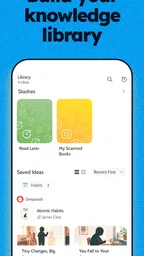
- Saving ideas makes it simple to revisit them later.
- A clean interface keeps browsing focused on the content.
What could be better
- Some ideas may feel too brief to provide meaningful context.
- Recommendations can become repetitive if your interests are narrow.
- Many features and content options require a paid subscription.
- The app depends on an internet connection for much of its content.
- Frequent prompts to save or explore ideas may interrupt reading.





