







Paladin: Learn History review
 Analysis by Appsdrops
I like history apps best when they make the past feel approachable without pretending that a few minutes of reading can replace a full course. Paladin: Learn History aims for that middle ground: it is an education app built around short, interactive lessons, with a format suited to curious people who want a little history in an ordinary day. My overall impression is that it is most appealing as a low-pressure way to explore and revisit ideas, rather than as a complete reference library or a substitute for structured study.
What the current version is best suited to
Paladin is developed by Deepstash SRL, and its current version is 7.2.0. It is free to download, while offering in-app purchases priced from $12.99 to $99.99 per item. The app is rated for Everyone 10+ and has an average rating of 4.5 from around 21,000 ratings. More than 500,000 people have installed it, which suggests that its bite-sized approach has found an audience beyond a small group of history specialists.
The practical appeal is easy to understand: a short lesson asks for less commitment than a textbook chapter, a lecture, or a documentary. I can see myself opening it while waiting for an appointment or during a quiet part of a commute, choosing one topic, and leaving with a useful starting point for further thought. That does not mean every brief session will produce lasting knowledge. It means the format lowers the barrier to beginning.
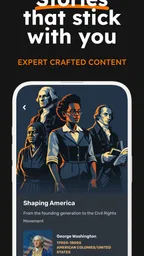
The app’s store summary describes an interactive lesson experience, and that distinction matters. A history app can simply present text, but an interactive format can make a quick session feel more active. I would approach each lesson as a prompt to notice a person, event, or historical connection, then decide whether it deserves more attention. That makes Paladin more useful as a discovery tool than as a final authority.
A small daily routine works better than a binge
For a realistic routine, I would tie a lesson to an existing pause: one while having breakfast, another when taking a break from work, or a quick session before bed. The value is not in racing through a large amount of content. It is in giving one idea enough attention to remember what interested me and, if needed, follow it up elsewhere.
A simple habit can help: after a lesson, try to explain its main point in one sentence without looking back. If the idea feels important, jot down the name, event, or question that you want to investigate. This turns casual browsing into a modest learning loop: encounter, recall, follow-up. It also makes clear when the short format has left too many gaps for the subject at hand.
I would not use a quick lesson as the only preparation for a school assignment, exam, or serious historical argument. In those situations, detail, context, and reliable citations matter more than convenience. Paladin can help me identify what I want to learn, but a dedicated textbook, course, or carefully sourced reference is a better next step when accuracy and depth are central.
Where it sits among history-learning options
Compared with a traditional history book, Paladin is easier to fit into spare minutes, but a book can build a longer narrative and give more room to explain causes and consequences. Compared with a video lecture, a short app session may be easier to start and stop, while a lecture can offer sustained explanation and a teacher’s framing. General reference sources are better when I need to check a date or compare accounts; Paladin’s strength is the invitation to explore, not necessarily the last word on a topic.
That trade-off is worth keeping in mind. If I want a guided nudge toward a subject, the app’s lesson format is a reasonable match. If I already know exactly what I need—such as a detailed chronology, primary sources, or competing scholarly interpretations—I would begin with a specialist resource instead. A short, engaging presentation is not automatically a deep one, and I would avoid treating a memorable summary as a complete account.
What the release history tells me—and what it does not
Paladin was released on October 1, 2024, and version 7.2.0 is the current version. That gives me a clear snapshot of the product’s present state, but the version number alone does not explain which features or lessons changed between releases. I would not infer a particular redesign, content expansion, or improvement from the number by itself.
For someone who has used an earlier version, the practical advice is to judge the current app by what is actually available after updating, rather than expecting a specific change based on the version label. For a new user, the release date provides context for how recently the app entered the market, while the current version indicates which build to evaluate. Neither fact guarantees that every subject a learner wants is covered in the way they prefer.
The app’s strong average rating and its 1,200 written reviews offer useful signs of broad interest, but they cannot settle whether its particular teaching style will suit me. History learners differ: some want concise introductions, others want long-form argument, maps, source documents, or structured courses. I would treat popularity as a reason to consider trying it, not as proof that it meets every learning need.
Useful ways to get more from each lesson
One non-obvious benefit of brief lessons is that they make it easier to notice the boundaries of my knowledge. If I find myself asking why an event happened, whose perspective is missing, or what came next, those questions become a ready-made study plan. Rather than opening a new lesson immediately, I can pause and choose one question to investigate. That keeps the app from becoming an endless stream of disconnected facts.
A second useful approach is to pair a lesson with a topic already in my life. If a book, film, or conversation mentions a historical period, I can use Paladin to get oriented before looking for a deeper account. I would still check any specific claim that matters, but the app can help me arrive at the follow-up reading with better questions. This is especially useful when a subject initially feels unfamiliar or intimidating.
A third trade-off concerns attention. Short sessions are convenient, yet frequent switching between unrelated topics can make history feel like a collection of isolated moments. I would group a few sessions around one broad theme when possible, or keep a note of the connections I notice. That small bit of organization can make a lightweight learning app feel more coherent without demanding a formal study schedule.
Who should try it, and who may prefer another route
I would recommend giving Paladin a try if you enjoy learning in compact sessions, want a gentle way into historical subjects, or prefer an app-based prompt over deciding what to read from scratch. It also makes sense for people who already read widely and want occasional starting points for topics they have not explored. Because the app is free to download, a new user can assess whether its format feels comfortable before deciding whether any paid option is worthwhile.
The purchase range is broad, from $12.99 to $99.99 per item, so I would check the exact offer and what it includes in the app store before spending. I would not assume that every learner needs to pay: the right choice depends on how often the free experience meets your needs and whether a particular purchase adds value for your goals. Anyone who dislikes in-app spending or wants a clearly defined, one-time course should look carefully at the purchase details before committing.
Paladin is less suitable for someone who needs an exhaustive academic resource, wants to cite original sources directly, or learns best through long explanations and guided discussion. It may also frustrate a reader who prefers to control the sequence and depth of every topic. In those cases, a library book, university course, specialist reference, or documentary series is likely to be a better primary tool, with Paladin used only as a companion if its short lessons are appealing.
What I would keep an eye on
As I consider the app’s future, the meaningful questions are practical rather than speculative: does the available lesson material continue to serve different levels of curiosity, and does the experience make it easy to turn an interesting introduction into deeper study? Those are the things I would watch as an existing user. The version number is a useful marker, but I would judge future changes by their visible effect on learning rather than by release labels alone.
I would also pay attention to whether the content gives enough context for a topic to make sense on its own. That is the central challenge for any short-form history app: concise lessons can make learning approachable, but compression can leave out nuance. When a topic is contested or complicated, I would welcome clear signals about what a lesson covers and what deserves further reading. Until then, I would use each lesson as an entry point and verify important details through stronger reference material.
My recommendation
My view is positive, with a clear boundary around what the app can do. Paladin offers a convenient way to make history part of a spare moment, and its interactive, compact approach is more inviting than facing a large reading task when I only have a few minutes. The release on October 1, 2024, and the current 7.2.0 version give a useful picture of its present stage, while its audience and average rating suggest that many learners are willing to give the approach a chance.
I would install it to explore, build a modest learning habit, and discover which historical questions deserve more time. I would not rely on it alone for detailed research, formal study, or decisions that depend on precise historical evidence. Used with that distinction in mind, Paladin: Learn History can be a friendly first step: not a replacement for deeper learning, but a practical way to find the next subject worth pursuing.
What we like
- Short lessons make history easier to fit into a busy day.
- The quiz format helps reinforce facts through active recall.
- A focused history app can make casual learning more engaging.
- Bite-sized topics offer an easy way to explore unfamiliar periods.
- Progress through lessons can encourage a regular learning habit.
What could be better
- Quiz questions may reward memorization more than deeper understanding.
- Some historical topics may receive limited coverage.
- Brief lessons can leave complex events without enough context.
- The learning experience may feel repetitive over time.
- Users seeking academic depth may need additional reference sources.





