

AI Language Learning & Tutor review
 Analysis by Appsdrops
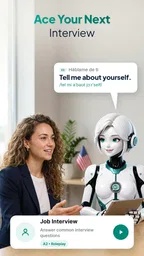
I look for an English-learning app that makes it easier to practise speaking, not just collect vocabulary or tap through lessons. AI Language Learning & Tutor is built around that practical need: it lets learners work on spoken English with an AI tutor and receive feedback. That focus can make it useful when I have a few minutes to rehearse a real conversation, though it is not a substitute for every kind of language study.
What speaking practice feels like here
AI Language Learning & Tutor is an education app from ATQ - AI Lab. Its central idea is straightforward: use an AI tutor to practise English and get feedback as you go. I find that appealing for learners who know some English already but hesitate when they need to form a sentence aloud. A speaking-focused tool gives that hesitation a place to be worked on, rather than leaving practice for the next class or conversation.
The app is free, and its Everyone age rating makes it broadly accessible. It has a 4.7 average from around 4,500 ratings, with over one million installs. Those figures suggest that many learners have tried it, but they do not tell me whether its teaching approach will suit a particular person. The more useful question is whether you want guided speaking practice or a broader course with multiple study modes.
I would treat the AI tutor as a practice partner, not as an examiner or a guaranteed route to fluency. Feedback can help you notice areas to revisit, but improving pronunciation and conversational confidence still takes repeated attempts and exposure to real speakers. The value is in making practice easier to start, especially when there is nobody available to talk with at that moment.
Speed expectations: quick to practise, not a shortcut to fluency
For a speaking app, “fast” has two meanings. One is how quickly I can begin a useful practice session; the other is how quickly my English improves. The app’s AI-led format is aimed at reducing the first barrier: I can turn to an interactive tutor instead of arranging a lesson or waiting for a language partner to be free. That convenience matters most when a learner can fit practice into ordinary gaps in the day.
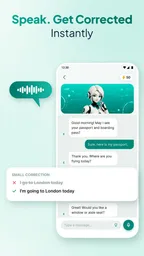
I would not expect an instant-feedback label to mean that every answer produces a complete diagnosis of a learner’s English. Feedback is most useful when I treat it as a prompt to try again, compare my phrasing, or identify a recurring difficulty. A single correction may improve one response; a routine of noticing and reusing corrections is what makes the session worthwhile.
A practical way to use the app is to pick one communication goal before opening it. For example, I might want to explain a delay, ask for directions, or describe a work task. Keeping the goal narrow makes it easier to judge whether the practice helped. It also prevents an AI conversation from becoming aimless: I can focus on getting a message across clearly instead of trying to cover every weakness in English at once.
That approach is especially useful for learners who already understand basic English but freeze when speaking. Beginners who are still learning common words may benefit from pairing speaking work with a structured vocabulary or grammar resource. The app’s conversational emphasis is not automatically the best starting point for every learner, and I would choose a course with clearer step-by-step foundations if I needed that kind of instruction first.
Heavy-use moments: making a short session count
Speaking practice can take more attention than reading a lesson, because I need to listen, form a response, and consider the feedback. I would avoid treating a long, unfocused session as the default. A short practice with a clear topic is easier to fit between errands or before a meeting, and it gives me a specific result to carry into the next conversation.
One everyday scenario is preparing for a call with an English-speaking colleague. I could rehearse a concise update, practise asking for clarification, and try explaining a problem in my own words. The useful part is not memorising a perfect script; it is discovering where I pause or struggle to phrase something. Afterward, I can write down one expression I want to reuse and try it in the real call.
Another sensible workflow is to revisit the same kind of situation on different days rather than jumping between unrelated topics. If I practise introductions once and then return to them later, I can check whether speaking feels more natural. This is a learner-created routine, not a claim that the app automatically tracks or schedules it. Keeping a small note outside the session can help make progress visible without relying on memory alone.
There is a trade-off with AI conversation practice: it can lower the social pressure of making mistakes, but it does not fully reproduce the unpredictability of a person. A human conversation partner may interrupt, change subjects, misunderstand, or use unfamiliar phrasing. I would use the tutor to build readiness and then seek real conversations for the listening and turn-taking skills that a simulated exchange cannot fully replace.
Reliability: useful as one practice option, not the whole study plan
The app’s role is clearest when I think of it as a repeatable speaking outlet. If a tutor or language partner is not available, an AI-led session gives me a way to practise forming answers rather than postponing speaking until the next class. That makes it a useful complement to lessons, books, podcasts, and real-world conversation, each of which serves a different purpose.
For feedback to be dependable in a learner’s routine, I would look for patterns rather than treating every individual response as definitive. If the same kind of correction appears repeatedly, it is worth studying. If feedback seems unclear or does not match what I intended to say, I would rephrase the sentence and compare the result, or check the issue with a teacher or trusted learning resource. That cautious habit helps prevent an AI suggestion from becoming an unquestioned rule.
AI Language Learning & Tutor is currently at version 1.6.0. That is useful context when deciding whether to rely on it as the only tool in a study plan: I would keep other materials available, particularly for grammar explanations, reading practice, or exam preparation. The app is most compelling when the missing piece in a learner’s routine is active spoken practice, rather than when they need a complete curriculum in one place.
It may also suit someone who feels self-conscious speaking in a class. Practising privately can make it easier to attempt a sentence, hear feedback, and try again without the pressure of holding up a group. Still, learners who need a teacher to explain why a phrase sounds unnatural, or who benefit from a real person responding emotionally and flexibly, may find a human tutor more valuable for those sessions.
Device constraints and choosing the right setup
The app’s minimum operating-system requirement is version 8.0, so it is not limited to only the newest supported software. That does not guarantee the same experience on every device. Speaking interactions naturally depend on being able to use the app comfortably and hear or provide spoken input, so I would choose a quiet place and check that the device’s audio setup is working before starting an important practice session.
For example, practising on a crowded bus may be less helpful than using a quiet room: background noise can make speaking and listening harder, even when the app itself is working as intended. A short session at home, during a break, or before leaving for an appointment is more likely to let me concentrate on the actual language. This is a practical limitation of speaking practice in general, rather than a special performance claim about this app.
I would also avoid assuming that an AI tutor can replace a full course just because it makes conversation practice convenient. If you are studying for a test, working through a beginner syllabus, or trying to build reading and writing alongside speaking, choose a resource that explicitly supports those goals and use this app as an additional speaking tool. If your main obstacle is getting words out in English, its narrower focus is a strength rather than a shortcoming.
Who I would recommend it to
I would recommend AI Language Learning & Tutor to learners who want a low-friction way to practise spoken English and are comfortable learning through interaction with an AI tutor. It is a particularly sensible option for someone who can read or understand more English than they can comfortably say. The free price also makes it approachable for trying a speaking-focused routine without committing to a paid product.
I would steer complete beginners toward a more structured foundation if they need explanations of basic grammar and vocabulary before they can hold even a simple exchange. I would also suggest a human tutor or conversation group to learners who need nuanced correction, genuine social interaction, or preparation for unpredictable face-to-face situations. And if you mainly want to improve reading, writing, or exam technique, a speaking-first app is unlikely to cover your priorities on its own.
Compared with a conventional language course, this app’s advantage is the chance to practise producing spoken English rather than only studying examples. Compared with a human language partner, its advantage is convenience; the trade-off is that an AI exchange is not the same as navigating a real person’s reactions. I would use both when possible: rehearse a topic with the tutor, then try the same skill in a class, call, or everyday conversation.
My performance verdict
I see this as a focused speaking-practice companion, not an all-purpose language school. Its value is less about racing through lessons and more about making it easier to attempt English aloud, receive feedback, and come back to a difficult situation with another try. For a learner who regularly avoids speaking because practice feels awkward or hard to arrange, that can be a meaningful change in routine.
I would keep expectations practical: use a quiet setting, set one goal for each session, and treat feedback as something to test and learn from rather than accept blindly. The app’s Education focus, broad age suitability, free availability, and substantial audience make it easy to consider, while its AI-based approach will not replace a teacher or the complexity of real conversation. If speaking is the skill you most need to exercise, AI Language Learning & Tutor is worth trying as part of a balanced English-learning plan.
What we like
- Offers flexible practice without requiring a scheduled class.
- Lets learners revisit explanations at their own pace.
- Can make language study feel more approachable for beginners.
- Supports quick practice sessions during short breaks.
- Provides a private space to practice without social pressure.
What could be better
- AI feedback may miss context or subtle meaning.
- Voice recognition can struggle with accents or background noise.
- Generated explanations may occasionally be inaccurate.
- Some useful features may require a paid subscription.
- App quality can depend on a stable internet connection.





