





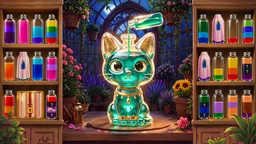


Water Sort! Color Sort Puzzle review
 Analysis by Appsdrops
I like puzzle games that give me a clear problem without demanding a long session, and Water Sort! Color Sort Puzzle is built around exactly that sort of small challenge. Its central task is to arrange colored liquid into matching groups by moving it between containers. The idea is easy to grasp, but choosing a sensible sequence is what makes each puzzle engaging. I find it best as a quiet, focused game for a spare moment rather than a sprawling game to get lost in for hours.
One simple capability, with room to think
The defining strength here is the color-sorting puzzle itself. Instead of asking me to learn a complicated set of controls, the game puts the sorting decision front and center: which color should move, and where can it go without making the remaining arrangement harder? That focus makes it approachable for someone new to puzzle games while still giving each move a little consequence.
In a typical water-sort puzzle, a move that looks convenient can leave a color blocked beneath others or use up a useful opening in a container. I get more out of the game when I pause to inspect the whole arrangement before pouring. That small habit turns the experience from random tapping into a tidy planning exercise: identify colors that can be grouped, preserve room for temporary moves, and avoid closing off options too early.
The appeal is less about a dramatic story or a changing world and more about seeing a messy arrangement become orderly. When I finish a puzzle, the satisfaction comes from having found a workable sequence. That makes it a good fit for people who enjoy logic problems in a visual, low-pressure form, especially if they would rather solve one self-contained challenge than follow a long campaign.
How the sorting works in practice
The basic interaction is easy to understand: choose a container and move its available color into another container where it can be sorted. The challenge is deciding what to do when several moves seem possible. A useful approach is to treat an empty container as workspace, not merely as a place to finish a color. Keeping that space available can make it easier to uncover and combine colors that are temporarily in the way.
I also recommend looking for a move that reveals a useful color, rather than making the move that immediately creates the neatest-looking pair. A quick pour may feel productive but can leave a container filled with a color that blocks progress. Thinking one or two moves ahead is often enough; this is not the kind of puzzle that requires elaborate notation, but it rewards a little patience.
Because the game is designed to be playable offline, it suits the small gaps in a day when a connection is unreliable or inconvenient. I can see it working during a commute, in a waiting room, or while taking a short break, where a puzzle can be picked up without needing an online session. The offline angle is particularly useful for a game whose main appeal is focused, individual play rather than interaction with other players.
One practical tip is to avoid tapping through a puzzle just because the first few moves are obvious. If I get stuck, I retrace the last decision that reduced my options and reconsider whether a container could have been kept open. That is more useful than treating every failed sequence as a sign that the puzzle is unfair. It also helps me learn the logic of the format, so later boards feel less like trial and error.
A good companion for short breaks
The strongest everyday use case is a short pause when I want something more engaging than scrolling, but not something that needs sustained attention. I might open it while waiting for food or between tasks, solve a puzzle, and put the phone away. The sorting mechanic gives that break a clear beginning and end, which is a better fit for brief sessions than games built around long matches or persistent objectives.
It can also suit a shared setting without requiring a group mode: one person can look at the containers and talk through possible moves with another. That works because the puzzle is visually understandable and the rules are straightforward. I would not mistake this for a dedicated family or multiplayer experience, but the clarity of the board makes it easy for someone nearby to follow along or suggest a move.
For younger players, the Everyone content rating makes the game broadly accessible, and the color-based task is simple to explain. Adults who want a gentle logic exercise may enjoy it for the same reason. Still, accessibility in age rating does not mean every person will find the puzzles equally comfortable; anyone who struggles to distinguish colors on a screen may find a color-dependent game less convenient, so it is worth considering personal visual needs.
Where it sits among puzzle alternatives
Compared with word puzzles, number grids, or match-style games, this one asks for spatial planning rather than vocabulary, arithmetic, or quick pattern matching. That difference is useful if I want a puzzle that feels orderly and tactile, with moves I can inspect before committing. It is less suitable if I want a deep variety of mechanics or a narrative reason to keep progressing; the core sorting loop is the point, and that focus can feel repetitive to players who need frequent changes in format.
It also differs from action-oriented mobile games because the challenge is not speed. I can take a moment to examine the containers and plan, making it a calmer option for someone who dislikes timers or reflex-heavy play. On the other hand, anyone looking for competition, social features, or a strong sense of progression should consider a different kind of puzzle game. Here, the value is in solving the arrangement in front of me.
The game is free to download, with in-app purchases ranging from $1.99 to $5.99 per item. That means the basic decision is easy: try the puzzle style without paying upfront, then decide whether any optional purchase is worthwhile for you. I would approach purchases as optional rather than necessary to enjoy the central sorting idea, and check the app store details before buying so I know what a particular item includes.
What to expect from the app
Bobodoo Game developed this puzzle, which has an average rating of 4.9 from around 490,000 ratings, alongside about 3,400 written reviews and over 10 million installs. Those figures suggest it has found a broad audience, though popularity alone cannot tell me whether its particular pace suits you. The useful question is whether you enjoy careful sorting and small, self-contained logic challenges.
It was released on November 8, 2024, and the current version is 1.0.68. The stated minimum operating system is Android 7.0, so someone using an older device should check compatibility in the app store before installing. The age rating is Everyone, which gives families a straightforward starting point when considering whether the content is suitable, while individual preferences about screen-based play still matter.
One tradeoff of such a focused design is that the same clarity that makes the game easy to start can also limit its appeal over longer sessions. If I am in the mood for a puzzle that constantly changes its rules, this is not the one I would choose. If I want a compact sorting problem that lets me think at my own pace, its simplicity becomes a strength rather than a shortcoming.
Who will enjoy it most
I would recommend it to someone who likes visual logic, wants a game that works offline, and prefers to play in brief bursts. It is also a sensible pick for a casual player who finds complicated tutorials off-putting: the central objective is easy to understand, while the order of moves provides the challenge. If you tend to enjoy organizing, grouping, and spotting a way through a crowded arrangement, the central mechanic should feel satisfying.
I would skip it if you need a wide range of activities, a compelling narrative, active competition, or a game that constantly introduces new kinds of decisions. The experience is deliberately narrow, and a person who tires quickly of repeating one puzzle format may lose interest. Likewise, if a puzzle frustrates you when a few early choices can constrain later ones, this may feel more demanding than its simple appearance suggests.
My best advice is to play deliberately rather than quickly: keep potential workspace in mind, look for moves that uncover useful colors, and reconsider the sequence when the board becomes crowded. That approach brings out the real pleasure of Water Sort! Color Sort Puzzle: not merely making the colors match, but finding a clean route to do it. For a free, offline-friendly logic game, I think it is an easy one to try—provided a focused sorting loop is what you want.
What we like
- Simple tap controls are easy to learn.
- Short levels suit quick play sessions.
- Sorting colors offers a relaxing puzzle challenge.
- No internet connection is needed for offline play.
- Later stages add more challenging tube layouts.
What could be better
- Some levels can feel repetitive over time.
- A mistaken pour may require restarting a level.
- Ads may interrupt play between puzzles.
- The difficulty can rise sharply in later stages.
- Color-based gameplay may be harder for some players.







