Threadform review
 Analysis by Appsdrops
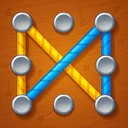
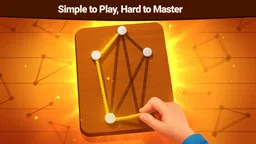
I’m drawn to puzzle games that give my attention one clear job rather than burying a simple idea under menus and effects. Threadform fits that minimalist mood: it is a puzzle game built around a thread concept, and its restrained identity is part of the appeal. I’d consider it when I want a small mental reset, not when I’m looking for a sprawling campaign or a competitive challenge.
A pared-back puzzle with a clear identity
The game’s appeal starts with its name and presentation: Threadform suggests a puzzle where thread and shape belong together. That is an inviting premise, especially for players who enjoy visual problems and careful choices. The minimalist approach can make a puzzle feel easier to approach; it also means the quality of the central challenge has to carry more of the experience.
I would not judge a game like this by how much noise it makes. A quiet puzzle can be satisfying when it encourages me to pause, study the arrangement, and try a deliberate solution. The trade-off is that anyone who needs a story, a changing cast of mechanics, or a strong sense of spectacle may find a restrained format too slight.
Its store summary calls it “The Minimalist Thread Puzzle,” while the short description is simply “Threadform.” I take that as a useful indication of its intended focus, not a promise of a particular control scheme or level structure. The verified details identify Gimica GmbH as the developer and place the game in the puzzle category.
Who is likely to enjoy it?
I’d recommend giving it a look if you enjoy solving compact visual challenges at your own pace. It seems best suited to a player who is happy to concentrate on one puzzle idea at a time, rather than someone who wants an extensive set of modes, social features, or constant new distractions. That distinction matters: a minimalist game can be a good fit precisely because it asks for less, but it is not automatically the right fit for every puzzle fan.
A realistic use case is a short break between tasks. I might open it while waiting for a kettle to boil, focus on a puzzle, and put the phone down when I’m ready to return to work. For that kind of session, a clear visual premise is helpful. If I wanted a long evening of escalating challenges, I would first make sure the game’s actual depth matched that expectation rather than assuming minimalism means a large campaign.
What the purchase details tell me
Threadform is free to download, with in-app purchases listed from $0.99 to $5.49 per item. That gives a prospective player a straightforward starting point: there is no purchase price to pay before trying it, while optional items have a stated price range. I would still check the purchase screen carefully before confirming anything, particularly if I were handing the device to a child.
The game is rated Everyone, which makes its listed content rating broadly accessible. That rating is useful when choosing a game for a family device, but it does not answer every practical question about how purchases are presented or whether any particular item is needed to keep progressing. I wouldn’t infer a specific purchase design from the price range alone.
It has an average rating of 4.4 from around 24,000 ratings, and it has passed one million installs. Those figures suggest that a substantial number of players have tried it and that the overall reception is positive. They are a helpful signal, not a substitute for deciding whether its particular minimalist puzzle style matches my taste.
Progress, pressure, and the value of a pause
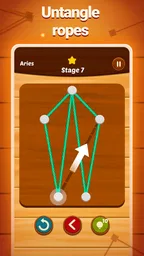
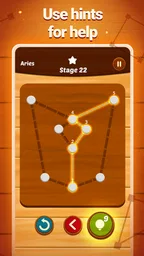
For a puzzle game, the most important question is how it treats a player who gets stuck. Does the challenge invite another attempt, or does it make a missed move feel costly? I can’t responsibly claim a particular hint system, timer, life limit, or level progression here. What I can say is that I would approach a minimal thread puzzle by first looking for the relationship between the visible pieces and the intended shape, then testing one change at a time instead of making several guesses in a row.
That small habit can make a visual puzzle less frustrating. If I reach a dead end, I would pause and ask what the last change actually established. Returning to the same screen after a brief break can be more useful than repeatedly dragging or rearranging elements without a plan. This is practical advice for engaging with the game’s stated thread-and-form premise, not a claim that it contains a particular undo, hint, or reset feature.
Minimal presentation also affects perceived difficulty. Without a lot of competing visual activity, details may be easier to focus on, but a sparse screen can leave less room for a player to infer what the game expects. If a puzzle’s goal is not obvious, I’d take time to inspect the whole arrangement before acting. Players who prefer explicit instructions at every step may find this kind of design less comfortable than a more guided puzzle game.
One useful way to judge the experience is to notice whether a challenge feels satisfying after a solution, not just difficult before it. A good fit for me would make each attempt feel informative: even a wrong choice should clarify the shape of the problem. If I find myself repeating the same action with no better understanding, that is a signal to stop rather than treat persistence as the only route forward.
Spending and fairness without guesswork
The listed price range is the clearest verified purchase context: in-app items cost from $0.99 to $5.49, while the game itself is free. That is enough to set a basic boundary for spending. I would not assume that purchases are required, that they are purely cosmetic, or that they change puzzle difficulty; none of those conclusions follows from the listed prices.
For a fair personal test, I would play the free portion first and decide whether the core puzzle loop is enjoyable before buying anything. If a purchase is offered during play, I’d ask what it provides and whether I can continue without it. That approach is especially sensible for a game whose appeal depends on focused problem-solving: paying should be a considered choice, not a response to impatience or an unclear prompt.
There is no basis here for comparing paying and non-paying players in a leaderboard or multiplayer setting, so I would not describe the game as competitive or claim that spending creates an advantage. The practical point is simpler: I can see that optional purchases exist and what their listed price range is, but I would make any fairness judgment about their effect only after seeing the offer in context.
How it stands beside other puzzle games
Compared with familiar match, word, or physics puzzles, Threadform’s thread-and-shape identity gives it a more focused visual angle. That may be a welcome change if I’m tired of clearing grids or chasing scores. It may be a weaker choice if what I enjoy most is collecting characters, following a story, competing with friends, or unlocking a broad set of puzzle types.
Compared with open-ended logic games, a minimalist puzzle can feel more immediate: the screen itself may be the whole problem rather than one layer in a larger system. The trade-off is variety. I would choose a broad puzzle collection when I want a rotating menu of activities, and I would choose this game when I specifically want to settle into its thread-based idea. That is a preference-based comparison, not a claim about the number of modes or levels.
It is also worth separating a quiet design from an easy one. Minimalist presentation does not mean a puzzle will be trivial, and a simple premise does not guarantee a deep learning curve. I’d give the game a fair trial with an open mind, then decide whether its particular kind of challenge holds my attention. If I need a constant stream of novelty, another puzzle game may serve me better.
Practical details before installing
The current version is 1.7.0, and the minimum operating-system requirement is 7.0. The game was released on November 18, 2025. I would check that my device meets the stated system requirement before installing, especially if I use an older phone or tablet. It is free to download, so the initial decision is less about an upfront price and more about whether I want to try this specific style of puzzle.
The rating and install figures can help set expectations about reach, but neither tells me how well the game fits my own habits. I would pay more attention to whether I like examining a visual arrangement and making measured moves. If I usually abandon puzzles that don’t explain their rules quickly, that is a reason to be cautious rather than a reason to expect the game to change its approach for me.
Where the unknowns matter
Before recommending any puzzle on the strength of its mechanics, I want to know how much it explains, how it handles a mistaken move, and whether purchases affect the flow. Those details are not established here, so I would not fill the gaps with assumptions. A player who needs reliable offline access, a specific accessibility option, a particular hint arrangement, or a clear level count should check those points in the game before relying on them.
That caution is not a knock against the game. It is a distinction between what is established and what a player may reasonably want to know. The thread-based concept and minimalist positioning are clear; the finer details that determine whether it suits a particular routine deserve a direct check during use. I’d keep that in mind if I were choosing it for a commute, a child, or a device with limited storage or older software.
For a quick trial, I’d install it when I have a few unhurried minutes, explore the core puzzle experience, and pay attention to whether the visual goal feels understandable. If the game makes me curious enough to study a problem, that is a stronger sign of fit than the number of times I open it in a single sitting. If I feel pushed toward a purchase before I understand its value, I’d stop and reassess rather than spend just to keep moving.
My trust verdict
Gimica GmbH’s Threadform looks like a reasonable choice for people who want a compact, visually focused puzzle rather than a busy game with many competing systems. Its free entry point makes trying it straightforward, and the listed purchase range gives me a useful spending boundary. The positive average rating and broad install base are encouraging context, though my recommendation remains tied to whether its minimalist style suits you.
I would recommend it to a friend who likes taking a moment to examine a visual problem and is comfortable judging the game on its central puzzle idea. I would steer someone toward a more varied or story-led alternative if they want lots of different activities, explicit guidance, or a long-form progression they can verify in advance. For me, the sensible verdict is to try it without assuming purchases are necessary, watch how the actual puzzle flow feels, and spend only if an offer clearly seems worthwhile.
What we like
- Threadform offers a focused space for sharing creative work.
- Its simple layout makes browsing posts easy.
- The app can help creators discover fresh ideas.
- A dedicated community can encourage useful feedback.
- Sharing work may help artists build an audience.
What could be better
- The value depends on how active the community is.
- New users may find few posts in some creative niches.
- Public sharing may raise privacy concerns for creators.
- Feedback quality can vary from one user to another.
- Some features may require an account to access.







