Splash Buster review
 Analysis by Appsdrops
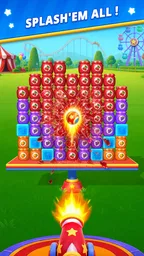
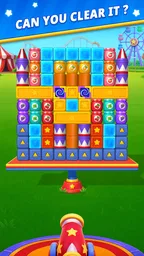
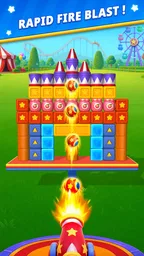
I like a puzzle game best when it gives me a clear goal, lets me try something, and makes the result easy to read. Splash Buster builds its idea around that simple appeal: fire a cannon at a target and use the impact to knock it into place in a three-dimensional physics puzzle. It is easy to understand before the first shot, but the appeal comes from working out how to make that shot count.
One clear shot to get started
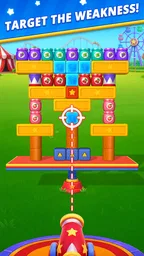
The opening action is straightforward: look at the target, aim the cannon, and fire. That direct setup suits a casual puzzle game because it puts the challenge in the decision rather than in a long explanation. I can focus on the relationship between the cannonball and the target, then see whether my chosen angle and force produce the result I wanted.
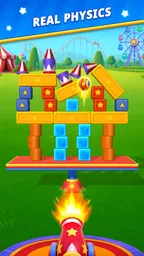
The three-dimensional physics premise gives each attempt a satisfying sense of cause and effect. A shot is not just a button press followed by an abstract score; it is a physical hit intended to move something. That makes the central question immediately engaging: where should I aim so the target gets knocked in the right way? Even a small adjustment can change how I think about the next attempt.
That clarity is a real strength for a game designed around quick, understandable actions. I do not need to keep several rules in my head to appreciate the basic task. The cannon is the tool, the target is the objective, and the impact is the answer to my plan. For players who enjoy compact challenges, this is a promising foundation: each shot gives the brain something concrete to solve.
Reading the result
The feedback rhythm is the heart of the experience. I choose a shot, fire, and watch the physics decide whether my plan works. When the target moves as intended, the result confirms that my aim and timing made sense. When it does not, the miss still gives me a useful prompt to reconsider the approach instead of leaving me with a vague sense that I pressed the wrong thing.
This kind of feedback makes the game easy to pick up in short bursts. A single attempt has a clear beginning and a visible outcome, so I can quickly understand what happened and decide whether to try again. The fun is not only in landing a successful hit; it is also in spotting a better angle or realizing that my first idea needs a small correction.
Physics puzzles can be enjoyable precisely because the action feels simple while the outcome invites thought. Splash Buster’s premise leans into that contrast. The cannon provides an immediate action, while the target’s movement gives me a result to interpret. That creates a small but effective mental loop: plan, shoot, observe, adjust. It is the sort of structure that can make a lightweight puzzle feel more involving than its controls suggest.
Why a successful hit feels rewarding
The reward comes from seeing the target respond to a shot I chose deliberately. A successful hit is satisfying because the result connects directly to my decision. I am not merely waiting for a puzzle to resolve; I have supplied the force and direction that make it happen. That sense of agency is important in a game with such a focused premise, and it gives each solved challenge a clear payoff.
There is also a pleasant difference between guessing and understanding. If I fire without thinking, I may get a result, but I am more likely to enjoy the moment when I can explain to myself why the shot worked. That small bit of insight is a reward of its own. It turns a hit into evidence that I have read the situation better, rather than a lucky outcome that I cannot repeat.
As a 3D physics puzzle, the game has an appealing kind of immediacy: the effect of the cannon fire is central to the objective. Players who like tactile, visual problem-solving may find that especially inviting. I can look at a target and imagine the impact before I act, then compare my expectation with what actually happens. That makes the puzzle feel like a miniature experiment, with every shot offering a chance to refine my reasoning.
The reset that invites another try
A good retry loop should make failure feel like a reason to adjust, not a reason to quit. Splash Buster’s core setup supports that idea naturally. If a shot does not knock the target where I want it, the next step is easy to understand: rethink the aim and fire again. The reset is part of the puzzle rather than an interruption to it, because the next attempt carries a lesson from the last one.
This is why the game’s basic action can encourage another session. I may finish one attempt feeling that I understand the target better, but still want to test whether a different shot will produce a cleaner result. That gap between “I see what went wrong” and “I want to get it right” is a strong hook for a puzzle game. It creates momentum without needing a complicated premise.
The rhythm should suit players who want something they can return to without a lengthy warm-up. The objective remains easy to recall: use cannon fire to hit and move the target. That simplicity makes it approachable when I have only a little time, while the physics-based problem-solving gives me a reason to stay for another attempt. It is a modest loop, but a recognizable and effective one.
Who may enjoy the challenge
I would point Splash Buster toward players who enjoy aiming, experimenting, and learning through visible outcomes. It is a puzzle experience first, with a playful action at its center. Anyone looking for a story-heavy adventure or a broad collection of systems may be after something different; the appeal here is the focused satisfaction of figuring out how to make a cannon shot do the job.
The game is free to play, and its content rating is Everyone. Optional in-app purchases range from $0.99 to $99.99 per item, so it is worth checking the purchase details in the app store before buying anything. Its current version is 1.2.4, and it requires Android 7.1 or later. Those practical details are useful when deciding whether it suits your device and how you prefer to manage purchases.
Its audience response is also notable: Splash Buster has a 4.9 average from around 154,000 ratings, with over a million installs. Those figures suggest that plenty of players have given the game a try and rated it highly. They do not replace personal taste, of course, but they make the straightforward cannon-and-target premise look like a puzzle concept with broad appeal.
A compact loop with a clear payoff
What works best for me is how neatly the action, feedback, and retry fit together. I take aim, fire, watch the target react, and use that result to decide what to do next. The reward is a successful knock, while the reset turns an imperfect shot into a fresh chance to solve the same physical problem more thoughtfully. That rhythm is the reason another attempt can feel worthwhile.
In the end, Splash Buster offers an easy-to-grasp idea with enough room for experimentation to make each shot matter. Its cannon puzzle gameplay is a natural fit for quick sessions, especially if you enjoy seeing a plan play out through three-dimensional physics. I find its appeal less about complexity and more about the pleasure of making a clear decision, reading the result, and trying again with a better one. If that kind of focused, action-led puzzle sounds fun, this is an approachable game to consider.
What we like
- Quick rounds make it easy to play in short breaks.
- Simple controls are easy for new players to learn.
- Colorful visuals give the game a cheerful look.
- Increasing difficulty can keep experienced players engaged.
- The premise is straightforward without a lengthy tutorial.
What could be better
- Gameplay may feel repetitive after extended sessions.
- Frequent mistakes can make later stages frustrating.
- The challenge may not appeal to players seeking a story.
- Small visual details may be hard to see on compact screens.
- Progress can feel slow for players who prefer rapid unlocks.







