






Screw Out 3D: Nut Sort Jam review
 Analysis by Appsdrops
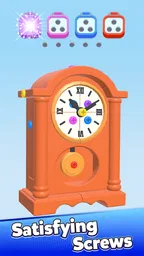
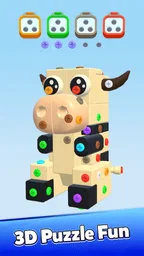
I like puzzle games that give me a clear problem to work through without demanding a long session, and Screw Out 3D: Nut Sort Jam is built around that kind of focused play. It is a free 3D puzzle game from Unico Studio, centered on sorting and manipulating screws. The appeal is tactile and easy to grasp: look at the arrangement, work out what needs to move, and try to leave the pieces in a more orderly state. In my experience, that simple premise makes it approachable, though it also means the game’s lasting appeal depends on whether you enjoy repeating a compact style of challenge.
Small goals make the first sessions easy to enter
The early attraction is the immediate puzzle in front of you. There is no need to learn a complicated backstory or manage a collection of systems before playing; the board itself is the task. That makes the game convenient when I have a few spare minutes, such as during a quiet break or while waiting for something. I can focus on a single arrangement rather than commit to a long play session.
Sorting puzzles reward a different habit from word games or number puzzles. Instead of searching for a clue in a grid, I have to read the physical layout and think about how a move affects the pieces around it. A useful approach is to pause before acting and identify which parts of the arrangement seem to constrain the rest. That little moment of planning is where the puzzle can feel satisfying rather than merely busy.
The 3D presentation is an important part of the premise, not just decoration: screws and their positions are easier to understand as objects than as abstract symbols. Still, spatial puzzles can ask for careful visual attention. If I am playing on a small screen or glancing at the game between other tasks, I may need to slow down and inspect the board rather than tap quickly. It suits relaxed concentration better than distracted, rapid play.
What progress feels like from one puzzle to the next
A good puzzle game needs to make progress legible. Here, the most satisfying signal is the change in the arrangement itself: a tangled-looking setup becomes clearer as I make useful decisions. That feedback is naturally tied to the core activity, so the reward comes from understanding the board and improving it, not from needing a complicated explanation of what the game wants me to do.
That directness is also a trade-off. Players who want a strong narrative, a map full of destinations, or elaborate character development may find the experience spare. Screw Out 3D is best approached as a sequence of focused sorting problems. I would choose it for a short mental reset, not as a substitute for a puzzle adventure whose appeal comes from a changing world or a story that unfolds between challenges.
One practical tip is to treat a failed attempt as information. Rather than repeating the same quick moves, I try to notice which decision created a bottleneck and rethink the order. This is especially useful in a puzzle built around physical arrangements, where a move that looks locally helpful might make the remaining pieces harder to manage. The game’s basic concept invites that kind of backward reasoning, even when the board itself appears simple at first glance.
Challenge, pacing, and the point where patience matters
The challenge in this sort of game comes from seeing a workable sequence, not from complicated controls. That gives it a low barrier to entry, but it does not guarantee that every puzzle will feel effortless. A board can be visually readable while still taking thought to sort out. When I am in the mood to concentrate, that gap between “I understand the pieces” and “I know what to do next” is the interesting part.
On the other hand, anyone expecting a deep strategy game should keep expectations grounded. The central activity remains sorting screws in 3D; its variety has to come from the arrangements and the decisions they invite. If you quickly tire of repeating one core mechanic, a broader puzzle collection with several distinct rule sets will probably hold your attention longer. This is a matter of taste, but it is worth considering before choosing a game for extended play.
For everyday use, I would keep sessions deliberately short. A quick attempt during a coffee break lets the board remain the focus, while playing when tired may make spatial details feel more fiddly than they are. If a puzzle stops being enjoyable, taking a pause is more sensible than tapping through it impatiently. The game’s relaxed sorting theme works best when I give myself enough attention to think, without turning every level into a test of endurance.
Unlocks and the pressure to keep playing
Progression can encourage another round, but I would not choose this game solely for a promise of extensive unlocks. Its strongest reason to continue is the immediate puzzle loop: I want to see whether I can solve the next arrangement. That is a healthy fit for players who enjoy small goals and self-directed pacing. It is less compelling for someone who needs a persistent collection, a competitive ladder, or a detailed long-term checklist to stay engaged.
There is also a distinction between being easy to pick up and being endlessly varied. The simple premise makes the first session accessible, but a familiar mechanic can become repetitive if the puzzles do not keep feeling fresh to you. I recommend paying attention to your own response after several rounds: are you still studying the arrangement, or are you moving pieces out of habit? If it is the latter, switching to a different kind of puzzle may be more rewarding than pushing through.
The game is free to download, with in-app purchases listed from $0.99 to $99.99 per item. That range is broad enough that I would check the purchase details in the app store before spending, especially if a child will be using the device. The content rating is Everyone, but that age label does not replace household decisions about purchases or screen time. I would treat optional spending as separate from the core question of whether the sorting puzzles suit you.
Who I would recommend it to
I would suggest Screw Out 3D to someone who likes untangling a visual problem, prefers a straightforward premise, and wants a puzzle they can approach in short bursts. It is also a reasonable pick for casual players who find physical objects easier to think about than abstract symbols. If you enjoy making a few deliberate moves and seeing the layout improve, the central idea has an immediate, satisfying logic.
I would be more cautious about recommending it to players who want frequent changes of genre, a substantial story, or a highly social challenge. It is also not my first choice for someone who dislikes spatial reasoning or gets frustrated when the best move is not obvious. A classic jigsaw or a word puzzle may feel more comfortable if you want a slower, less object-based task; a multi-mode puzzle game may be better if variety is your main priority.
The game has an average rating of 4.7 from around 253,000 ratings, and it has passed one million installs. Those figures suggest that its straightforward puzzle format has found a sizeable audience, but they cannot tell you whether the specific sorting loop will suit your habits. I would use them as context, then judge the game by whether its first few boards make you curious enough to keep thinking.
A measured verdict on its progression
For its version 2.9, Screw Out 3D remains easy to understand as a puzzle-first experience: the goal is concrete, progress is visible in the arrangement, and the challenge comes from choosing an effective order. It was released on August 13, 2025, and requires Android 7.0 or later. Unico Studio has kept the identity clear around a single central activity, which is both the game’s strength and the main limit I would weigh before installing it.
My recommendation is simple: try it if a compact 3D sorting puzzle sounds relaxing, and do not expect a sprawling progression system to be the main attraction. I appreciate that the core task can fit into an ordinary break, while still asking me to think rather than merely tap. Its pacing is best when I play at my own speed and stop when the familiar pattern ceases to engage me. For the right player, that makes it an enjoyable casual puzzle; for someone seeking broad variety or a deeper campaign, another game will be a better fit.
What we like
- 3D visuals make the sorting board easy to read.
- Short levels suit quick play sessions.
- Sorting mechanics are simple to learn.
- The game offers a clear goal in each level.
- Colorful pieces give the boards a cheerful look.
What could be better
- Later levels may feel repetitive.
- Small pieces can be harder to distinguish on phones.
- Some puzzles may require trial and error.
- The game may interrupt play with frequent ads.
- Timed challenges can feel stressful for casual players.







