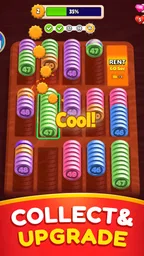
Pocket Sort: Coin Merge Puzzle review
 Analysis by Appsdrops
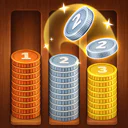
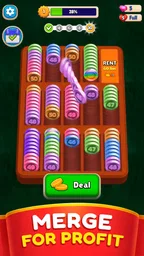
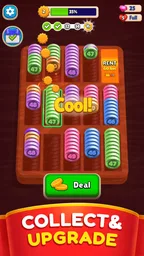
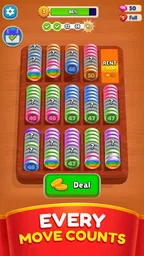
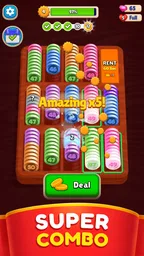
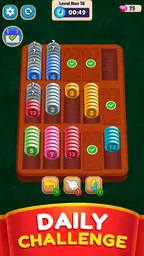
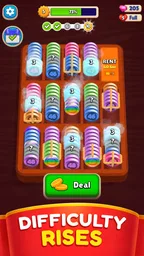
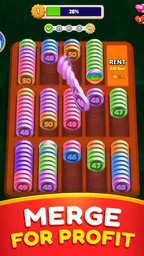
Pocket Sort: Coin Merge Puzzle is a compact puzzle game built around a simple idea: sort coins by color, then merge them. I find that straightforward premise appealing because it gives each brief play session a clear focus without asking me to learn a complicated rule set. Its best quality is the small, satisfying puzzle loop; its main limitation is that the concept may feel familiar if you already play a lot of sorting games.
A tidy puzzle with a clear purpose
Made by SayGames Ltd, this free puzzle game turns arranging colored coins into its central challenge. The aim is easy to understand, but the appeal comes from thinking through the order of moves rather than tapping at random. When a puzzle is flowing, I’m watching how the available colors fit together and trying to keep the board organized enough to make the next merge possible.
That makes it a natural choice for short breaks: a few minutes while waiting for a drink, sitting on a bus, or pausing between other tasks. It doesn’t demand the sustained attention of a long strategy game, yet it can still ask me to slow down and plan. The contrast between a relaxed presentation and the need to avoid careless moves is what gives the concept its modest pull.
The game sits in the sorting puzzle corner of the genre, but the coin-merging angle gives the arrangement task a concrete goal. Instead of treating colors as abstract pieces to shuffle, I’m trying to create useful groupings and make progress through combination. That distinction matters: if you enjoy puzzles where order is both the challenge and the reward, the loop makes sense quickly.
Why the coin loop works
The strongest part of the design is how little explanation the premise needs. Sorting by color is immediately legible, and merging gives that sorting a reason. I can focus on the actual decision in front of me: which pieces should be moved first, and will that choice leave enough room to handle the colors that come after? Even a basic rule set can be engaging when each move affects the next one.
A useful way to approach a crowded board is to think one step beyond the move that looks most satisfying. A quick merge might clear a color, but it can also leave other pieces awkwardly placed. I’d prioritize preserving flexible space and avoiding moves that trap a color behind a less convenient arrangement. That kind of small planning habit is more helpful here than simply chasing the most obvious match.
Another practical tip is to treat a move that opens room as progress, even when it doesn’t immediately create the merge you want. In sorting puzzles, a tidy-looking board can still be difficult if it leaves no useful route for the next color. I get more value from asking, “What will this move let me do afterward?” than from judging a move only by how neat the board looks right now.
This also gives the game a different rhythm from many familiar match-style puzzles. Those often reward quick reactions or clearing pieces in succession. Here, the central satisfaction is more deliberate: arrange, assess, and combine. If you prefer fast action, that slower decision-making may feel restrained. If you like spotting a workable sequence, it’s a better fit.
Where it can lose momentum
The same narrow focus that makes the game easy to pick up also limits its reach. Sorting colored coins and merging them is a specific activity, and players who want a broad set of puzzle mechanics may eventually want more variety. I wouldn’t choose it as a substitute for a puzzle collection with word, logic, physics, and spatial challenges; it is more appealing when you want to settle into one recognizable loop.
There is also a potential friction point in the way sorting puzzles depend on board state. A move that seems harmless can make later organization harder, so a player who taps quickly may find the puzzle less forgiving than its simple premise suggests. My advice is to pause before committing to a move when the arrangement is tight. If you prefer games that let you play on instinct and recover easily from every choice, this may not be the most relaxing option.
It is free to download, but in-app purchases range from $0.99 to $99.99 per item. That wide span is worth keeping in mind if you prefer games with no optional spending at all. I’d decide in advance whether I’m comfortable with in-app offers and avoid treating a purchase as necessary to enjoy a sorting puzzle. The game’s basic appeal is its move-by-move challenge, not the idea of spending to make the board more satisfying.
Because the game is centered on a repeated puzzle format, it is also less suited to someone looking for a narrative to follow or a social competition to return to. Its value is self-contained: you open it, work through the coin arrangement, and leave when you’re ready. That makes it convenient, but it also means that players who need a strong story, a changing cast of activities, or a sense of shared play should look elsewhere.
Who is likely to enjoy it
I’d recommend it first to people who like color-sorting puzzles and want a low-barrier game they can understand without a long tutorial. It is especially suitable for players who enjoy planning a few moves ahead, tidying a crowded arrangement, and getting a clear sense of progress from a successful merge. The Everyone age rating also makes its presentation broadly accessible, though puzzle patience still matters more than age alone.
For an everyday example, imagine you have a few spare minutes before an appointment and want something more engaging than scrolling but less demanding than a long gaming session. This is the kind of game I’d open for a short attempt: the goal is clear, the puzzle occupies my attention, and I can stop once the break is over. It’s not the option I’d pick when I need a major distraction or a deep evening-long challenge.
If you’re comparing it with the usual alternatives, the choice comes down to the kind of thinking you enjoy. A match-three game is generally a better pick for rapid cascades and a more energetic pace. A classic block puzzle may suit you more if you want to fit shapes into open spaces. Pocket Sort is the better match when the appeal is specifically arranging colors and making merges from that arrangement. It offers a focused variation, not a universal upgrade over those other styles.
The game has reached over ten million installs and holds a 4.5 average from around 230,000 ratings, with roughly 3,000 written reviews. Those figures suggest a substantial audience, but they don’t tell me whether its particular loop will suit you. I’d use them as context rather than a promise: if the sorting-and-merging premise already sounds satisfying, they support giving it a try; if that premise sounds repetitive, popularity is unlikely to change your mind.
Practical details and a fair verdict
The game was released on September 5, 2025, and its current version is 1.17.0. It requires Android 8.0 or later. Those details are useful to check before downloading, particularly if you use an older Android device. The game is free, while optional in-app purchases are available, so it’s sensible to be aware of spending controls if the phone is shared or used by a younger player.
My overall view is that this is a neat, focused puzzle rather than a genre-defining one. Its color-based organization and merging give short sessions a satisfying objective, and a little forward planning can make the loop more rewarding than the simple premise first suggests. At the same time, the narrow format and the possibility of getting boxed in by a careless move mean it won’t suit every mood or every puzzle fan.
I’d give it a try if you enjoy orderly, deliberate puzzles and want something easy to fit into everyday gaps. I’d skip it if you need constant novelty, fast action, a story, or a game that forgives every impulsive choice. For the right player, Pocket Sort offers a pleasant pocket-sized exercise in thinking ahead; for everyone else, a puzzle game with more varied mechanics will probably hold attention longer.
What we like
- Simple drag-and-drop controls make sorting easy to learn.
- Short rounds suit quick play sessions.
- Coin merges add a satisfying puzzle element.
- The compact board keeps choices easy to scan.
- Progressive challenges give players new sorting goals.
What could be better
- Random coin drops can make some rounds feel luck-based.
- Limited board space can leave few useful moves.
- Later stages may require repeated attempts to solve.
- Frequent play can make the merge mechanic feel repetitive.
- A mistake may quickly block the remaining sorting options.







