
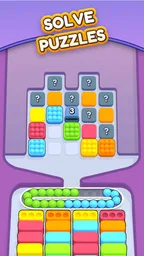
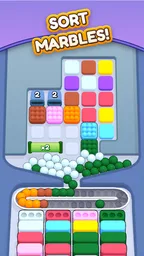
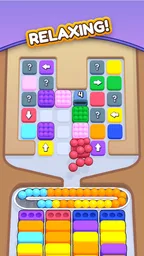
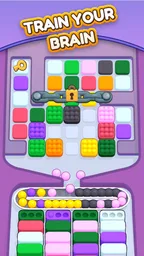
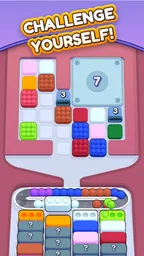
Marble Sort! - Color Puzzle review
 Analysis by Appsdrops
I like puzzle games that make sense before I have time to overthink them, and Marble Sort! - Color Puzzle has that immediate appeal. It puts colored marbles on a moving conveyor and asks me to sort them, so the goal is easy to grasp while the shifting stream gives each decision a little urgency. It is a puzzle game from VOODOO, but its appeal is less about elaborate rules than the satisfying rhythm of watching a colorful tangle become orderly.
That simplicity makes it easy to pick up during a short break. I can understand what the game is asking of me without a tutorial-heavy introduction, then focus on the conveyor and the colors in front of me. The pleasure comes from small, visible progress: notice a useful grouping, make a sorting choice, and see the flow become more manageable. It is a light, tactile-feeling idea rather than a deep strategic challenge.
Why the conveyor works in quick sessions
The moving belt gives the sorting task its character. In a conventional static color-sorting puzzle, I can inspect the whole arrangement and plan at my own pace. Here, the conveyor adds motion, which makes even a simple decision feel more immediate. That is a good fit for a game I might open while waiting for a drink or between everyday tasks: the premise is clear, and the action does not demand a long explanation before I can enjoy it.
The game’s store description frames it as relaxing and ASMR-like, and that is a useful expectation if you want a gentle sensory break. I would not treat “relaxing” as a guarantee that every moment is effortless, though. A moving stream naturally asks me to keep paying attention, and the pleasure depends on being comfortable with a little visual activity. If I want a completely still puzzle where I can pause over every move, a traditional untimed sort game may suit me better.
One practical way to approach a round is to watch the conveyor for a moment before reacting. Spotting which colors are beginning to cluster can help me make a deliberate choice instead of chasing every marble as it arrives. That small pause makes the game feel more like sorting and less like tapping reflexively. It is also a useful way to keep the visual flow manageable when I am playing in a noisy place or with only part of my attention available.
The strongest part of the design is how quickly it turns a simple color task into a focused little moment. The moving belt gives the eye something to follow, while the sorting goal supplies a clear reason to stay engaged. I find that combination more compelling than a static arrangement when I want a puzzle that feels active without asking me to learn a complicated system.
A handy choice when attention comes and goes
Short-session games need to be easy to enter, but they also need to fit around interruptions. Marble sorting has an obvious stopping point in the shape of a round, which can make it a natural choice when I only have a few minutes. I can decide to play one go rather than commit to a lengthy story or a multiplayer match that depends on other people staying available.
If something interrupts me, the sensible habit is to finish the current action or round before switching away whenever possible. A moving conveyor is the kind of visual task where returning midway through a decision could leave me unsure what I was tracking. I would not assume that the game will preserve a particular state or offer a special pause system; the more reliable approach is to treat each brief play session as a self-contained visit and stop at a natural break.
That distinction matters for commuters, people waiting for appointments, and anyone who plays with frequent distractions. The game’s basic premise is accessible, but the moving marbles still benefit from a little attention. If you expect to be interrupted every few seconds, a non-moving sorting puzzle could be less frustrating. If your breaks are short but reasonably uninterrupted, the conveyor gives those minutes a clear focus without requiring a large investment.
Another useful habit is to avoid playing while doing something that already needs your eyes. The colorful motion is the main source of feedback, so glancing away repeatedly can make the experience less satisfying. I would choose it for a coffee break, a quiet ride, or a pause between chores rather than as background entertainment while reading or watching something else. That is a modest trade-off, but it helps set realistic expectations for a game that looks simple yet relies on visual attention.
Replay value comes from the sorting rhythm
The main reason to return is the repeatable pleasure of bringing order to moving colors. This is not the sort of puzzle I would recommend for a sprawling narrative or a dramatic sense of progression. Its value is in the compact loop: look, decide, sort, and enjoy the change in the pattern. Players who like small challenges they can revisit without remembering a plot or a complex rule set are likely to find that rhythm appealing.
There is also a trade-off in that focused simplicity. Once the novelty of the conveyor has settled, the central activity remains sorting colored marbles. If you need every session to introduce a new mechanic or a major twist, repetition may set in sooner than it would in a puzzle game built around varied rules. I would choose it for an easy reset and a brief sense of order, not as my only puzzle game for long evenings.
Compared with familiar match-three games, this is less about making lines disappear and more about managing a stream of colors. Compared with a classic tube-based sorting puzzle, the moving belt makes the task feel more immediate but gives the experience a busier visual quality. Those differences make it a worthwhile alternative when stationary puzzles feel too contemplative and match-three boards feel too focused on combos. They also explain why it will not replace either style for everyone.
A small strategy I find useful is to focus on the next clear sorting opportunity rather than trying to mentally solve the entire conveyor at once. That keeps the task readable and makes a short session feel calmer. It also helps reveal whether the game’s pace suits you: if you enjoy following the flow and making quick, simple choices, the format clicks; if you prefer to survey a board with no motion, the same quality may feel like unnecessary pressure.
What to expect before installing
Marble Sort! - Color Puzzle is free to download and is rated for Everyone, so it is easy to consider as a casual game for a broad audience. It has an average rating of 4.6 from around 77 thousand ratings, with roughly 2.4 thousand written reviews, and has passed 10 million installs. Those figures suggest that the straightforward concept has reached many players, though popularity alone cannot tell you whether its pace or repetition will match your tastes.
In-app purchases range from $0.99 to $199.99 per item. That wide range is worth keeping in mind if you are choosing a game for yourself or a younger player: the download is free, but optional spending is part of the app’s setup. I would check purchase controls on the device before handing it over to a child, rather than assuming that a free game means there is nothing to monitor.
The current version is 1.25.00, and the game requires Android 8.0 or later. Those details make it straightforward to judge basic compatibility before installing. VOODOO is the developer, and the game’s identity is easy to understand from its title and central sorting task: this is a compact color puzzle, not a broad collection of unrelated activities.
For replay value, the key question is not whether the game can keep adding novelty forever, but whether you enjoy repeating its central action. I would keep it on my phone for moments when I want a small, visually clear task that feels more active than a static puzzle. I would look elsewhere if I wanted deep planning, a calm board with no motion, or a game that builds a long-term story through each session.
My casual verdict
I recommend Marble Sort! - Color Puzzle to people who enjoy colorful sorting and want a game that is quick to understand. Its conveyor gives a familiar puzzle idea a lively edge, and the short, focused rhythm is well suited to spare minutes. The best use case is simple: open it when you can give the screen a little attention, play for the pleasure of turning a moving jumble into something orderly, and stop when your break is over.
I would skip it if motion makes puzzles feel stressful, if you need every game to offer substantial strategic depth, or if repeated sorting loses its charm quickly. For those players, a still-board logic puzzle or a match-three game with more varied objectives may be a better fit. But if you want a light puzzle that offers an immediate task and does not ask you to learn much before starting, Marble Sort! - Color Puzzle is a pleasant option. Its appeal is modest but clear: a moving stream, a simple goal, and a satisfying little pause in the day.
What we like
- The tap controls are simple to learn.
- Short rounds make it easy to play in spare moments.
- Sorting colors offers a satisfying puzzle challenge.
- The marble theme gives the game a distinctive look.
- Progressive levels provide a steady sense of achievement.
What could be better
- Later stages may feel repetitive.
- Some puzzles can become difficult without careful planning.
- Frequent play may rely heavily on familiar sorting mechanics.
- A small screen can make crowded layouts harder to read.
- The game may not appeal to players seeking a story.







