





Hidden Object Games: Seek It review
 Analysis by Appsdrops
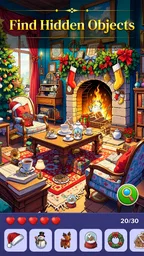
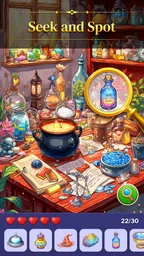
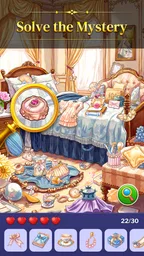
I like hidden-object games best when they give me a small, satisfying task without asking me to learn a complicated system first. Hidden Object Games: Seek It is built around that kind of quick search: look over a scene, spot the requested items, and fit a round into a spare moment. In my view, its appeal is less about a grand story or long-term strategy and more about the quiet focus of scanning a busy picture until the last object clicks into view.
A quick puzzle with a clear purpose
This is a free puzzle game from NimbleMind Network Inc., aimed at players who want a brief change of pace rather than a lengthy session. Its central activity is easy to understand, which makes it approachable if you are new to hidden-object games: examine the image, identify what you have been asked to find, and keep searching. The game is rated for Everyone, so its basic premise is suitable for a broad audience.
The three-minute format is a useful distinction. It gives a round a natural boundary, making the game easier to pick up while waiting for a bus, taking a short break, or unwinding before bed. I would not treat that time limit as a promise that every player will finish each scene at the same pace; the practical benefit is that the experience is designed for short visits rather than an uninterrupted evening.
That brevity also changes how I approach a scene. Instead of casually browsing every corner, I scan in a deliberate pattern: divide the picture into rough zones, check each one once, then revisit areas where shapes overlap or blend into the background. This simple habit helps avoid the frustrating loop of sweeping randomly over the same patch. It is especially useful when an object is small or its outline is partially hidden among similar colors.
Who will enjoy the short rounds
I can see this working well for someone who likes visual puzzles but does not want a demanding brainteaser. It offers a modest, concrete goal and a reason to pay attention, without requiring you to remember a complicated set of rules between sessions. It may also suit a household where different people want to try a puzzle without needing a shared campaign or a long explanation before handing over the device.
It is less suitable if you are looking for a deep narrative, elaborate progression, or a puzzle that rewards mathematical reasoning. Hidden-object play depends on careful observation, not on building a strategy across many moves. If you find repeated visual scanning tedious, or you prefer games with a strong sense of character and story, this may feel narrow even when its quick format is convenient.
What the current version tells me
The game’s current version is 1.38.1, and it was released on July 15, 2025. Those details establish the version and release timing, but they do not, by themselves, reveal a history of particular feature changes. I would not assume that a numbered update introduced a specific mode or improvement without clear evidence. What I can say is that the current product is presented as a focused hidden-object puzzle, rather than as a broader collection of unrelated game types.
For someone already playing, the most practical question is whether the present version still matches the reason they installed it: short searches that are easy to start. If that is what you want, the format remains straightforward. If you are hoping updates have transformed it into a larger adventure, a competitive game, or a more complex puzzle suite, the version number alone is not enough to support that expectation.
There is a strong audience signal around it: the average rating is 4.9 from around 343,000 ratings, with about 4,500 written reviews, and it has over 10 million installs. I read that as evidence that many players find the basic appeal easy to understand, not as a guarantee that every scene or session will suit my taste. Ratings are helpful context, but your enjoyment still depends on whether searching pictures is relaxing or repetitive for you.
How to make a short session feel smoother
A small change in technique can make this style of game more enjoyable. I try not to hunt for one object by staring at the whole scene indefinitely. Instead, I compare the target’s broad shape and color against the image, scan one area at a time, and move on when that area has been checked. For an object that resembles its surroundings, I look for an unusual edge or silhouette rather than relying only on color.
It also helps to choose the right moment. A quick round can fit into a break, but a crowded or distracting environment makes visual searching harder. If I am checking the game while someone is talking or while I am walking, I am more likely to miss an obvious object and mistake distraction for difficulty. A calm couple of minutes is a better match for the puzzle than trying to play while multitasking.
For younger players, the uncomplicated search premise may be easier to grasp than rules-heavy puzzles, and the Everyone rating is reassuring as a broad content classification. I would still use ordinary judgment about screen time and whether a particular child enjoys this kind of visual task. The age label describes the game’s content category; it cannot tell you whether its pace or challenge is a good fit for an individual player.
Where it sits among other hidden-object games
Compared with hidden-object adventures that place searches inside a long story, this game’s short-session identity is the main reason to choose it. Story-led alternatives are a better fit when you want characters, narrative momentum, or a reason to return to a larger sequence of scenes. A more open-ended puzzle game may also be preferable if you want to spend longer studying a single image without the pressure of a compact round.
On the other hand, a sprawling adventure can make a casual player keep track of plot details or progress systems they did not ask for. Here, the immediate visual task is the point. That makes it easier to dip in and out, though it can also leave the experience feeling less varied to someone who wants each session to introduce a new kind of challenge. The trade-off is simple: convenience and focus in exchange for less depth than a larger puzzle adventure may offer.
One useful way to decide is to ask what you want from a break. If you want a gentle activity that occupies your eyes and attention for a short stretch, this is a sensible option. If you want to switch off completely, a passive video or music app may be more relaxing. If you want a demanding mental workout, a logic puzzle is likely to give you more to think through than searching an image.
Costs and practical expectations
The game is free to download, with in-app purchases listed from $0.99 to $99.99 per item. That range is worth knowing before you install, especially if a child will use the device or if you prefer games with no optional spending. I would check the purchase controls on the device before handing it over. The presence of in-app purchases does not mean you need to buy something to understand the game’s central premise, but it does mean that “free” should not be confused with “no paid options.”
It supports devices running Android 7.0 or later. If you are choosing it for an older device, checking the operating-system requirement first can save a frustrating download attempt. The same kind of practical check applies to storage and device performance: before installing any game, I make sure there is room and that the device can run its current software comfortably, rather than assuming a compatible operating system guarantees the same experience on every handset.
When deciding whether to keep it, I would judge it by a few ordinary sessions rather than by the download count or rating alone. Do the searches make a short pause feel pleasant? Do you find yourself scanning with more confidence, or does the same visual task become tiresome? Those answers matter more than whether the game is popular. If you enjoy the core loop but want a slower pace, try playing when you are not rushed; if the act of searching itself feels like work, a different puzzle style is probably a better choice.
My verdict on its lasting appeal
Hidden Object Games: Seek It has a clear role: it is a compact visual puzzle for people who enjoy finding details in a scene and want to play in short bursts. Its accessible premise and brief format are real strengths, particularly for casual breaks. Its limits are just as clear: this is not the choice I would make for a substantial story, a broad range of puzzle mechanics, or a long session built around strategic progression.
I would recommend giving it a try if you find the act of noticing small details satisfying and want a low-commitment game to open for a few minutes. I would skip it if repeated searching tends to frustrate you, or if you need a deeper sense of progression to stay interested. As the current version continues, I would watch for clear, concrete changes to the way scenes or sessions work rather than reading too much into version numbers alone. For now, its strongest case is the one it makes through play: a focused little search that can fit neatly into an ordinary day.
What we like
- The hidden-object format is easy to understand for new players.
- Short search rounds suit quick play sessions.
- Spot-the-item puzzles encourage careful observation.
- The casual gameplay does not demand advanced gaming skills.
- It offers a relaxed alternative to fast-paced action games.
What could be better
- Small objects may be difficult to spot on smaller screens.
- Repeated search tasks can feel predictable over time.
- Timed challenges may frustrate players who prefer relaxed play.
- Progress may depend on replaying stages to earn more rewards.
- Frequent visual details can make some scenes feel cluttered.







