

Cube Land Puzzle Game review
 Analysis by Appsdrops
I like puzzle games that let me settle into a small, clear task without demanding a long session, and Cube Land has that appeal. It is a free puzzle game built around arranging color-matched blocks in a three-dimensional space. The basic idea is easy to grasp, but the cube perspective makes each move something to look at rather than a routine swipe across a flat grid. In my view, its strongest quality is that it offers a calm, visually focused kind of play; its biggest caveat is that the very features that make it tactile and spatial may not suit every player or every moment.
Seeing the board and finding your way around
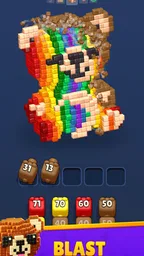
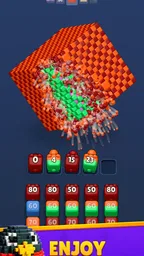
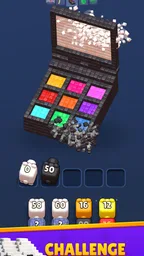
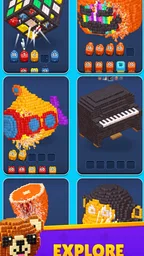
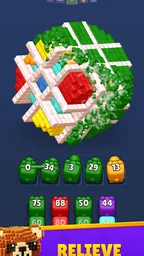
Cube Land presents its puzzle as a collection of 3D cube blocks, so the first thing I pay attention to is how the colors and block shapes read together. A color-matching puzzle is most comfortable when the board’s pieces are easy to distinguish at a glance. Here, the spatial presentation gives the playfield more depth than the usual flat color grid, which can make the task feel more like examining a small object than scanning rows on a screen.
That visual approach has a trade-off. Depth can make a board engaging, but it can also ask for more interpretation than a flat layout: I need to work out how the visible blocks relate to one another before deciding what to clear. Players who enjoy mentally rotating or visualizing objects may find that satisfying. If you prefer puzzles where every available move is immediately apparent, the 3D framing may feel like an extra step rather than a bonus.
I would approach a new board by pausing long enough to identify its color groups before making a move. That small habit helps avoid treating the game as a reflex challenge when its appeal is more about noticing a useful arrangement. It is also a practical way to keep the experience relaxed: scan, choose a target, then act, instead of making quick moves and trying to recover from a less helpful choice.
The game is described as a block-blasting puzzle, but I would not assume that this means it behaves exactly like every familiar grid-based blast game. Its defining identity is the 3D cube presentation, and that is where I would expect the main difference in feel. Compared with a flat match or blast puzzle, Cube Land gives visual depth a larger role; compared with a pure spatial-rotation game, its color-matching premise keeps the objective approachable. That middle ground is likely its most appealing design choice.
A simple premise with a spatial twist
In ordinary use, I can imagine opening Cube Land when I want a puzzle that does not require me to remember a complicated story or manage a long chain of tasks. The store summary points to matching colors and clearing cube blocks, which is enough to understand the central activity before starting. The game is made by Rotatelab Yazilim ve Bilisim A.S., and its current version is 0.6.3. Those details place it as a specific, actively versioned game rather than an abstract puzzle concept.
Its audience is broad: the content rating is Everyone, and the game sits in the puzzle category. That makes it a reasonable candidate for casual play across age groups, though a general age rating does not tell me whether the visuals or interactions will work equally well for every person. A parent choosing a puzzle for a child, for example, may appreciate the straightforward color-and-block premise, while still wanting to see how the actual screen looks and feels on that child’s device.
Touch, color, and sensory comfort
Because the central objects are colored cubes, color perception matters. If two shades are difficult for you to distinguish, a puzzle that depends on matching colors can become tiring or uncertain. I would try a few boards before deciding whether the contrast works for my eyes, rather than relying on the broad age rating as a sign that the game is visually accessible. The 3D look may help some players separate blocks by position, but it should not be treated as a substitute for clear color distinctions.
The game’s relaxed puzzle framing may appeal to people who do not want the urgency of a fast arcade challenge. Still, “relaxing” does not mean every sensory aspect will feel comfortable to everyone. Bright colors, a busy board, or visual movement can be tiring in some contexts, and I would make that judgment from actual play. If I am already sensitive to animated or highly saturated screens, I would start with a short session and see how the presentation feels before settling in for longer.
Touch use is another practical consideration. A phone puzzle generally asks for deliberate screen interaction, and Cube Land’s spatial board makes accurate selection more important than it would be in a very simple one-tap activity. Anyone who finds small targets or repeated gestures difficult should check whether their own device and grip make moves comfortable. I would avoid playing one-handed while walking or carrying something: even a calm puzzle deserves enough attention to see the board and tap with control.
Where it fits into an ordinary day
Cube Land makes the most sense to me as a short break between other tasks. I could picture opening it while waiting for a friend, taking a quiet pause after work, or occupying a few spare minutes at home. Its central puzzle idea is easy to return to without needing to reconstruct a complicated plot. For someone who wants a focused activity rather than an endless stream of notifications and social competition, that can be a welcome change of pace.
It is less suitable when I need to keep my attention on the world around me. A 3D board invites looking closely and thinking through a move, so I would not recommend playing while crossing a street, watching a child, or trying to follow a conversation. The practical test is simple: if the setting makes it hard to hold the screen steadily or inspect the cubes, save the game for a calmer moment.
It can also work as a low-pressure introduction to spatial puzzles for someone who normally plays only flat match games. I would suggest treating the first session as a chance to understand how the cube layout reads, not as a test of speed. That helps distinguish whether the challenge feels pleasantly different or merely less clear than the player’s usual choices. If the depth clicks, it offers a fresh angle on a familiar color-matching idea; if it does not, a flat-grid puzzle may be a better fit.
For users who need a particular access feature—such as a specific visual adjustment, simplified touch controls, or support for a chosen input method—I would not assume it is available without checking the game directly on their device. The most useful approach is to test the interaction in a real setting: can you see the blocks comfortably, make the intended move, and understand the result without strain? That quick trial answers more than a general promise of accessibility would.
What may get in the way
The main limitation I see is not a flaw in the premise but a potential mismatch between the 3D presentation and a player’s preferred way of processing a puzzle. A flat board makes adjacency and possible matches easy to scan; cube blocks can introduce visual depth that some people love and others find harder to parse. If you regularly lose track of which pieces belong together in a perspective view, Cube Land may demand more effort than the relaxing tone suggests.
There is also a difference between an easy-to-understand objective and an easy-to-use experience. Knowing that the aim involves matching colors and clearing blocks does not answer whether every tap will feel precise or whether every board will be comfortable to inspect. I would give the game a fair try, but I would not push through eye strain or hand discomfort just because the puzzle itself is simple. A different game with larger, flatter visual targets could be a more inclusive choice for some players.
Cube Land is free to download, with optional in-app purchases priced from $0.99 to $99.99 per item. That range is worth knowing before handing the device to a child or letting a younger player explore unsupervised. It does not mean a purchase is necessary to enjoy the puzzle, but it does mean I would review purchase controls on the device and make sure the person playing understands that optional spending may be offered.
The game has an average rating of 4.5 from around 73,000 ratings, and it has been installed over a million times. Those figures suggest that it has found a substantial audience, but they cannot predict whether its visual style suits an individual player. I would use them as context, not as a substitute for trying the core interaction. The game was released on January 16, 2026, and its stated minimum operating-system requirement is 7.1; before installing, I would check that the device meets that requirement and has enough room for another game.
Who I would recommend it to
I would recommend Cube Land to someone who likes color puzzles but wants a more spatial presentation than the standard flat grid. It is especially promising for players who enjoy studying a board before acting, and for people looking for a self-contained puzzle break rather than a high-pressure action game. The Everyone rating and free entry point make it easy to consider, while the optional purchases are a reason to keep spending controls in mind.
I would suggest a different option for players who need strong visual customization, rely on non-touch controls, or find color distinctions difficult. I would also steer away from it if what you want is a fast puzzle with instantly readable moves and almost no visual depth to interpret. In those situations, a familiar flat match game may be more comfortable and efficient. That is not a judgment on skill; it is simply about choosing a format that works with the way you see and interact.
My inclusive verdict
For me, Cube Land is worth trying when a calm color puzzle with a 3D feel sounds more appealing than another flat grid. Its clearest strength is the combination of an approachable objective and a board that asks me to think spatially. Its clearest caution is that color matching, perspective, and precise touch interaction can create barriers for players who need more visual or motor flexibility.
I would not call it a universal fit, and I would not choose it for a setting where attention is divided. But as a short, focused puzzle for someone comfortable with colored 3D objects on a touchscreen, it has a distinct reason to exist among ordinary block games. I would give it a brief, unhurried trial, pay attention to how easily the board reads, and keep it only if the spatial twist feels inviting rather than demanding. Cube Land is at its best when its extra depth adds interest without getting in the player’s way.
What we like
- Simple rules make it easy to start playing.
- Short levels suit quick gaming breaks.
- Cube-based visuals keep the board easy to read.
- Puzzle challenges reward careful planning.
- The game can be enjoyable for solo play.
What could be better
- Some puzzles may feel repetitive over time.
- Later levels can require considerable trial and error.
- The cube visuals may seem plain to some players.
- Puzzle difficulty may rise unevenly.
- Progress may feel slow for players seeking fast rewards.







