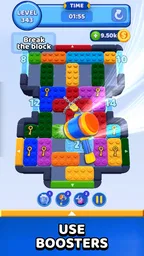

Color Block Jam review
 Analysis by Appsdrops
I like puzzle games that are easy to pick up but still make me pause before committing to a move. Color Block Jam aims for that middle ground: it is a free block puzzle from Rollic Games, built around arranging colors and working through challenges. Its premise is immediately understandable, but the fun depends on whether you enjoy thinking a few moves ahead rather than simply tapping through a board.
In my experience, this is best approached as a small, focused puzzle break. You do not need to learn a long rulebook before getting started, and the color-and-block format gives each puzzle a clear visual goal. That makes it approachable for casual players, while the need to consider placement gives it more to chew on than a purely reflex-based game.
Quick to understand, better when you slow down
The opening appeal is its low barrier to entry. A block puzzle is a familiar idea, so I can imagine starting a round while waiting for a drink or taking a short break without needing to set aside time for a long session. The challenge comes from making the board work, not from mastering a complicated control scheme.
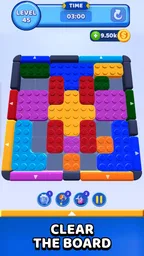
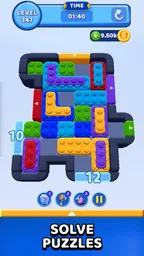
That simplicity does not mean every decision is obvious. Matching colors can invite an impulsive move, but a placement that looks good immediately may leave the remaining space awkward. My practical tip is to scan the whole board before moving a piece: identify the tightest area first, then think about which placement keeps options open there. This habit is more useful than trying to clear whatever looks easiest.
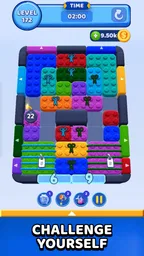
The game’s stated aim of unlocking further challenges gives the puzzle loop a reason to continue beyond a single board. Still, I would not treat progression as a promise of a particular pace or difficulty curve. The appeal is strongest when solving a puzzle itself feels rewarding; if you need a detailed story, elaborate characters, or a large social layer to keep you invested, this is not the kind of game I would choose.
How it feels in short sessions
For a quick session, the main advantage is that the task is self-contained: focus on the puzzle in front of you, make a move, and see whether the board improves. That suits a commute break, a quiet moment between chores, or a few minutes before bed. If I were playing in a setting where interruptions are likely, I would avoid starting when I only have a few seconds; a puzzle is more satisfying when I can look over the board rather than tapping in a rush.
Compared with familiar match-three games, this has a more spatial feel. Match-three play often rewards noticing combinations and reacting to a changing board, while a block puzzle asks me to think about fit, color, and the consequences of using available space. Compared with classic falling-block games, the draw is less about reacting to pieces under time pressure and more about deliberate placement. If you prefer fast reflex tests, those alternatives may be a better fit.
When a puzzle gets demanding
The moments that call for the most attention are the ones where several placements seem plausible. It is tempting to choose the move that creates an immediate match, but I would first ask whether it blocks a useful space or makes later pieces harder to position. A good general workflow is to reserve flexible areas for pieces that are difficult to fit and use tighter spaces for placements that clearly belong there. That is a way of thinking, not a guarantee that every board has one obvious solution.
This approach also helps when I make a move and then regret it. Rather than tapping quickly to force progress, I would pause and reassess what the board now allows. The useful skill is not memorizing a trick; it is recognizing when a move reduces future choices. That makes the game more thoughtful than its simple premise may suggest, though players who dislike trial and error could find that deliberation frustrating.
Another practical trade-off is session length. A puzzle that looks simple can keep me engaged longer than intended because I want to test one more arrangement. If I am trying to use the game only as a brief distraction, I would set a natural stopping point before starting, such as finishing the current puzzle rather than continuing through every new challenge that appears. The format is easy to return to, but that same ease can make it tempting to extend a break.
Reliability and everyday expectations
I would set ordinary expectations for a mobile puzzle game: it should feel comfortable to pick up and play, but I would not assume that every device or situation will feel identical. No performance measurements are available here, so I would not claim a particular loading time, frame rate, battery impact, or crash rate. What matters to a prospective player is whether the simple puzzle format suits the way they use a phone, and that is easier to judge than a technical benchmark.
For interruptions, the sensible habit is to finish a move before switching away whenever possible. That gives the board a clear state to return to and avoids losing track of what I was planning. I would also avoid assuming that progress or a particular session state will recover in a specific way after closing the game; those details can depend on the app and device. If uninterrupted play is important to you, try it during a relaxed moment before relying on it for a long trip or a tightly scheduled break.
Heavy use is mostly a question of attention rather than demanding gameplay, at least from what can responsibly be inferred about its puzzle format. Longer sessions mean more time studying placements, and bright colors or repeated close inspection may feel tiring if you are already using your phone for work or reading. I would take a pause when I start making careless moves. That is a better response than blaming the puzzle for becoming difficult when fatigue may be the real problem.
Compatibility, cost, and who should try it
The game is rated for Everyone and is free to download. It supports Android 7.0 and later, and the current version is 12.1.4. In-app purchases range from $0.99 to $179.99 per item, so I would check the purchase screen carefully and avoid tapping through any offer without understanding what it costs. A free download does not mean every optional purchase is inexpensive, and the broad price range is worth keeping in mind, especially if a child may use the device.
It has reached over ten million installs, with an average rating of 4.1 from around 355,000 ratings and roughly 4,700 reviews. Those figures suggest that many people have tried it, but they do not tell me whether its particular puzzle style will suit you. I would use them as context, not as a substitute for asking whether you enjoy careful spatial decisions and repeated challenge-based play.
Because the minimum Android requirement is an older version, the stated compatibility covers a wide range of Android software. That alone does not establish how smoothly it runs on any individual phone, especially one with limited free space or an older processor. If your device is already struggling with everyday apps, I would keep expectations cautious and test the game rather than assuming that a puzzle title will automatically be lightweight. iOS availability is not something I would infer from these Android details.
This is a good fit for people who like visual puzzles, want a game that is easy to understand, and are happy to spend a few minutes considering each move. I would skip it if I wanted a story-led adventure, competitive multiplayer, or action that depends on quick reactions. I would also steer away if making a wrong placement and reconsidering the board feels annoying rather than satisfying. In those cases, a relaxed word puzzle or a fast arcade game may be a better match, depending on whether you want calm deduction or immediate action.
My performance verdict
My overall view is that Color Block Jam makes sense as a straightforward puzzle companion, not as a technical showcase. Its familiar block-and-color idea is easy to approach, and the best way to get more from it is to protect open space, prioritize awkward areas, and avoid rushing into the first satisfying-looking move. Those small habits turn a quick tap game into a more considered puzzle session.
Rollic Games has made a free game with a broad audience, and its Everyone rating makes the premise approachable for different ages, though adults should still be mindful of in-app purchases on a shared device. I would try it if I wanted a compact mental challenge for spare moments. I would choose something else if my priority were a rich narrative, guaranteed uninterrupted progress, or a game whose appeal rests on speed. As a color-based block puzzle, it is most rewarding when I give each board a little attention and treat every placement as a choice that shapes the next one.
What we like
- Controls are simple to learn and work well on a touchscreen.
- Short levels make it easy to play in quick sessions.
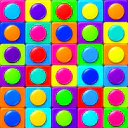
- Colorful visuals make blocks and goals easy to distinguish.
- Puzzles reward planning rather than quick reflexes.
- New challenges keep the core puzzle idea feeling fresh.
What could be better
- Some levels can require several attempts to solve.
- Later puzzles may feel frustrating without a clear hint system.
- The matching colors can be difficult to distinguish for some players.
- Progress may feel slow when a puzzle has a tricky solution.
- The gameplay offers limited variety beyond sliding and matching blocks.







