Block Crush! review
 Analysis by Appsdrops
Block Crush! is a straightforward wood-block puzzle built around a satisfying little decision: where can I place this piece without closing off the board? I like it most as a quiet, low-commitment game for a spare moment, not as a deep puzzle campaign. Its appeal is the steady rhythm of fitting shapes, clearing lines, and spotting chances to build combos. That simplicity is also its main limitation: if you want new mechanics, a story, or a strong sense of progression, this is unlikely to hold your attention for long.
Why the board keeps me thinking
The basic loop is easy to understand, but a good run asks for more than filling obvious gaps. I find myself weighing a safe placement against one that leaves room for a less convenient shape later. Clearing a line can feel rewarding, yet clearing too quickly is not always the best move if it leaves the remaining spaces awkward. That small tension gives the game its puzzle character without asking me to learn a complicated rule set.
The most useful habit is to treat open space as a resource. Rather than placing each piece wherever it fits, I try to preserve a broad patch of the board and avoid creating narrow pockets that only a very particular shape could fill. When a move offers a line clear, I still check whether it breaks up the space I need for future pieces. This is a simple way to make the decisions feel more deliberate, especially once the board is crowded.
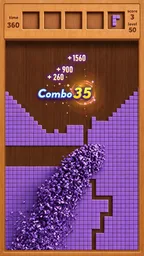
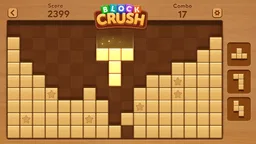
Combos add another layer to that planning. I look for placements that can clear more than one line or set up a follow-on clear, but I avoid chasing a combo if it leaves the board in a worse state. That trade-off is the most interesting part of the game for me: an immediate reward can be less valuable than keeping several useful placements available. It makes each turn feel like a quick assessment rather than a reflex tap.
Because the rules are so accessible, I can pick it up without warming up or remembering a long set of instructions. It suits a short break when I want something more engaging than scrolling but less demanding than a competitive match. The game’s free price also makes it easy to try, while its Everyone age rating points to a broad, casual audience rather than a narrowly specialized one.
A small puzzle with a clear identity
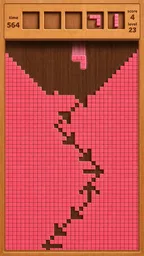
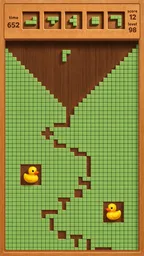
As a puzzle game, Block Crush! focuses on spatial judgment rather than a narrative or a collection of elaborate systems. The wood-block presentation gives the board a familiar, tactile feel, and the central activity stays in view: fit pieces, manage empty space, and clear lines. I appreciate that directness. There is little between me and the next decision, which makes it easy to return after putting the game down.
It is worth distinguishing this from match-based puzzles. In a typical match game, I might scan for a pattern and make a move that changes the board in a chain. Here, I’m arranging shapes against fixed gaps, so planning depends on how much usable room I preserve. Compared with a classic falling-block game, the pace feels less like reacting under pressure and more like calmly evaluating each placement. If you enjoy spatial puzzles, that difference is a strength; if you want speed and urgency, it may feel restrained.
I also find that the game works best when I give each move a brief pause. A quick tap can be tempting, especially when a piece seems to fit neatly, but looking at the remaining open area first often reveals a better placement. My practical routine is to check for immediate clears, then look for the largest open region, and only then decide whether a combo is worth pursuing. It is not a hidden trick or a guarantee of a long run; it simply helps make the puzzle less dependent on impulse.
Where the simplicity becomes a weakness
The same focused design can start to feel repetitive. Once I understand the placement-and-clear rhythm, the game’s enjoyment depends heavily on whether I still like optimizing a board one piece at a time. Players who need regular changes in objectives, a developing story, or a sense of unlocking new ways to play may find the core loop too familiar. I would not choose it as my main game if variety were my top priority.
There is also a natural limit to how much control I have. A careful player can protect open space and avoid careless dead ends, but planning cannot make every piece convenient. That uncertainty is part of a shape-placement puzzle, yet it can make a promising board feel frustrating when the available space no longer suits what I need to fit. I think it is best approached as a score-and-focus pastime rather than a puzzle with a single solution that patience will always reveal.
Its easy-to-grasp format is not the same as a guarantee that every session will feel relaxing. If I am already tired of making small optimization decisions, even a simple board can feel like one more thing to manage. In that mood, a passive game or a puzzle with shorter, clearly finished challenges may be a better choice. Block Crush! asks for attention in modest doses, but it still asks for attention.
Who will get the most from it
I would recommend it to people who like spatial challenges, enjoy improving their decisions through repetition, and want a game they can start without a long commitment. It is also a reasonable pick for someone curious about block puzzles who would rather learn by playing than absorb a complicated tutorial. Wonderful Studio is the developer, and the game’s broad appeal is reflected in its 50 million-plus installs and an average rating of 4.6 from around 731,000 ratings.
A realistic use case is a short wait between errands. I can open the game, focus on a board for a little while, and put it aside when my turn arrives. The same quick-session quality makes it suitable for a brief break at home. I would not count on it to replace a longer game night, though: its strength is how little preparation it needs, not the breadth of activities it offers.
It may be a poor fit for anyone who prefers multiplayer competition, character-driven play, or puzzles where each stage introduces a distinct challenge. A more varied puzzle game is likely the better option for that audience. Likewise, if the appeal of a block game for you is a fast, escalating pace, a falling-block alternative may suit you more. Block Crush! is at its best when you want to think calmly about placement rather than race a clock or compete with someone else.
For players who do enjoy this kind of loop, a useful way to keep it fresh is to set a personal focus for a session: protect a large open area, avoid leaving isolated holes, or look for a worthwhile combo without sacrificing flexibility. These small goals change what I pay attention to, even though the underlying rules stay familiar. They also make a loss more informative: I can see whether I boxed myself in by placing too greedily, rather than blaming every bad board on luck.
Practical details and my verdict
The game is free, and the current version is 3.2.8. It was released on December 14, 2021, and supports Android 7.1 or later. It has also gathered around 5,400 written reviews alongside its much larger pool of ratings, which suggests that many players have taken time to share their views. I treat those numbers as context, not as proof that the style will suit everyone: the core question is whether careful block placement is the kind of small puzzle you want to revisit.
My verdict is positive, with a clear qualification. Block Crush! is a good choice for calm, repeatable spatial puzzling, but not for players who need constant novelty. I like the way it rewards leaving room for future pieces and thinking about combos without making the rules difficult to grasp. I would suggest trying it if you want a free, accessible puzzle for brief breaks; I would steer you elsewhere if progression, variety, or high-pressure action matters more than a clean board-and-piece challenge.
What we like
- Simple rules make it easy to start playing.
- Short rounds work well for quick breaks.
- Increasing difficulty keeps the challenge engaging.
- The game works well for solo play.
- Block placement rewards careful planning.
What could be better
- Repeated layouts may feel monotonous over time.
- Later levels can become quite difficult.
- A misplaced block can quickly limit your options.
- The game offers little variety beyond its core puzzle.
- Frequent play may feel repetitive.







