
Ball Sort Puzzle - Color Game review
 Analysis by Appsdrops
I like puzzle games that make their rules clear and leave the challenge to my own decisions. Ball Sort Puzzle - Color Game follows that simple idea: colored balls sit in tubes, and I move them around to sort each color together. It takes only a moment to understand what I’m meant to do, but a crowded board can turn a quick round into a proper little logic exercise. That balance is the game’s appeal: easy to pick up, satisfying when a plan works, and challenging enough to keep me thinking.
A simple puzzle with room to think
Developed by Guru Puzzle Game, Ball Sort Puzzle is a free puzzle game for Android. It was released on May 18, 2022, and its current version is 5.9.0, with Android 7.0 as the minimum operating system requirement. The game is rated for everyone, so its straightforward, non-violent puzzle format can suit a broad audience. It has also found a substantial player base, with over 50 million installs and an average rating of 4.9 from around one million ratings.
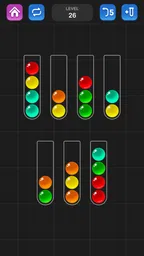
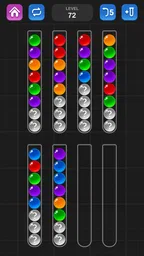
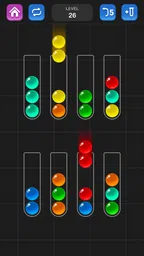
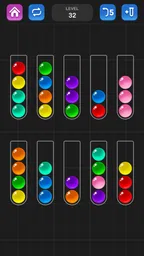
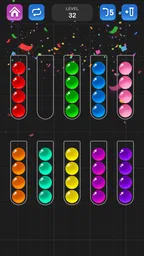
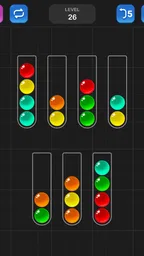
The premise needs little explanation. Each level presents tubes holding balls of different colors, and the aim is to sort them so matching colors end up together. A move might look obvious at first, but every tube has limited room. That means a seemingly harmless choice can block a color I need to move later. I enjoy that small tension: the game doesn’t bury the puzzle under a complicated story or a long list of rules. It asks me to look, plan, and make the next move count.
The store description sums up the central appeal as challenging but addictive, with offline play and a chance to train your brain. That’s a fair description of the experience. I can play without needing a network connection, which makes it handy for a quiet break or a journey when I’d rather keep things simple. The focus stays on the board and the decisions in front of me, rather than on online competition or elaborate presentation.
The baseline workflow: look before you move
My most reliable routine starts with a pause. Before tapping a tube, I scan the board and identify which colors are already grouped, which are scattered, and where there’s room to maneuver. Since the goal is to bring matching balls together, it’s tempting to start moving the most visible color immediately. I’ve found that a brief overview is usually more useful: it helps me avoid filling a tube that could have served as temporary space for a harder-to-place color.
From there, I work one color at a time when the layout makes that practical. I look for a move that opens access to a ball underneath another color, or that gathers matching balls without closing off too many options. The point isn’t to follow a rigid formula—every board can call for a different order—but to make moves that improve the overall position. When a move only shifts a problem from one tube to another, I take a second to check whether it also creates a useful opening.
Empty space deserves particular attention. A tube with room can act as a buffer while I sort out a crowded arrangement, so I try not to treat every available spot as an invitation to move the first ball I see. Keeping flexibility in reserve makes it easier to respond when a color I need is buried. This is a small habit, but it changes the way the puzzle feels: instead of reacting to each tap, I’m choosing moves with the next few possibilities in mind.
When I do make a mistake, I use it as information. A color moved into the wrong place may reveal that I underestimated how much room another group would need. Rather than rushing into another move, I reassess the tubes and look for a route that restores space or exposes a useful ball. That approach keeps the game from feeling like a test of perfect foresight. It becomes a process of observing, adjusting, and gradually finding a workable sequence.
Settings and a comfortable play rhythm
I like to check a game’s settings before settling into a longer session, especially when I expect to play in different situations. A calm presentation and comfortable audio level can make a simple puzzle easier to enjoy, whether I’m concentrating in a quiet room or fitting in a few moves during a break. Ball Sort Puzzle is built around brief, repeatable rounds, so I can pick it up for a short session without needing to prepare for a lengthy commitment.
The most useful “setting” in practice is often my own pace. I try not to tap quickly just because the rules are simple. A slower rhythm gives me time to notice how a move affects the remaining space and which colors are now accessible. If I’m playing while distracted, I keep the goal modest: solve a board, take a break, and return when I can focus. That’s a more satisfying habit than treating every level as something to clear as fast as possible.
There’s also value in choosing a comfortable way to hold and use the phone. Since the core interaction is moving balls between tubes, clear taps matter. I make sure I can see the full board and reach the tubes without awkwardly shifting my grip mid-move. It sounds basic, but reducing accidental taps helps keep my attention on the puzzle itself rather than on correcting a clumsy input.
The game’s offline play is a practical part of its appeal. I can settle into a puzzle without making connectivity the center of the experience, and that suits the quiet, self-contained nature of color sorting. It’s the kind of game I can return to when I want a mental pause rather than a sprawling adventure. I don’t need to remember a plot or manage a complicated set of systems; I just look at the current arrangement and start planning.
Faster patterns that still leave room for judgment
With experience, I’ve become quicker at spotting useful patterns. One is to separate “progress” from “movement.” A ball changing tubes doesn’t necessarily mean I’m closer to a solution. A genuinely useful move either groups matching colors, exposes something I need, or preserves a route for later. Keeping that distinction in mind cuts down on aimless shuffling and makes each decision feel more deliberate.
Another helpful habit is to identify which color is causing the greatest blockage. If one color is spread across several tubes and covered by others, it may deserve attention before a color that is already nearly sorted. I don’t always deal with the most tangled color first, because the board may offer a better opening elsewhere. Still, naming the main obstacle gives me a clearer plan than simply moving whichever ball catches my eye.
I also try to think in short sequences. Instead of planning the entire solution in one go, I ask what a move will make possible next. Can it free a ball? Will it leave enough space to collect a matching group? Does it create a dead end where every tube is awkwardly occupied? This modest look-ahead is more useful than trying to predict every move from the start, particularly when a board has several colors interwoven in the same tubes.
When I’m stuck, I sometimes change my perspective by tracing one color through the board. I locate its visible balls, note what is covering them, and consider which tube could receive them as they become available. Then I repeat the process for another color if needed. It’s a simple mental shortcut, not a special feature or guaranteed solution, but it helps turn a busy arrangement into a set of smaller questions.
Experienced players can also benefit from a repeatable check before each tap: what am I moving, where will it go, and what space will remain afterward? That brief routine catches many impulsive choices. It doesn’t make every level effortless, and that’s a good thing. The satisfaction comes from applying a consistent method to a layout that still asks me to adapt.
Where the challenge reaches its limits
The strength of Ball Sort Puzzle is also its main limitation: it keeps its attention firmly on sorting. Players who enjoy compact logic puzzles will likely appreciate that focus, while anyone looking for a story-led campaign, elaborate characters, or a wide variety of game modes may find the experience narrow. The central mechanic is easy to grasp, and much of the continuing challenge comes from the arrangement of colors and the need to manage space.
That simplicity can make the game relaxing, but it can also create repetition over longer sessions. I’m happy to play several puzzles when I’m in the mood to spot patterns, yet I don’t expect each round to feel like a completely new kind of game. The best way to enjoy it is to take the levels on their own terms: as small exercises in planning rather than as a progression full of narrative surprises.
The free-to-play model is another practical consideration. Ball Sort Puzzle is free to download, and it offers in-app purchases priced at $7.99 per item. That’s worth keeping in mind when deciding what to install or when a child is using the device. The game is rated for everyone, but the presence of in-app purchases still makes it sensible for families to be attentive to purchase controls on their device.
Its large audience suggests that the basic concept has broad appeal, but popularity alone doesn’t decide whether it will suit a particular player. I’d recommend it most readily to people who enjoy tidy visual puzzles, short sessions, and the feeling of finding an efficient sequence. If you prefer constant novelty or a more involved progression, the focused format may not hold your attention for as long. Knowing that upfront makes it easier to approach the game for what it is.
A satisfying choice for focused puzzle breaks
After spending time with its central loop, I see Ball Sort Puzzle as a dependable little brain teaser rather than a game that needs to reinvent itself. Its rules are approachable, but its limited tube space rewards patience and a bit of forward thinking. I especially enjoy the moment when a crowded board starts to make sense and a careful sequence brings scattered colors together. That feeling is small, clear, and exactly what I want from a casual logic game.
For the best results, I recommend starting each puzzle with a quick scan, preserving useful empty space, and checking what a move enables before making it. These habits don’t remove the challenge; they make the challenge more rewarding. I also find that short sessions work well, since stepping away when I’m tired can make it easier to return with fresh eyes and notice a route I missed.
Ball Sort Puzzle - Color Game is at its best when I treat every move as a choice about space, access, and future options. It’s free, supports offline play, and offers a straightforward way to exercise logic during a spare moment. The familiar mechanic may eventually feel repetitive, but for players who like color sorting and measured problem-solving, it delivers a clean, accessible puzzle experience. If that sounds like your kind of break, it’s an easy game to pick up and a surprisingly engaging one to keep thinking about.
What we like
- Simple rules make it easy to start playing.
- Short levels fit well into quick breaks.
- Sorting colors offers a satisfying logic challenge.
- No fast reactions are needed to solve puzzles.
- The familiar format suits casual puzzle fans.
What could be better
- Some levels may feel repetitive over time.
- A mistaken move can leave a puzzle harder to solve.
- Later stages can require several attempts.
- Ads may interrupt the flow of play.
- The basic mechanics may not appeal to players seeking variety.







