






Testerup: Test & Earn Rewards review
 Analysis by Appsdrops
I would approach Testerup as a paid-for-time activity, not as a dependable way to make money. The idea is appealing: try mobile apps and games, complete tasks, and receive rewards. The important question is whether the tasks fit naturally into your spare time—and whether you are comfortable evaluating offers and sharing whatever information a particular task requires. My view is that it can be worth exploring for curious, patient users, but it is a poor match for anyone expecting quick, predictable income.
What the app asks you to trust
Testerup is a finance app from aestimium GmbH, though its day-to-day appeal is closer to a task marketplace than a budgeting or banking tool. Its audience is broad: it is rated for Everyone, costs nothing to download, and has reached over ten million installs. That makes it easy to try, but a large audience should not be mistaken for a guarantee that every offer suits every person.
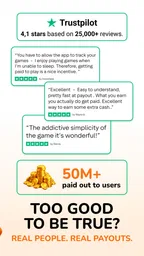
The app has an average rating of 4.2 from around 234,000 ratings, with roughly 55,000 written reviews. I take that as a sign that many people have formed a clear opinion, not as proof that every user will have the same experience. Reward apps depend heavily on individual task availability, eligibility, completion requirements, and patience. A good result for one person does not necessarily predict yours.
At its core, Testerup connects users with app and game tasks. That is different from earning cashback on purchases you already planned or answering a single survey with a clearly bounded time commitment. Here, the reward is tied to trying something and meeting its conditions. Before starting, I would treat each task as a small commitment: understand what it asks, decide whether I would use the app or game anyway, and consider what I am willing to share along the way.
Read the task before you begin
The most useful habit is to inspect an offer before installing anything. Pay attention to the exact action that counts as completion, any stated deadline, and whether the task describes a sequence of steps rather than one simple action. If a game offer requires sustained progress, it may demand repeated sessions; a quick-looking task can turn into a longer project once you begin.
I would also compare the promised reward with the effort in practical terms. A task that sounds fun may still be a bad trade if it takes more time than you want to give. The key is not to chase every available offer, but to pick work that fits your spare time and interests. That simple filter helps prevent the common reward-app trap of spending an evening on something you would never have chosen to do otherwise.
Controls and choices matter
Testerup is currently at version 3.2.14 and supports Android 7.0 or later. App versions and operating-system compatibility can affect how smoothly an experience runs, so I would keep the app current through the app store and make sure my device meets that requirement before troubleshooting a task. The developer is aestimium GmbH, a name worth recognizing when checking which app you have installed or reviewing its store page.
For trust, I would focus on choices I can actually make rather than assumptions about unseen safeguards. I would review the task terms, the app-store permission prompts, and any account or privacy controls shown inside Testerup. If an offer sends me to another app, I would evaluate that app separately: accepting a task does not mean every permission requested by the destination app is necessary for my own purposes.
That distinction is easy to overlook. A reward platform can introduce you to third-party apps, but your comfort with the platform and your comfort with each task are separate decisions. I would decline a task if its requirements feel unclear, if the destination app asks for access I do not want to grant, or if I would not install that app outside the reward context. Being able to skip an offer is a meaningful part of using the service thoughtfully.
When personal data enters the picture
Trying apps and games can involve more than opening them. A task may ask you to create an account, complete an in-app action, or keep using a product long enough to meet a milestone. Each step can bring its own data choices. I would pause before entering personal details, connecting another account, or allowing a permission, then ask whether that information is genuinely needed for the task I chose.
I would be especially careful with anything involving payment details or a subscription. A task’s reward should not distract from a purchase prompt or trial terms in the app being tested. Read those screens as if no reward were involved, and do not proceed just because you have already invested time. If a task requires spending money, the sensible comparison is the possible benefit against the full cost and cancellation responsibility—not the headline reward alone.
For a lower-risk first try, I would choose an offer whose steps are easy to understand and that does not require sensitive information or a purchase. That lets me learn how the task flow works before committing more time. It also gives me a chance to see whether the instructions are clear enough to follow and whether the experience feels worthwhile to me, without treating an early task as a reason to accept every later one.
A practical way to fit it into your day
Imagine you have a quiet half-hour after dinner and are already interested in trying a casual game. I would browse the available tasks, select one with a clear goal, and note the requirements before starting. Then I would use a short checklist—what I need to do, what counts as completion, and how much time I am willing to spend. If the task turns into a grind or the instructions no longer match what I see, I would stop and reassess rather than keep going simply because I had begun.
That approach is more useful than opening the app whenever you have a spare minute and accepting whatever appears first. Some tasks are better suited to a few planned sessions than to fragmented attention. Keeping your own note of the task’s stated conditions can also help you remember what you agreed to do, especially if you are testing several things over time. I would avoid relying on memory for milestones or deadlines.
Another practical tip is to separate “I want to try this” from “I want the reward.” If you would enjoy the game or app even without compensation, the task can feel like a bonus. If you dislike it from the start, the reward may not justify the time. This is the difference between a small, enjoyable side activity and turning leisure into unpaid work with an uncertain payoff.
How it compares with familiar alternatives
Compared with cashback apps, Testerup is less about earning from a purchase you were already making and more about completing an assigned experience. Compared with surveys, it may offer a more interactive task, but the time commitment can be harder to judge because app and game progress varies. Neither comparison makes one format universally better; it clarifies what you are trading: a more involved activity in exchange for a reward opportunity.
If you want a predictable side income, a standard paid shift or freelance job is a better choice. Those options involve their own effort and conditions, but they are designed around compensation for work rather than a selection of app-based tasks. If you simply want to discover new games, browsing the app store directly may be better because you can choose without shaping your play around a reward requirement.
Testerup makes the most sense when you enjoy trying unfamiliar mobile experiences, can be selective, and are comfortable treating rewards as occasional rather than guaranteed. It is less suitable for anyone who needs money by a certain date, dislikes promotional task flows, or has little patience for goals that require several sessions. I would also skip it if you know you tend to continue with a task just because you have already spent time on it.
My cautious verdict
Testerup has a straightforward appeal: it turns app and game testing into a possible reward activity, and the free entry point makes it easy to consider. I would use it selectively, beginning with a clearly explained task that fits an existing interest. The app’s 4.2 average and large user base provide useful context, but they do not replace checking the terms and deciding whether each individual offer is worth your time.
The strongest reason to try it is curiosity: you already like exploring mobile apps and want a structured way to do that. The strongest reason to pass is the need for certainty. A reward task is not the same as a fixed wage, and the experience may involve time, eligibility conditions, or data choices that deserve a careful look. I would keep expectations modest, avoid sharing information I am uncomfortable providing, and stop when a task no longer feels like a fair exchange.
My recommendation is to treat Testerup as an optional experiment, not a financial plan. Start small, read each task before accepting it, and make your own comfort the deciding factor. The app is free, but your attention and personal choices still have value; it is worth using only when the task feels reasonable even after you account for both.
What we like
- The app is free to download and create an account.
- Game offers display their reward amounts before you start.
- Progress tracking helps you follow each offer’s requirements.
- A broad selection of offers can suit different gaming interests.
- The app can be a low-effort way to explore new games.
What could be better
- Rewards require completing specific tasks rather than simply playing.
- Some offers may take considerable time to finish.
- Eligibility and availability can vary by location.
- You may need to share personal details to claim rewards.
- Offer terms can be strict about deadlines and qualifying actions.





