


Taptap Send: Money Transfer review
 Analysis by Appsdrops
I look at an international money-transfer app differently from a budgeting tool: the important question is not whether it has a long feature list, but whether it makes sending money feel clear and manageable when someone is waiting on the other end. Taptap Send is built around that focused job. In my view, it is worth considering if you regularly send money across borders and want to handle the process on your phone, but it is not automatically the best fit for every route or every kind of payment.
A focused tool for sending money abroad
This is a finance app from Taptap Send, Inc., with an audience that appears to have found it useful: it has a 4.7 average from around 363,000 ratings and more than 10 million installs. Those figures suggest broad adoption, but they do not tell me whether a particular transfer route will suit your needs. For an international transfer, the details that matter most are the destination, payout method, exchange rate, fees, and how long the recipient may wait.
The app is free to download and rated for Everyone. That does not mean every transfer itself is free; before sending, I would treat the final review screen as the place to check the amount the recipient is expected to get and any charges shown. This is the practical distinction people sometimes miss: a free app is not the same thing as a free financial service.
My overall impression is that Taptap Send makes most sense as a repeat-use utility. If you send money to family, support someone studying abroad, or regularly contribute to household expenses in another country, having a dedicated transfer app can be more convenient than starting from scratch with a bank or visiting a physical remittance counter. If you only need to move money internationally once, comparing the total cost and delivery options across services may matter more than choosing a familiar app.
Where it fits in the current transfer landscape
The usual alternatives are a bank’s international transfer service, another money-transfer app, or an in-person remittance provider. A bank may be the natural choice if you already manage everything there, while a counter service can be useful for someone who prefers help face to face or needs a specific cash-based arrangement. A mobile specialist such as Taptap Send is appealing when you value being able to arrange a transfer from your phone and want a process centered on sending rather than general banking.
That focus is also a limitation. I would not choose it as a substitute for a full bank account, a way to manage spending, or a general-purpose payment wallet. Its value depends on whether the country and recipient options you need are supported and whether the quoted terms compare well with alternatives. Transfer services can differ by destination, so a good experience on one route should not be taken as proof that every other route works the same way.
A useful habit is to compare the amount arriving, not just the fee displayed. Exchange rates can change the effective cost, and a low-looking charge does not by itself establish that a transfer is the best value. Before committing, I would enter the intended amount and destination, inspect the recipient’s expected payout, and compare that result with at least one alternative. That small check is more informative than relying on a service’s general reputation.
What the current version tells existing users
The current release is version 2.105.0, and the app first appeared on June 5, 2018. That gives it a longer history than a brand-new transfer product, while the version number indicates that it has continued to be maintained. I would read those facts as evidence of an established app, not as proof that a particular feature has recently changed or that the service has improved in a specific way.
For someone already using it, the practical question is whether the current app continues to make their usual sending routine straightforward. An update can matter if it changes navigation, security prompts, or the information shown during a transfer, but I would not assume any of those changes from a version number alone. After updating, it is sensible to review the recipient details and transfer summary carefully rather than relying on muscle memory.
For a new user, the app’s history and current version are useful context, but not a reason to skip a first-transfer check. I would begin with a modest amount if that is appropriate for the situation, verify the recipient’s name and payout details, and make sure the app displays the expected destination and total before confirming. That workflow is not a claim about a special feature; it is a sensible way to reduce avoidable mistakes in any money-transfer service.
Everyday situations where the focused approach helps
Imagine you send money home after payday and the recipient relies on it for groceries or a bill. A dedicated app can make the routine easier to repeat because you can handle the transfer without planning a trip to a counter. The important step is to leave time for the transfer rather than assuming that every payment arrives immediately. If the recipient needs the money by a deadline, check the estimated delivery information shown for that particular transfer and send early enough to allow for delays.
Another useful case is occasional support for a student or relative abroad. Here, I would think about more than the amount: does the recipient need funds paid out in a way they can actually access, and are their details accurate? A transfer that looks convenient to the sender may be less useful if the payout arrangement does not match the recipient’s circumstances. Confirming those points with the recipient before sending can prevent a correction from turning into a stressful back-and-forth.
A less obvious trade-off arises when you send several small amounts instead of one larger transfer. Convenience may favor sending whenever someone asks, but fees or exchange-rate effects can make repeated transfers less attractive depending on the route. I would compare the total cost of the pattern you actually use, rather than judging the app based on a single sample amount. If the recipient can plan around a regular transfer, combining needs may be worth considering, provided that doing so does not leave them short when they need support.
For a shared family arrangement, I would also keep a simple record outside the app of what was sent and why. That is useful when several people contribute to the same household or when you need to distinguish routine support from an emergency payment. It does not depend on assuming that the app provides a particular budgeting or receipt feature; it is a practical habit that makes recurring transfers easier to discuss and reconcile.
What to check before relying on it
The first question is whether your sending country, destination, and preferred payout arrangement are available. The second is what the recipient will actually receive after the exchange rate and any displayed charges are applied. The third is timing: if a transfer is urgent, check the estimate for that transaction and have a backup plan rather than treating a general expectation as a guarantee. These checks are more useful than assuming that an app’s broad international focus means every corridor has identical terms.
I would also take recipient setup seriously. International transfers involve details that can be easy to mistype, and a misspelled name or incorrect payment information can create unnecessary delays. Before confirming, compare the information on screen with what the recipient has provided, especially if you are sending to someone new. For a first transfer, do not rush through the final confirmation just because the app feels familiar or the amount is small.
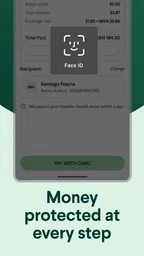
Privacy and account access matter as well. A finance app is only as safe in practice as the person’s device and login habits, so I would keep the phone protected, avoid sharing access, and read any security prompts rather than tapping through them automatically. If you are using a shared device or travelling, be especially careful about staying signed in and about checking that the recipient is correct before sending.
One real limitation is that mobile convenience cannot eliminate the uncertainty that comes with cross-border payments. Processing times, recipient access, and the value of an exchange can all be relevant to the result. If you need a guaranteed arrival time, a particular payout method, or a transfer route that is not offered, another provider may be a better choice. Likewise, someone who prefers speaking with a person before each transaction may feel more comfortable with an in-person service or a bank they already know.
Who should choose it, and who should compare first
I would put Taptap Send on the shortlist for people who send money internationally more than occasionally, are comfortable using a phone for financial tasks, and can confirm that their route and recipient arrangement fit. Its focused purpose is a strength for that audience: it keeps the task centered on transferring money rather than burying it among unrelated banking features. The app’s free download lowers the barrier to trying it, but the transfer terms still deserve a careful look every time.
I would compare other options first if cost is the overriding concern, if you need a specific delivery method, or if your destination is not clearly available in the app. A bank transfer may be preferable when you want to keep the process inside an existing banking relationship; an in-person provider may be better when personal assistance is important. Neither alternative is universally superior. The right choice depends on the actual route, the recipient’s needs, and the amount that arrives after all costs are considered.
The app has 14,000 reviews, alongside its much larger pool of ratings, which offers prospective users more than a handful of public experiences to consider. I would read recent comments with care and look for reports from people using the same destination or payout arrangement rather than treating any one review as representative. A smooth transfer on one route does not guarantee the same result elsewhere, and an isolated complaint should not be taken as the whole story either.
A measured recommendation
My recommendation is to try Taptap Send if it supports the route you need and its quoted recipient amount and timing make sense against your alternatives. Approach it as a practical transfer tool, not as a promise that every international payment will be instant, identical, or the cheapest available. The best first step is to set up the recipient carefully, review the complete transfer summary, and avoid sending under deadline pressure until you understand how that route works for you.
The product’s long-running presence and current version make it a credible option to investigate, while the app’s strong average rating and wide adoption offer reassuring context rather than a guarantee. What I would watch over time is whether the app keeps the steps understandable and makes the costs, timing, and recipient options clear for the routes people actually use. For regular senders who value phone-based convenience, it deserves consideration; for everyone else, a direct comparison before sending is still the most responsible choice.
What we like
- Clear transfer steps make sending money straightforward.
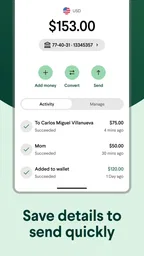
- Recipient details can be saved for future transfers.
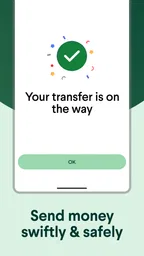
- Transfer updates help users follow payment progress.
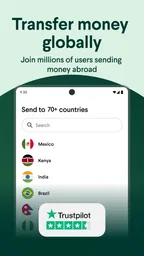
- The app supports sending money to multiple countries.
- A digital service can be more convenient than visiting an agent.
What could be better
- Transfer availability depends on the sender's and recipient's locations.
- Identity checks may be required before sending money.
- Exchange rates can change between transfers.
- Recipients may need a supported bank or mobile wallet.
- Transfer limits may restrict the amount you can send.





