



Snopes review
 Analysis by Appsdrops
Snopes is most useful when a claim has already caught my attention and I want to slow down before sharing it. As a News & Magazines app from Snopes, Inc, it puts fact-checking at the center rather than trying to replace a general news feed. I like that focus: the app gives me a reason to look for evidence instead of relying on a confident caption, a forwarded message, or a headline alone. It is a focused reference tool, though, not a complete picture of the day’s news.
Evidence before the share button
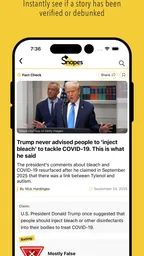
The best reason to keep this app around is the kind of question it helps me ask: not just whether a story sounds plausible, but what evidence supports it. That distinction matters with viral rumors, misleading images, recycled claims, and snippets stripped of context. A fact-check is more useful when it explains how a claim was assessed than when it simply delivers a verdict, so I treat the reasoning as the main value and the label as a starting point.
In an everyday situation, imagine a family group chat circulating a dramatic claim about a public event. Rather than replying from memory, I can open Snopes, search for the subject, and see whether there is a relevant fact-check to consult. If one exists, I can read the explanation before deciding what to say. That is a better workflow than sending a quick correction based on a search result headline, which may leave out a crucial qualification.
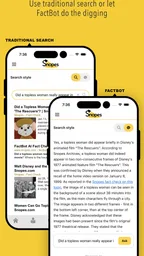
My practical tip is to search for the exact wording of the claim, then try its key subject or a distinctive phrase if the first search is unhelpful. Viral posts are often paraphrased, so a fact-check may not use the same sentence that appeared in a message. When I find a match, I look beyond the conclusion for the scope: a claim may be partly accurate, misleading in context, or based on an old event rather than wholly invented. That habit helps prevent the app from becoming a source of oversimplified “true or false” replies.
The app is also useful when I want to investigate something without joining a debate. I can check a claim privately, decide whether the evidence is strong enough to share, and avoid amplifying a rumor while asking others to verify it. For teachers, students, and anyone who regularly encounters questionable posts, that makes Snopes a modest but worthwhile part of a broader media-literacy routine.
How it fits alongside ordinary news apps
Most general news apps are built to keep a stream of current reporting moving. Snopes has a different job: it is most valuable when a specific assertion needs scrutiny. I would not use it as my only news source, because a fact-checking app and a reporting app answer different questions. News coverage can tell me what is happening; a fact-check can help me assess whether a circulating claim about it holds up.
Search engines are the obvious alternative when I need to check something quickly. They can surface many sources at once, which is useful when I want to compare original reporting, official statements, and expert commentary. The trade-off is that I have to do more of the evaluation myself, and search results can put a persuasive headline ahead of the underlying evidence. Snopes offers a more focused place to begin, but it should not be treated as the only place to end.
Social platforms have the opposite convenience: the claim is already in front of me, often beside reactions from people I know. That immediacy can make a rumor feel more credible than it is. I prefer to leave the post, check the claim separately, and return only if I have something useful to add. The app supports that deliberate pause; it cannot make a conversation civil or guarantee that other people will accept a correction.
Where the experience has limits
A fact-checking app is only as useful as its coverage of the particular claim I have in mind. If a rumor is very new, phrased in an unusual way, or circulating in a community or language that is not well represented, I may not find a direct match. In that case, I do not take a missing result as evidence that the claim is true or false. I switch to checking the original source, looking for reputable reporting, and comparing dates and context.
There is another important limitation: fact-checking often involves nuance that is awkward to pass along in a short message. A verdict can be easier to quote than the explanation, but quoting only the label may distort what the research actually says. I recommend reading the supporting discussion before sharing a finding, especially when the claim concerns a fast-moving story or relies on a number, image, or quotation that could have changed context over time.
The app is not the right choice for someone who mainly wants breaking-news alerts, a personalized stream of local coverage, or a broad mix of opinion and reporting. It is also not a shortcut around source evaluation. When a claim is important to a decision—health, money, safety, or voting, for example—I would use Snopes as one useful check, then consult relevant primary sources and qualified reporting as well.
Cost, audience, and practical expectations
Snopes is free to install, with in-app purchases listed from $4.99 to $199.99 per item. The range is broad, so I would check the purchase details in the app store before paying for anything and decide whether the available free use already meets my needs. For a reader who only checks occasional viral claims, the free option may be enough to make the app useful; frequent users should weigh any purchase against how often they actually rely on it.
Its average rating is 4.6 from 284 ratings, with 70 written reviews, and it has passed 50K installs. Those figures suggest a well-received niche app, not proof that every claim will be covered or every user will prefer its approach. I would use the rating as a little reassurance, then judge it by whether its explanations help me make better decisions about the claims I encounter.
The app is rated Everyone 10+ and its current version is 3.10.0, with a minimum operating system requirement of 7.0. It was released on October 6, 2025. Those details are worth checking against the device and app-store page before installing, particularly if the device is older. I would not choose it for entertainment or endless scrolling; its value comes from having a place to turn when a questionable assertion needs attention.
Who I would recommend it to
I would recommend Snopes to people who often receive forwarded claims, follow public conversations online, or want a practical way to build better verification habits. It is especially appealing if you prefer an explanation to a bare verdict and are willing to read past a headline. A parent checking a rumor before discussing it with a child, a student tracing a claim used in an assignment, or a group-chat regular trying not to spread misinformation can all get something concrete from that routine.
I would skip it if I wanted one app to deliver comprehensive daily news, if I rarely encounter claims that need checking, or if I expected a definitive answer to every emerging rumor. In those cases, a trusted news source, a search engine, or a specialist source may be a better first stop. Even for regular users, the strongest approach is to combine Snopes with original documents and independent reporting when the stakes are high.
A useful pause, not the last word
My verdict is positive, with a clear boundary: Snopes works best as a deliberate fact-checking companion, not as a universal news destination or an automatic truth button. Its real strength is encouraging me to inspect evidence before I repeat a claim. Its real weakness is the natural limit of any fact-checking resource: the exact claim I need may not be covered, and a short conclusion can be easier to misuse than a careful explanation.
If you want a focused place to investigate viral assertions and are prepared to follow the reasoning, I think it is worth keeping on your phone. I would open it when a claim feels urgent, surprising, or unusually convenient to believe; search carefully; read the context; and use another reliable source when the answer matters. That is a small change in habit, but it is the kind of change that makes a fact-checking app genuinely useful.
What we like
- Fact-checks claims with links to supporting sources.
- Search makes it easy to find coverage of familiar rumors.
- Articles explain the evidence behind each verdict.
- Covers politics alongside everyday rumors and urban legends.
- The site offers a free way to browse its fact checks.
What could be better
- Some investigations are lengthy for readers seeking quick answers.
- Coverage can focus on claims familiar to US audiences.
- Verdicts may require context rather than a simple true-or-false answer.
- Fact-checks depend on the sources available at publication time.
- The website experience may include ads and promotional content.





