


Reverse Song & Voice Challenge review
 Analysis by Appsdrops
I expected a voice-reversal app to be a quick novelty: record a phrase, play it backward, laugh, and move on. Reverse Song & Voice Challenge is built around that simple idea, but the best way to enjoy it is to treat it as a small audio experiment rather than a full music studio. Reversing a familiar line can make it sound unexpectedly strange, and trying to imitate the reversed playback turns a few seconds of audio into a singing challenge. I’d recommend it when you want something playful to share or a low-effort way to pass a break, not when you need careful recording or professional editing.
Quick experiments, not a full recording studio
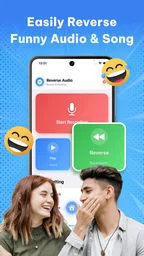
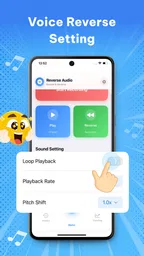
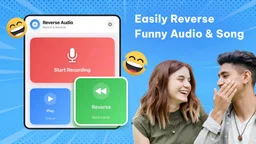
The appeal is immediate: start with a voice or song, hear it reversed, and see what happens when you try to reproduce the sound. That makes the app easy to understand even if you have never used an audio editor. There is no need to learn a timeline or arrange tracks before the central idea makes sense. In my view, that low barrier is the right fit for a casual music and audio app whose main pleasure is hearing familiar sounds become unfamiliar.
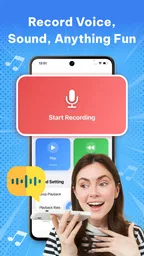
A realistic use is a quiet moment with friends: record a short greeting, reverse it, then challenge someone to sing or speak what they hear. Short clips work better for this kind of game than a whole song. They are easier to replay, easier to imitate, and less likely to turn a quick joke into a long session. The result is most entertaining when everyone understands that the performance is meant to be silly rather than polished.
The name tells you what sort of play to expect, but it does not make the app a general-purpose audio workstation. If your aim is to trim a podcast, mix several recordings, or prepare a finished music track, a dedicated editor is a better tool. Here, the appeal is the transformation itself and the challenge of reacting to it.
Why the reversed playback feels like a challenge
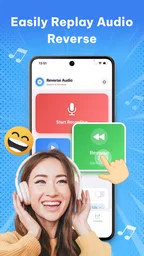
Reversed audio changes the familiar shape of speech and melody. A short word can become hard to recognize, while a sung phrase may sound like a peculiar new tune. That gap between knowing what you recorded and hearing something that seems unfamiliar is the source of the fun. I find it works especially well with a phrase everyone in the room knows, because listeners can compare the original with the odd backward version.
One useful trick is to keep the recording brief and leave a little silence around the words. That gives you a cleaner moment to focus on the sound instead of trying to decipher a long, crowded clip. You can also choose a phrase with distinct syllables rather than a fast, mumbled sentence; the challenge remains, but the playback is easier to follow. These are simple choices, yet they make the difference between a clip people replay and one they give up on.
It is also worth separating the app’s entertainment value from any expectation that it will make a song sound better. Reversal is an effect, not a repair tool. If a recording is noisy or difficult to hear in its ordinary direction, reversing it will not magically make it clean. I would start with a clear, short source and use the transformation to create a game, rather than expecting the app to rescue poor audio.
Speed expectations and a sensible workflow
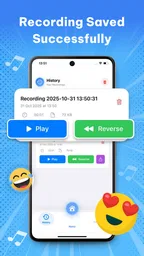
The premise suggests a quick loop, and that is how I would approach it: capture a short sound, listen, then decide whether it is worth repeating. For an everyday user, the most important kind of speed is not a benchmark but whether the idea stays spontaneous. A brief recording keeps the process playful; a long source makes it harder to isolate the part you want to test and can make the challenge feel less immediate.
I would prepare the source before recording. Move away from competing conversation, say the line clearly, and keep the phone at a steady distance. This is more useful than recording several messy takes and hoping the effect will make them entertaining. If the first result is unclear, change one thing at a time—shorten the phrase or speak more distinctly—so you can tell what improved it.
For a singing challenge, choose a small musical phrase rather than an entire song. That makes it easier to replay the same passage and compare attempts without losing track of where you are. It also reduces the temptation to judge the app as if it were intended for long-form music production. The reversal is the point; the shorter workflow helps it stay the point.
When repeated use gets demanding
The app’s lightweight idea can still lead to a busy session. A group may record one person after another, replay clips repeatedly, and try several versions of the same phrase. That kind of use is entertaining, but it also means more attention to the recording environment: overlapping voices and background music can make it difficult to hear what each person contributed. I would take turns and keep each attempt separate rather than having everyone talk over the phone at once.
Audio playback is also a social choice. A clip that sounds funny to the person holding the phone may be hard for a whole room to hear clearly. In a shared setting, use a comfortable listening level and avoid treating a private recording as something to pass around without the speaker’s agreement. The app’s playful format does not change the ordinary courtesy that applies to recording people.
For a solo user, the most useful heavy-use habit is to stop when the joke has run its course. Replaying the same clip many times can make the sound less surprising, and the app does not need to become a daily routine to justify installing it. I see it as a novelty that earns its place through occasional use: a short break, a party prompt, or a quick experiment with a phrase you already have in mind.
Reliability and what to do if a result disappoints
With any recording-based effect, a disappointing result may come from the source rather than the transformation. A quiet voice, a noisy room, or several people speaking together can make the clip difficult to judge. My first response would be to record a fresh, shorter sample in a calmer spot instead of assuming that repeated playback will clarify it. This is a practical recovery step for the kind of task the app is meant to handle.
I would also keep expectations modest about repeatability. The fun comes from hearing a particular recording backward, not from expecting every take to produce an equally clear or amusing result. A person who speaks softly may need to try a more distinct delivery; someone testing a song may get a more satisfying challenge from a clean, short phrase than from a dense passage. That makes the app better for experimentation than for dependable, finished output.
If you are using it around other people, agree on the recording before starting. That avoids the awkwardness of capturing someone who thought the conversation was private. For a personal experiment, a short test clip is enough to decide whether the result is enjoyable on your device and in your surroundings. I would not build an important recording task around a novelty effect when a standard recorder or editor is the more suitable option.
Device fit, cost, and who should choose it
It is a free app from AI Tech Expe, with optional in-app purchases priced from $3.99 to $39.99 per item. The age rating is Everyone, which suits the casual, simple premise, though families should still use normal judgment about recording and sharing voices. Its current version is 8.1, and the minimum operating-system requirement is 7.1. Those details make it easier to judge basic compatibility, but the experience will still depend on how comfortably your own device handles recording and playback.
The app has a 4.0 average rating from around 126,000 ratings, with more than 10 million installs. Those figures suggest that the concept has broad reach, but they do not tell me whether it matches a particular person’s expectations. I would judge it by the specific use: if you want backward playback for a quick challenge, the premise is clear; if you are looking for a complete suite of editing controls, popularity does not make it the right substitute.
Because the main activity is recording and listening, I would pay more attention to practical setup than to imagined performance figures. Use a device with enough battery for the session, keep the microphone unobstructed, and listen somewhere you can hear the playback without raising the volume excessively. Those habits help avoid the common frustration of a clip that seems disappointing simply because it was captured or played back under poor conditions.
The app is a good fit for curious listeners, friends who enjoy quick challenges, and anyone who likes hearing familiar speech or music transformed. It is less suitable for people who want precise editing, a library of production tools, or a reliable workflow for finished audio. If your priority is controlling cuts and layers, a conventional audio editor is the better choice; if you simply want to see how a short phrase behaves backward, this focused app makes more sense.
My verdict after weighing the trade-offs
I like the idea because it gets to its point without asking the user to become an audio engineer. The reversal gives ordinary speech a strange new shape, and the singing challenge adds a reason to involve another person instead of merely listening once. The strongest results come from clear, short recordings and modest expectations. That combination makes the app entertaining without pretending that an amusing effect is the same thing as a full music-editing toolkit.
My recommendation is to try it for brief, shared experiments if you enjoy playful audio and do not mind that the joke depends on the clip you make. Start with a phrase you can say clearly, keep the room quiet, and use a short segment for singing attempts. Skip it if you need dependable production features or if you are unlikely to record and replay voice clips. For the right person, Reverse Song & Voice Challenge is an easy source of a few odd, memorable moments; for everyone else, a standard recorder or a more capable editor will be more useful.
What we like
- Easy to start with simple controls.
- Works well for short group challenges.
- Voice playback adds variety to song rounds.
- Quick rounds suit casual play sessions.
- The challenge format encourages repeated attempts.
What could be better
- Reverse audio can be difficult to understand.
- Some rounds may feel repetitive over time.
- Playing aloud may disturb people nearby.
- The experience depends on clear audio output.
- Not ideal for players who dislike sound-based games.





