
World Map Quiz review
 Analysis by Appsdrops
I like geography games that turn a spare minute into something useful, and World Map Quiz has a clear appeal: it asks you to learn where countries sit rather than simply memorize their names. In my view, that makes it a friendly starting point for map practice, whether you are brushing up before a trip, helping a student revise, or testing how much of the world you can recall without looking. Its focus is deliberately narrow, which is both its strength and the main question to consider before making it a regular habit.
Why the first sessions feel rewarding
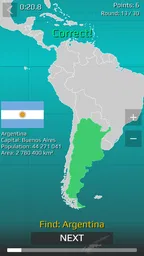
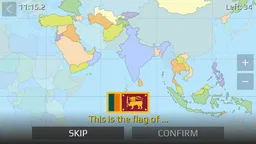
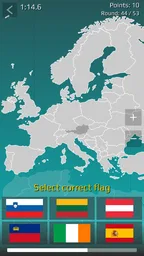
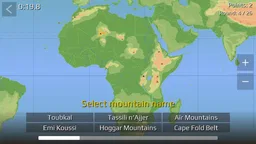
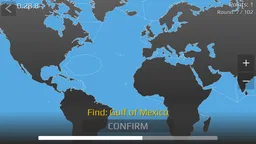
As a trivia game, the experience is built around recognition and recall. You see a world-map challenge and try to connect a country with its position. That simple loop gives a quick sense of progress: familiar places come easily, while less familiar regions expose gaps you may not have noticed. The most useful early shift is from guessing based on a country’s name to remembering its neighbors and the shape of its region.
That distinction matters because map knowledge is relational. Knowing that a country is in Africa is less precise than recalling whether it is on the coast, near a particular neighbor, or tucked into a cluster of smaller states. I would use each answer as a prompt to build those connections, not just as a score to chase. If you miss a location, pause long enough to place it mentally among nearby countries; that small habit makes a short round more educational.
The game is a good fit for brief breaks. A student could use it for a few minutes before a geography lesson, while a traveler might play while waiting for a train and then look up the region on a paper map or atlas afterward. It also works as a light challenge between friends who want to compare what they remember, provided the goal is learning rather than turning every mistake into a contest.
Qbis Studio developed the game, which is free to install and rated for Everyone. Its audience is broad, but the simple premise does not mean every player will find it equally satisfying. Someone who enjoys quick recall challenges and wants a compact geography refresher is more likely to appreciate it than a player looking for a sprawling adventure, a detailed reference tool, or an elaborate lesson plan.
Make guesses turn into map knowledge
My practical tip is to divide the world into regions in your own head instead of trying to learn the entire map at once. Work through one area, then revisit it later after shifting attention elsewhere. Even if you are playing casually, naming a country’s neighbors after answering can turn a single location question into a richer memory. You can also keep a small list of places you repeatedly confuse and review those regions on a conventional map outside the game.
This approach is especially helpful for countries that are small, closely grouped, or easy to mix up. A quiz can show that you know the broad outline of a continent while still missing its more compact parts. Rather than treating those errors as proof that the game is failing, use them to decide what to study next. The game provides the retrieval challenge; a map or classroom resource can supply the wider context.
What keeps it useful after the novelty
The first burst of interest in any quiz can fade once the questions begin to feel familiar. For this title, lasting value depends on whether you enjoy revisiting the same basic skill: locating countries. Its appeal is not that it promises a different kind of activity every day, but that repeated recall can make a world map feel less intimidating over time. If geography is a subject you genuinely want to improve at, that repeatability is a virtue.
There is also a useful distinction between remembering an answer and understanding a place. A correct guess may come from recognition, a lucky choice, or a solid mental map. I recommend checking yourself by trying to describe where the country sits relative to its region, rather than assuming every correct response means the location is firmly learned. That self-check helps keep practice honest and gives you a reason to return beyond chasing a streak or a high score.
The game has reached more than five million installs, with a 4.7 average from around sixty-three thousand ratings. Those figures suggest that its straightforward format has broad appeal, but they do not guarantee that it will become a lasting part of your routine. For me, its best recurring role is as a warm-up: play a short session, notice a weak region, then use a map, book, or lesson to add context. That combination is more valuable than expecting a quiz alone to teach every geographic detail.
Compared with general trivia games, this one gives you a narrower subject and a clearer learning goal. That focus is helpful when you want map practice without unrelated questions competing for attention. Compared with a traditional atlas or a dedicated classroom resource, though, a quiz is less suited to exploring borders, physical geography, cultural context, or why a location matters. I would choose the game for recall and an atlas for explanation; the two serve different purposes rather than replacing one another.
Keeping the habit light
A sustainable routine does not need to mean playing for a long time. I would use the game in short sessions and stop when attention starts slipping. If you keep tapping through answers while distracted, the activity can become a reflex test rather than useful practice. A better pattern is to focus on one region, notice a few uncertain locations, and return later to see whether they now come to mind more naturally.
For parents or teachers, it can be a low-pressure way to spark a geography conversation. After a child answers, ask what else they know about that part of the world, or invite them to find the country on a classroom map. The game itself is the prompt, not a complete curriculum. That distinction keeps expectations realistic and makes it easier to adapt the activity to a learner’s age and knowledge.
On the other hand, someone who needs structured instruction, explanations after every error, or a detailed course sequence may find a dedicated educational resource more appropriate. Likewise, if you already know country locations well and want deeper geography, the basic map-quiz premise may offer too little new material to justify frequent play. Its strongest use is reinforcing a foundational skill, not replacing broader study.
Where repetition can wear thin
The same focus that makes the game easy to pick up can also become its main source of fatigue. If you are not interested in memorizing political geography, a stream of country-location challenges may feel repetitive. Players who prefer varied trivia subjects, narrative progression, or complex strategy should look elsewhere; this is a focused exercise, and its simplicity is not a hidden promise of a much broader game.
Another possible friction point is the gap between a quick answer and meaningful learning. When you already know a region, the questions may feel effortless; when you do not, repeated guessing can be frustrating unless you take time to build a mental map. I would avoid treating every round as a performance test. Use uncertainty as a cue to slow down, and bring in an atlas or other reference when you want to understand the surrounding geography.
There are in-app purchases, priced from $1.99 to $12.99 per item. The game itself is free, so I would begin with the no-cost experience and decide whether it is useful enough to keep before considering any optional spending. That is a sensible approach for a narrowly focused trivia title: first see whether its particular style of practice suits you, rather than paying in the hope that a simple map challenge will become a different kind of game.
For ongoing upkeep, the practical burden appears modest from a player’s point of view: install it and return when you want a map refresher. The current version is 3.38.1, and it runs on Android 6.0 or later. Those details make it relevant to people using compatible Android devices, while iOS users should check the app store they use for availability and device requirements before planning to install it. I would not make the game the sole home for a study plan; keep any notes or learning goals somewhere you can revisit independently.
Who should keep it installed
I would recommend World Map Quiz to curious beginners, students who want a low-pressure way to revisit country locations, and travelers who enjoy learning the shape of the places they may visit. It also suits anyone who likes quick trivia but wants the answers to build a practical skill. The strongest results will come from players who are willing to turn wrong answers into a reason to study a region, not simply tap through and move on.
I would skip it if you want a geography reference with detailed explanations, a broad trivia collection, or a game whose challenge changes substantially from one session to another. It is also not the best choice for someone who finds memorization tedious. In those cases, an atlas, a guided learning resource, or a more varied trivia game will probably match your needs better.
Overall, the game earns a place on my device when I want a quick, focused map refresher, but I would not expect novelty alone to keep it there. Its lasting value comes from pairing short quiz sessions with deliberate review and occasional exploration beyond the game. With a 4.7 average and more than 1.2 thousand written reviews, it has an established audience, yet the right question for an individual player is simpler: do you want to practice where countries are? If yes, its focused format can make that habit easy to start and easy to revisit.
What we like
- Covers countries and capitals across the globe.
- Short rounds make it easy to play in spare moments.
- Quiz format can help reinforce geographic knowledge.
- A clear map makes locations easier to identify.
- Suitable for players who enjoy casual learning games.
What could be better
- Some country names may be hard to read on small screens.
- Repeated questions can make sessions feel less varied.
- Geography coverage may not suit advanced quiz fans.
- Players unfamiliar with maps may find early rounds challenging.
- The quiz offers limited appeal beyond geography practice.







