


Millionaire 2026 Quiz & Trivia review
 Analysis by Appsdrops
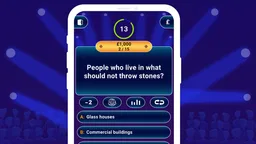
I like trivia games best when they give me a reason to think between questions, rather than turning every answer into a quick tap. Millionaire 2026 Quiz & Trivia uses the familiar climb toward a million as its central hook, making general knowledge feel like a small test of nerve as well as memory. It is free, rated for Everyone, and made by Quiz & Trivia Games by Submarine Apps. My overall impression is that it works well for short, self-contained quiz sessions, especially if you enjoy broad questions and the suspense of deciding whether to commit to an answer.
Why the first questions are easy to return to
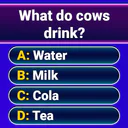
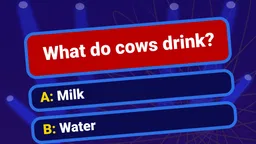
The appeal is immediate: start a round, read a question, and weigh the answer choices. That straightforward loop is a good fit for a break, a quiet commute, or a few minutes before bed. You do not need to learn a complicated control scheme before you can play. The game’s Millionaire framing also gives each answer a clear purpose: you are trying to keep progressing rather than merely clearing a random stack of facts.
That sense of a goal matters more than it may seem. In a less structured trivia app, a correct answer can feel like one point in an endless stream. Here, the prize ladder gives the session a shape. I find that useful when I want a quick challenge with a natural stopping point: finish a run, see how far I got, and decide whether I have time for another.
The title calls itself Millionaire 2026, while the game has been available since May 23, 2019. Its current version is 1.8.6.8, and it runs on Android 7.0 or later. Those details make it easier to judge whether it fits an older Android device, while the Everyone age rating makes its general-knowledge format suitable for a broad audience. It is also listed as a top free general-knowledge game in the US, though I would treat that as context rather than a guarantee that every question will suit every player.
Progress feels clearest inside a run
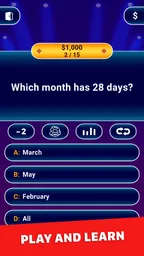
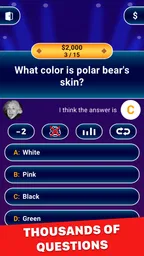
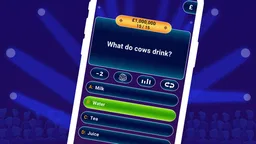
The strongest progress signal is the climb itself. Each correct response moves the session forward, and the risk of losing ground gives the next choice some weight. That creates a more engaging rhythm than answering isolated questions with no visible destination. It also makes a modest personal goal easy to set: try to get one question farther than last time, or play carefully instead of guessing whenever two options look plausible.
One practical way to make the game more satisfying is to treat a run as a learning exercise, not just a score attempt. When I miss a question, I try to pause long enough to understand why the answer was correct. If I simply rush into another round, the game can become a sequence of guesses; if I notice the topic I misunderstood, the next session has a small, useful focus. This works especially well for general knowledge, where an unfamiliar name, place, or concept can be more memorable once it has surprised you.
The game’s broad trivia identity is both a strength and a trade-off. It can move between subjects, so it suits players who like being tested outside a single specialty. The same breadth means it is not the ideal choice when you want a carefully targeted study tool or a quiz devoted to one subject. I would pick it for variety and casual challenge, not as a replacement for a structured course or a topic-specific practice app.
How the challenge changes as you play
The Millionaire-style setup naturally encourages a cautious approach. Early answers are a chance to settle into the session; later ones feel more consequential because you have already invested time and built a run. I enjoy that tension, but it also means this is not purely a knowledge check. Confidence and willingness to risk a guess become part of the experience, so two people with similar knowledge may approach a question differently.
A useful habit is to read every option before choosing, even when an answer seems obvious at first glance. In multiple-choice trivia, a familiar-looking answer can pull attention away from a more precise alternative. Taking a beat to compare the options makes the game feel less like reflex tapping and gives you a better chance to learn from the question. If you are playing with someone else, saying why you chose an answer before revealing it can turn a solo quiz into a small conversation without needing a separate game mode.
The difficulty can feel uneven from one subject to another, as broad trivia often does. A question may be comfortable for someone who follows a particular area and obscure to someone else. I would not read one difficult question as proof that the whole game has suddenly become too hard, nor assume that an early run predicts how challenging later play will feel. The more helpful test is whether you enjoy the mix and can accept occasional gaps in your knowledge.
That makes this a better fit for curious players than for anyone who expects a perfectly calibrated ladder from beginner to expert. If you want a quiz that keeps to a narrow subject and steadily teaches a defined syllabus, another option will serve you better. If you like being surprised by the range of things you do and do not know, the broad format is part of the fun.
When the progression helps—and when it can become pressure
The prize-climb structure gives a round momentum, but it can also encourage chasing a better result after a frustrating miss. I recommend deciding before you start whether you want one relaxed run or a longer session. That small boundary helps keep the game in its best role: an easy-to-pick-up diversion, rather than a loop where you keep replaying simply because the last attempt ended badly.
For an everyday example, I would use it during a short wait when I want something more engaging than scrolling but do not want to start a long game. A single run gives the wait a clear beginning and end. At home, it can also work as a casual turn-taking challenge with a friend: compare how you reason through the answers, not only how far each of you progresses. That makes the questions themselves the conversation, even when one person knows a topic better than the other.
Compared with quick-fire trivia apps that emphasize speed, this game’s appeal is the decision around each answer and the feeling of advancing through a familiar quiz-show structure. Compared with trivia built around daily streaks, collections, or a specific subject, it is more about the run in front of you than about building a long-term study routine. That distinction is useful when choosing: pick this if you want a compact general-knowledge challenge; choose another style if you need timed competition, focused lessons, or a persistent learning plan.
I would also avoid judging the experience only by whether a run reaches its highest point. The more revealing question is whether you enjoy the process of making choices under a little pressure. If you find yourself thinking through options and remembering an answer afterward, the session has done its job even if you did not get as far as you hoped. If losing progress makes you tense or you dislike uncertain multiple-choice questions, the same structure may feel more aggravating than rewarding.
What the community response suggests
The game has a 4.5 average from around 375,000 ratings, alongside roughly 3,200 written reviews and over 100 million installs. That level of reach suggests that the simple format has found a large audience, but popularity alone cannot tell you whether its question mix will match your interests. I would use those figures as reassurance that it is an established choice in free trivia, not as a substitute for deciding whether you enjoy its particular pace.
Because it is free, it is easy to try without treating the download as a major commitment. The age rating is Everyone, and the subject matter is general knowledge, which makes it a reasonable option to consider for family play. I would still keep expectations practical: it is a game for answering quiz questions, not a promise that every session will be equally easy, educational, or entertaining for every age and interest.
One small but useful approach is to alternate between confident answers and deliberate passes in your own mind. Before committing, ask yourself whether you know the fact or are only recognizing one option. That does not change the game’s rules; it changes how thoughtfully you play. It can make a run feel more rewarding and help you spot the subjects where your knowledge is strongest, without turning a casual game into homework.
My verdict on its staying power
The progression is most effective when you treat each run as a fresh, limited challenge. The climb supplies an understandable goal, the questions provide a changing test, and the possibility of a wrong answer gives otherwise simple choices some tension. For me, that combination is enough to make it a handy game to revisit in spare moments, particularly when I want general knowledge rather than a themed quiz.
Its limits are worth keeping in view. The broad subject mix may not feel consistent from one question to the next, and players who want a long-term progression system, subject-specific learning, or a strong focus on speed should look elsewhere. The game’s main strength is not a deep collection of systems; it is the clarity of its quiz-show climb. That makes it easy to understand, but it may not provide enough variety for someone who needs new modes or elaborate goals to stay interested.
I would recommend Millionaire 2026 Quiz & Trivia to anyone who likes general-knowledge questions, enjoys weighing an answer before choosing, and wants a free game that can fit into short breaks. I would skip it if you dislike the pressure of risking a run or would rather study one topic systematically. For the right player, its simple goal is the point: answer well, see how far you can go, learn from the questions that catch you out, and stop when the session has reached a satisfying end.
What we like
- Offers a familiar multiple-choice format that is easy to pick up.
- Short quiz rounds fit conveniently into brief breaks.
- Questions can provide a light way to test general knowledge.
- Progress through the quiz gives players a clear sense of advancement.
- Suitable for solo play without needing to coordinate with others.
What could be better
- Some questions may feel too easy for experienced trivia fans.
- Repeated rounds can become predictable over time.
- A wrong answer may end a run before players can recover.
- Quiz content may not appeal to players who prefer action games.
- The app may require an internet connection for some features.







