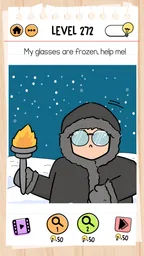
Brain Test 2: Tricky Stories review
 Analysis by Appsdrops
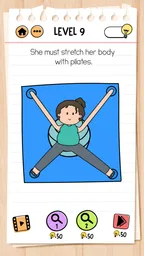
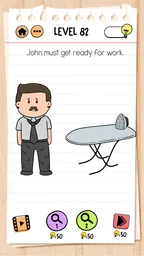
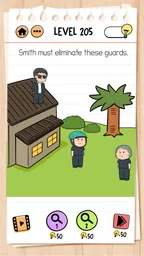
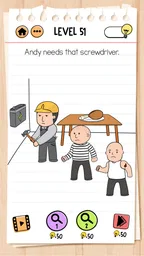
I like puzzle games that make me pause and reconsider a question rather than simply test how quickly I can tap. Brain Test 2: Tricky Stories is built around that kind of playful misdirection: it presents short brainteasers as parts of story-driven challenges, so the fun often comes from noticing what the wording or picture is inviting me to assume. It is a trivia game in a broad, casual sense, but it feels more like a collection of visual riddles than a conventional quiz.
That distinction matters when deciding whether to try it. If you enjoy lateral-thinking puzzles and don’t mind occasionally getting an answer wrong before spotting the trick, it’s an easy game to dip into. If you want factual questions, a serious logic course, or a competitive quiz with dependable rules, you may prefer another kind of game. My first useful piece of advice is to approach each puzzle as a little scene to investigate, not a test with an obvious textbook answer.
What the puzzles feel like
Unico Studio gives the game a light, accessible tone, while the story framing provides a reason to move from one riddle to another. Instead of relying only on isolated questions, the puzzles are presented in themed sequences. That can make progress feel more inviting than a long list of unrelated brainteasers, especially if you’re playing for a few minutes at a time.
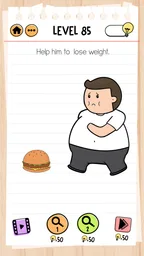
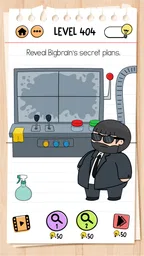
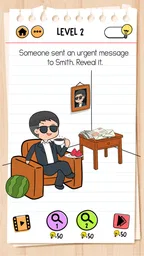
The central pleasure is the moment when a puzzle’s apparent rule turns out not to be the useful one. A familiar object, a character’s situation, or a seemingly straightforward prompt may deserve a second look. I found that it helps to ask, “What assumption am I making?” before trying random actions. That small change in approach turns a frustrating guess into a more satisfying bit of reasoning.
The game has broad reach: it has passed 100 million installs and has a 4.7 average from around 1.7 million ratings. Those figures suggest that its quick, playful format has found a large audience, but they don’t mean every puzzle will click for every player. Humor and lateral thinking are personal, and a solution that feels clever to one person can feel arbitrary to another.
How to begin without overthinking it
Getting started is straightforward: install it from your device’s app store and open the game. It is free to download, and its age rating is Everyone 10+. The current version is 1.26.13, and it supports devices running Android 7.0 or later. If you are choosing a game for a younger player, the rating is a useful starting point, though I’d still consider whether they enjoy reading prompts and experimenting with visual puzzles.
You don’t need a special preparation routine to reach the first meaningful win. Read the prompt slowly, inspect the whole scene, and try one deliberate idea at a time. If the first interpretation fails, don’t immediately repeat the same gesture in a different spot. Look for an overlooked detail or a word that could have a second meaning. That gives you a better chance of learning the puzzle’s logic rather than stumbling into the answer.
For a first session, I’d play somewhere you can give each challenge a little attention. The game is suitable for spare moments, but rushing through prompts while distracted can make its wordplay seem less fair than it is. A few focused minutes are often more rewarding than tapping rapidly through several puzzles and then forgetting what each one was asking.
Turning a stuck moment into a useful clue
When I get stuck, I separate the puzzle into three questions: what does the text literally ask, what does the scene actually show, and what am I assuming must stay fixed? This is especially useful in a game where the visual setup may be part of the riddle rather than decoration. It also keeps experimentation manageable: test one interpretation, observe what happens, then reassess.
A practical example is a short break while waiting for a bus or for a meal to finish. I can open the game, focus on one scene, and make a genuine attempt instead of treating it as background tapping. If I’m still stuck when my break ends, I can put it down and return later with fresh eyes. That is a better fit for these puzzles than trying to force a solution when I’m tired or impatient.
There’s another useful habit: say the prompt in your own words. If the rewritten version sounds much narrower than the original, I may have added a restriction that the game never imposed. Conversely, if the wording contains an odd emphasis, it may be pointing toward a deliberate twist. This doesn’t guarantee a solution, but it makes each attempt more thoughtful and helps the game feel less like random trial and error.
Where confusion and friction can creep in
The same surprise that makes a puzzle enjoyable can also be its main weakness. Some answers may depend on interpreting a scene in a way that isn’t immediately obvious. When I understand the intended trick, the result can be funny; before that, the puzzle can feel as though I’m being asked to guess what the designer had in mind. If you prefer strict, consistently stated logic, that looseness may wear on you.
It’s also worth distinguishing this experience from a standard trivia app. Traditional quiz games usually reward recall and let you judge an answer against a stable fact. Here, success is more often about noticing an unusual reading or interaction. That makes it less useful for learning general knowledge and less suited to players who want to compare scores based on factual expertise. For a calmer, more methodical logic workout, a puzzle game with clearly defined rules may be a better match.
Because the challenges are brief, it’s tempting to tap at everything until something works. I don’t recommend that as a default strategy. Random testing can sometimes move you forward, but it weakens the satisfaction of understanding why the answer works. Instead, use a small set of purposeful attempts and then take a short pause. Returning after a minute can reveal a detail that was easy to overlook while fixated on the first idea.
The game is free, with in-app purchases ranging from $0.99 to $8.99 per item. That is relevant if you’re trying to keep spending predictable, particularly on a shared device. I’d check purchase controls in the app store or device settings before handing the phone to a child. The presence of optional purchases doesn’t change the basic appeal of the riddles, but it is sensible to know the setup on a family device.
Who will enjoy it, and who may want something else
I’d recommend it to people who like playful misdirection, visual details, and compact challenges they can tackle between everyday tasks. It can also work well when two people are looking at the same screen: one person can read the prompt while the other studies the scene, and comparing interpretations often makes the puzzle more entertaining. The story structure gives those short exchanges a little continuity without requiring a long, uninterrupted session.
I’d be more cautious about recommending it to someone who dislikes trial-and-error, wants every solution to follow formal logic, or expects a quiz to teach facts. It may also frustrate a player who feels compelled to finish every challenge immediately. The game is at its best when a wrong answer is just a cue to rethink, not a reason to treat the puzzle as a personal test.
Compared with familiar trivia alternatives, this is a better pick for playful problem-solving than for knowledge practice. Compared with conventional brain-training exercises, it leans more on surprise and humor than on a clearly measurable routine. That’s not a flaw by itself; it simply means you should choose it for the experience of untangling odd little riddles, rather than expecting structured lessons or a serious performance benchmark.
A sensible next step after the first win
Once you solve an early puzzle, keep the same deliberate method for the next one instead of assuming every challenge uses the same trick. Look closely, read the exact wording, and change only one part of your interpretation at a time. Some riddles may reward a fresh perspective, while others may ask you to notice a detail you initially treated as irrelevant. The variety is part of the appeal, but it also means there is no single shortcut that replaces paying attention.
If you’re playing with someone else, try agreeing not to reveal a solution too quickly. Offer a hint about what to inspect or which assumption to question instead. That preserves the satisfying moment of discovery and makes the game a better shared activity than simply passing the phone back and forth after each answer.
Overall, I see Brain Test 2 as a friendly, low-commitment choice for people who enjoy being surprised by a puzzle. Its story-led presentation and accessible format make it easy to try, while its occasional leaps in interpretation mean it won’t suit everyone. I’d install it for short, curious sessions, give each scene a careful look, and switch to a more conventional quiz or structured logic game if I wanted factual learning or rigorously consistent rules.
What we like
- Short levels make it easy to play during a quick break.
- The story format gives puzzles a light narrative context.
- Many puzzles reward creative thinking rather than standard logic.
- Hints can help when a puzzle feels too difficult.
- Its playful artwork suits casual players of different ages.
What could be better
- Some solutions depend on tapping unexpected parts of the screen.
- Hints may make challenging puzzles feel less rewarding.
- Repeated level patterns can make later puzzles feel familiar.
- The game may show ads between stages.
- Progress can feel slow when a puzzle requires trial and error.







