

Trivia Game - IQ Quiz Test review
 Analysis by Appsdrops
Trivia Game - IQ Quiz Test is best approached as a compact way to give your general knowledge a workout, not as a serious intelligence test. I like the appeal of switching among six trivia topics and having a reason to keep going as progress builds. That makes it a plausible choice for a short break or a casual challenge with someone nearby. The important caveat is that the “IQ” framing can set expectations the game’s trivia format does not necessarily meet: answering general-knowledge questions is entertaining, but it is not the same thing as measuring intelligence.
Quick rounds with a reason to continue
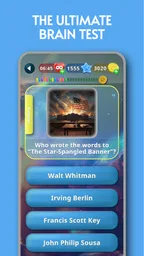
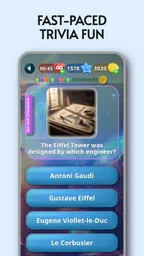
At its core, this is a trivia game from Appgeneration. The basic attraction is easy to understand: choose from six topic areas, answer questions, and work toward rewards as you level up. That combination gives a session more direction than a stream of unrelated quiz prompts. If I have only a few minutes, I can treat it as a brief mental diversion; if I feel competitive with myself, the leveling element gives me a simple reason to carry on.
The six-topic structure is also a useful middle ground. A quiz focused on one subject can become frustrating when it lands on a weak spot, while a completely mixed quiz can feel arbitrary. Here, topic choice offers a little control without turning the game into a specialist study tool. My practical advice is to treat topic selection as a way to keep play enjoyable, not as a way to prove broad expertise. A strong run in one area says more about familiarity with that subject than about overall ability.
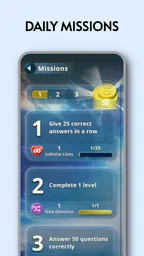
The reward and leveling loop is the clearest reason to play beyond a single round. It gives correct answers a sense of progression, which can make a quick quiz feel more purposeful. At the same time, I would not choose the game solely for its rewards. They are most useful as light motivation; if you need deep strategy, a detailed learning path, or a substantial competitive system, this is not the kind of experience the premise promises.
What the format does well
Trivia works particularly well in small gaps in the day because the basic activity is familiar: read a question, think, answer, and move on. This game’s broad topic selection makes it easier to return when your mood changes. You can use a topic you enjoy for a relaxed session, then switch to another when you want a different kind of challenge. That flexibility is more valuable for everyday use than a complicated set of modes would be.
One useful way to play is to make the question itself the point, rather than rushing to maximize progress. When a prompt catches you out, pause long enough to remember the answer and why it surprised you. That small habit turns a casual quiz into a better memory exercise without requiring notes or a separate study routine. It also keeps the leveling loop from becoming the only thing you notice.
For a shared setting, the game can provide a quick conversation starter: take turns answering, explain why you chose an option, and see which topics produce the most disagreement. I would keep that informal rather than treating the result as a definitive contest. Differences in subject knowledge, wording, and luck can all affect a trivia run, so a score is more fun as a prompt for discussion than as a verdict on who is smarter.
Where the “IQ” label needs perspective
The biggest limitation is expectation management. The title places IQ in the foreground, but the described experience is a trivia quiz spanning several topics. I would not use a performance here to estimate intelligence, compare people’s cognitive ability, or make decisions about learning needs. General knowledge depends on what someone has encountered and remembered; an IQ assessment is a different kind of undertaking. If you are specifically looking for a formal cognitive assessment, this is the wrong choice.
There is also a natural ceiling to the format. A quiz can be satisfying when you enjoy the questions, but repeated question-and-answer play may feel samey if you want a story, a world to explore, or a puzzle that changes through experimentation. The leveling and rewards add motivation, yet they do not alter the basic activity. I would see that as a trade-off rather than a flaw: the straightforward structure is easy to pick up, but it may not hold the attention of someone who needs constant mechanical variety.
Another point to consider is that six topics do not guarantee equal appeal for every player. If your favorite subject is not among the options, or if you want detailed coverage of one specialist field, a dedicated subject quiz may suit you better. Likewise, players who prefer questions with lengthy explanations should check whether the experience matches that preference before making it their main learning tool. The central draw here is answering and progressing, not an academic course.
Who is likely to enjoy it
I would recommend it most to people who enjoy general-knowledge quizzes and want an uncomplicated activity they can pick up for a short spell. It is also a reasonable fit for casual players who like having a visible sense of progression, but do not need a complex rank system or a serious tournament structure. If you enjoy bouncing between subject areas instead of committing to one, the six-topic approach is the most relevant part of the pitch.
A realistic use case is a commute or a wait before an appointment: open the game, answer a few questions, and stop when you reach your destination or are called in. That works better than planning a long session around it, because the appeal is immediate and self-contained. For a family or group, it can also fill a quiet moment if everyone is happy to take turns and treat mistakes lightly. I would avoid using it to put children or adults on the spot; the fun is in the challenge, not in judging someone’s knowledge.
It is less suitable for anyone seeking a structured learning app, a verified IQ test, a deep single-player campaign, or a highly social quiz competition. Those needs call for different tools: a focused educational resource for studying, a reputable assessment for cognitive testing, or a multiplayer-first quiz game for organized competition. The best reason to choose this one is simpler: you like trivia, want several broad topics to choose from, and find rewards helpful as a nudge to keep playing.
Cost, availability, and what to expect
The game is free to download, with optional in-app purchases listed from $0.99 to $9.99 per item. I would start with the free experience and decide whether the questions and progression are enjoyable before spending anything. Since optional purchases are part of the offer, it is sensible to keep an eye on purchase prompts if you prefer a completely no-cost session. The game is rated Everyone, which makes its stated age rating broadly accessible, though parents should still decide whether the content and purchase setup suit their household.
It has a 4.6 average from around 1.7 thousand ratings, alongside over 100 thousand installs. Those figures suggest that it has found an audience, but they are not a substitute for deciding whether its particular style suits you. The current version is 1.6.0, and it was released on December 2, 2025. It requires iOS 10 or later. I would check that requirement against the device you plan to use before installing, especially if you rely on an older phone or tablet.
Compared with the usual alternatives, this sits on the casual end of the trivia spectrum. A general quiz app is often best when you want quick questions without having to prepare; a subject-specific app is stronger when your goal is to learn one field in depth; a multiplayer quiz is preferable when the competition and social interaction are the main attraction. This game’s appeal is the combination of topic choice and level-based rewards, not a claim to replace those other experiences.
My verdict
Trivia Game - IQ Quiz Test makes the most sense as a low-commitment trivia diversion with enough progression to encourage another round. I like that its six topics give casual play some direction and that the reward loop offers a reason to keep answering. The limits are equally clear: it should not be mistaken for an intelligence measurement, and its familiar quiz structure may not satisfy players who want deep instruction, elaborate modes, or sustained competition.
If you want a free-to-start quiz for spare moments and are happy to treat scores as part of the fun, I think it is worth trying. Begin with the topics you actually enjoy, pay attention to whether the leveling feels motivating rather than repetitive, and keep purchases optional. If your goal is formal assessment or serious study, choose a tool built for that instead. For everyone else, this is a straightforward way to make a few idle minutes more engaging.
What we like
- Quick questions make it easy to play during short breaks.
- A broad mix of topics helps keep rounds varied.
- Answer explanations can turn mistakes into learning moments.
- Solo play lets users test themselves at their own pace.
- Progress tracking can help players see how they improve.
What could be better
- Some questions may feel too easy for experienced trivia fans.
- A few answers may depend on regional knowledge.
- Repeated questions can reduce replay value over time.
- Timed rounds may frustrate players who prefer a relaxed pace.
- An internet connection may be needed for some features.







