






Sweet Baby Girl Cleanup 5 review
 Analysis by Appsdrops
When I want a gentle game for a young child, I look for something that feels welcoming without asking for much reading, coordination, or patience. Sweet Baby Girl Cleanup 5 is built around that kind of short, approachable play: a messy home gives a child a simple purpose, while a cute kitty helps make the setting feel friendly rather than like a chore. My overall impression is that it works best as a light activity to share or dip into, not as a deep game intended to hold a child’s attention for a long stretch.
A small, inviting world built around tidying
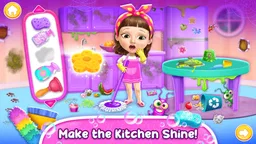
The game’s central idea is easy for a child to understand: things are out of place, and the player helps clean up. That familiar household setting is a useful choice. A child doesn’t need a fantasy backstory or elaborate instructions to grasp why the task matters, and the kitty adds a playful presence to an otherwise ordinary activity. The result is a soft, domestic mood that suits an educational game for younger players.
That everyday framing also makes the play easier to connect to real life. I can imagine opening it while a child is waiting for dinner or taking a quiet break, then using the on-screen cleanup as a prompt to put away a few toys afterward. I wouldn’t present the game as a substitute for helping around the house, but it can make the idea of tidying feel less like a reprimand and more like a small, manageable task.
Art direction matters particularly in a game for children: clutter needs to read as something to sort out, not as visual noise that makes the screen confusing. The appealing character and home setting give the activity a clear emotional frame. Rather than trying to create tension around the mess, the game’s premise keeps the mood light. That is a good fit for a child who enjoys cute characters and familiar scenes, though it may feel too gentle for a player looking for a strong story or an exciting challenge.
How the atmosphere supports the activity
The setting gives the cleanup theme a bit more context than a bare matching or sorting exercise. A child can understand the home as a place that needs care, while the kitty makes the experience feel companionable. This combination is the game’s most effective design choice: the task has a recognizable purpose, and the character helps it feel like play.
That doesn’t mean every child will respond to the same tone. A player who likes fast movement, elaborate customization, or a competitive goal may find the domestic pace subdued. I see this as a game to offer when calm, guided play is the point, rather than when the aim is to keep an older child absorbed in a complicated challenge.
Sound and a child-friendly rhythm
The game’s premise suggests a naturally unhurried rhythm: look at the mess, take an action, and see the space become more orderly. That sort of pace is valuable for younger children because it gives them room to notice what they are doing instead of demanding quick reactions. I’d treat it as a short, focused activity, especially for a child who is still learning to follow a simple task from beginning to end.
Sound is part of how a game makes its actions feel satisfying, but I would avoid choosing this solely for audio stimulation. Its strongest appeal is the combination of a familiar setting, a cute kitty, and the cleanup theme. For parents, a practical approach is to try it together first and see whether the game’s presentation suits the child’s sensitivity to sound and screen activity. That is more useful than assuming every young player will enjoy the same audio style.
One small but worthwhile way to use the pacing is to let the child explain what they are doing as they play: “What needs putting right?” or “What should we do next?” This turns an otherwise simple activity into a chance to practice observation and sequencing. It also helps an adult tell whether the child is enjoying the task or simply tapping through it. I would keep the conversation relaxed; the point is to make the game inviting, not turn it into a lesson with a right answer for everything.
What the cleanup mechanics are best suited to
As an educational game, this is a better fit for introductory, low-pressure play than for teaching a detailed household routine. The central cleanup concept is immediately understandable, which is a strength for a young audience. It gives children a reason to interact with the scene without requiring them to master a complicated ruleset first. For a first try, I’d sit nearby, let the child explore, and offer a hint only if they seem stuck or lose interest.
A useful trade-off is that a simple theme can make the game approachable but may also limit how much variety a child expects from it. Children who enjoy repeated, familiar activities may be happy to return to a tidy-up setting; those who need frequent changes of objective may move on quickly. I would not expect it to replace a more open-ended pretend-play game, a drawing app, or a game built around puzzles. It has a narrower purpose, and it is most appealing when that purpose matches the moment.
Compared with many children’s games that focus on collecting, racing, or dressing up, the household-cleanup angle gives this one a more practical theme. Compared with real-world chores, of course, it is still screen play: it can introduce the idea of sorting and care, but it cannot give a child the tactile experience of putting their own belongings away. A good routine is to play briefly, then invite the child to do one small real task if they are receptive. If they are tired or resistant, I’d leave it as a game rather than turning the screen into leverage.
For a parent deciding whether it suits a particular child, the key question is not whether the premise sounds educational in general. It is whether that child enjoys cute characters and calm, concrete activities. If they do, the simple household setting gives them an easy way in. If they prefer dramatic stories or high-energy action, a different kind of game is likely to hold their interest better.
Practical fit for families
The game is free to download, but it includes in-app purchases priced from $1.49 to $99.99 per item. That wide range makes it sensible for an adult to review purchase settings before handing a device to a child. I would also treat “free” as the starting point rather than an assurance that every part of the experience is available without spending. For a family, a quick adult check before play can prevent an unexpected purchase from interrupting an otherwise calm session.
Its age rating is Everyone, and it is published by TutoTOONS. The game has been available since July 3, 2017, and its current version is 7.0.30541. Those details make it a long-running entry in the developer’s children’s-game catalog, but the practical question remains whether its style suits your household. It supports Android 7.0 and later, so device compatibility is worth checking before installing it on an older phone or tablet.
There is a sizable audience for it: it has more than 50 million installs, with an average rating of 3.8 from around 87,000 ratings and roughly 2,300 written reviews. I read that as evidence that many families have tried it, not as a guarantee that every child will click with it. A rating can’t tell me whether the child in front of me likes slow, tidy-up play, so a brief supervised trial is the clearest test.
One practical tip is to decide in advance how the game fits into screen time. Because the cleanup theme can connect naturally to a small real-world activity, it may work well as a transition: play a little, talk about the idea of putting things in order, then move on. If the child treats the game as a reason to avoid actual tidying, that is a sign to keep the two activities separate. The game can be a conversation starter, but it need not become a reward or a chore chart.
Who I’d recommend it to—and who may prefer something else
I’d recommend it to families looking for a gentle, child-oriented game with a clear, familiar theme. It is especially worth considering for a young player who enjoys cute animals and responds well to simple activities with an obvious purpose. The calm domestic setting can also make it a reasonable choice for a short waiting-room distraction or a quiet moment at home, provided an adult has checked the purchase setup first.
I would skip it if you want a rich narrative, demanding puzzles, or a game designed to keep an older child challenged over time. I’d also choose a non-screen activity when the goal is genuine hands-on practice with cleaning, since a game can only model the idea. For children who prefer fast, varied action, a more energetic game will probably be a better match than asking them to enjoy a slower home-based theme.
A gentle premise, with a deliberately modest reach
My verdict is that Sweet Baby Girl Cleanup 5 makes its best case through mood and clarity. The familiar home, the friendly kitty, and the approachable cleanup idea fit together in a way that makes the game easy for a young child to understand. Its strength is not complexity; it is giving a child a calm, recognizable activity that can sit comfortably within a short play session.
The limitation follows from that same simplicity. A child who wants a lot of novelty or a more involved challenge may lose interest, and the app’s in-app purchases mean adults should prepare the device rather than assume a free download is the whole story. If your child likes gentle character-led play, I think it is worth trying together. If you need lasting depth or real-world chore practice, I’d choose a different option—or use this one only as a brief, playful introduction to the idea of caring for a space.
What we like
- Clear tasks make it easy for young children to follow along.
- Bright visuals give each cleanup activity a cheerful look.
- Simple touch controls suit players who are new to mobile games.
- Varied rooms help keep the cleanup theme from feeling repetitive.
- The game encourages tidiness through playful activities.
What could be better
- Some activities may feel repetitive after several sessions.
- Children may need adult guidance when navigating menus.
- The cleanup theme may not appeal to every child.
- Small on-screen details can be hard to tap on smaller phones.
- The game offers limited challenge for older players.







