



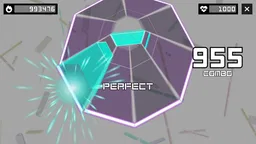
Sonolus review
 Analysis by Appsdrops
Most rhythm games hand me a fixed playlist and ask me to chase a score. Sonolus feels more like a place to play rhythm charts, with the appeal depending on how much I enjoy learning a flexible tool rather than simply tapping through a curated set of songs. That distinction is important: I’d recommend it to someone who likes experimenting and refining a routine, but not to a friend who wants a polished, pick-up-and-play music game with a familiar track list.
Sonolus is a free music game from Macau FosFenes Technology. It has a 3.8 average from around 7,100 ratings, and more than a million installs, so it has found an audience without being a universal favorite. I see the main question as whether its open-ended rhythm-game approach suits you. The rating makes sense to me as a sign of an experience with real appeal but a learning curve: players who enjoy adjusting their approach can get more out of it than people expecting instant comfort.
Building a reliable first-session routine
My first piece of advice is to treat the opening sessions as setup and familiarization, not as a test of skill. Begin with a chart that feels manageable, pay attention to how its notes line up with the music, and change only one part of your approach at a time. If you alter several settings or habits together, it becomes harder to tell what actually helped.
This is where Sonolus differs from a conventional rhythm game built around a fixed campaign. Its identity is less about following a single prescribed progression and more about finding charts and play patterns that suit you. That flexibility is a strength once you know what you want, but it can make the first session feel less guided. If you prefer a game that immediately explains its structure and gives you a clear sequence of songs, a tightly curated alternative may be easier to settle into.
I’d make a short repeatable loop: choose a chart, play it once without worrying about a perfect result, note the section that caused trouble, then replay with that passage in mind. This simple habit is more useful than restarting impulsively after every mistake. It also helps separate timing problems from reading problems: if you can anticipate the notes but still miss them, focus on your rhythm; if the pattern itself surprises you, slow down mentally and learn its shape before pushing for a better score.
For an everyday example, Sonolus can work well during a short break when I have enough time for a couple of focused attempts but not a long session. I’d pick one chart and stick with it rather than spend the whole break browsing. That turns a few minutes into a small practice goal. On a commute or in a noisy room, though, I would be less inclined to use any rhythm game that depends on closely following musical cues; the experience is more satisfying when I can concentrate on both sound and on-screen patterns.
Settings are most useful when changed with a purpose
Before settling into regular play, I’d check the available settings and identify which ones affect comfort or timing. The key is to avoid treating every option as an upgrade. A setting that helps one player may make another’s reading less natural, and frequent changes can make your results difficult to compare. Set a baseline, play a few attempts, then adjust one thing only if you can describe the problem it is meant to solve.
Keep that baseline consistent when you return to a chart. If a result changes after you have altered several preferences, it may reflect the new setup rather than genuine improvement. I find that a small note in my head—what I changed and why—is enough to keep experiments honest. This is a practical advantage of the game’s more flexible feel: you can approach it as something to tune to your habits, but that flexibility rewards patience rather than constant tinkering.
Touchscreen comfort deserves attention too. A grip that feels fine for a quick attempt can become awkward during repeated play, and an uncomfortable posture can look like a timing issue when it is really fatigue. I’d keep the phone steady, use a position that lets both hands move naturally, and take a pause when accuracy starts falling. That advice is especially relevant if you are switching from a game whose controls or note patterns feel more familiar.
Faster play comes from repeatable choices
Experienced play is not just reacting faster. It is also reducing unnecessary decisions. I’d choose a chart before starting, commit to a small practice objective, and avoid changing the setup halfway through. When replaying, focus on one difficult phrase rather than trying to fix every mistake at once. This gives each attempt a purpose and makes progress easier to judge.
Another useful pattern is to distinguish a learning run from a performance run. In a learning run, I pay attention to where the chart becomes confusing and accept that the score may not improve. In a performance run, I use the familiarity gained from that exploration and try to play cleanly from beginning to end. Mixing these two goals can be frustrating: demanding a personal best while still figuring out a pattern sets an unfair standard.
Sonolus is a better fit for this kind of self-directed practice than for someone who wants the game to choose the next task and pace every session. The trade-off is real. You gain room to shape your own routine, yet you also take responsibility for making that routine useful. If browsing and experimentation are part of the fun, that freedom is a draw. If they feel like chores between songs, a more linear music game will probably hold your attention better.
What the broader audience and costs suggest
The game is free to start, while optional in-app purchases range from $4.99 to $49.99 per item. I would approach those purchases as optional rather than necessary for deciding whether the core style suits me. Spend time learning the basic rhythm and browsing the experience first; paying before you know whether you enjoy its flexible structure is an avoidable gamble. The game is rated for Everyone, which makes its audience broad, but that label does not mean its less-guided approach will appeal equally to every age or skill level.
It is currently version 1.1.5 and requires Android 7.1 or newer. Those details matter if you are deciding whether to install it on an older device, but I would still judge the game primarily by how well its rhythm-focused play fits your preferences. Its 253 written reviews offer more detail for anyone who wants to compare other players’ impressions, while the overall rating is best read as a quick signal rather than a promise that the experience will click immediately.
Where flexibility stops being an advantage
The main limitation I’d keep in mind is that freedom can become friction. A player who wants a clear onboarding path, a dependable sequence of songs, or a strong sense of progression may find the experience less welcoming than a more traditional rhythm title. Likewise, if you prefer to play casually without repeating charts or thinking about your settings, Sonolus may ask more attention than you want to give a mobile game.
There is also a difference between having a repeatable practice plan and having a plan that suits your actual goal. If you only want a quick music break, chasing a difficult section can turn play into work. If you are trying to improve, replaying without a specific focus can waste time. I’d switch between focused practice and relaxed play deliberately, rather than expecting every session to provide both. That small boundary keeps the game enjoyable instead of making every score feel like a verdict.
Compared with rhythm games that emphasize a handpicked set of tracks and a guided route, Sonolus is more attractive to curious players who like to shape their own experience. Compared with casual tap-along games, it asks for more concentration and repetition. Neither style is inherently better; the right choice depends on whether you enjoy exploring and refining your play or would rather be served a straightforward playlist.
My verdict after settling into its rhythm
I’d recommend Sonolus to rhythm-game fans who enjoy chart-focused play, are willing to establish a consistent setup, and find satisfaction in getting better through deliberate repetition. The best way to start is modestly: choose one approachable chart, keep your settings steady, and give each replay a clear purpose. That routine reveals the game’s appeal without demanding that you master everything at once.
I would skip it if I wanted an immediately guided experience, a predictable song campaign, or a game that required little thought between attempts. Its flexibility is its strongest quality, but also the source of its learning curve. Once I stop expecting it to behave like a conventional playlist game, the appeal becomes clearer: Sonolus is for players who enjoy making their own rhythm-game habits, not just following someone else’s.
What we like
- Supports custom levels created by the community.
- Offers a range of rhythm game modes.
- Lets players adjust note speed for their preferences.
- Provides detailed timing and scoring feedback.
- Works with songs and charts shared by other players.
What could be better
- Most content depends on community-created charts.
- Chart quality and difficulty can vary widely.
- Requires precise timing that may challenge beginners.
- Some features may need an internet connection.
- Custom content can take time to browse and set up.







